
Hailey Glassman Opens Up About Her ‘Lavender Marriage’
Hailey Glassman is bringing a very nontraditional marriage arrangement to The Real Housewives of New York City. E! News reports that the season 16 newcomer spoke candidly about her relationship with a husband whose identity has not been disclosed in the available coverage.
The headline-making detail is Glassman’s use of the phrase “lavender marriage,” paired with a description of an unconventional bedroom agreement. E! also characterizes her outlook on marriage as essentially “the more the merrier,” though the report does not provide enough detail to map out the couple’s exact boundaries or arrangement.
That distinction matters. “Lavender marriage” is a loaded label, and Glassman’s use of it should not be treated as proof of anything about either spouse’s sexuality, motives or private life beyond what she reportedly chose to describe. The phrase creates intrigue; it does not fill in every blank.
The husband remains a mystery in this coverage, which leaves the story with one clear celebrity hook and several deliberate question marks. There is also no independent corroboration supplied beyond the E! News report and a related duplicate listing, so the responsible read is that this is Glassman’s reported account—not a fully documented portrait of the marriage.
Still, it is a revealing introduction for a new RHONY cast member. Rather than presenting marriage as a neat, sealed-off romantic package, Glassman appears willing to discuss the negotiated rules behind hers. That kind of candor can make a reality-TV newcomer instantly watchable, especially when the most interesting cast detail arrives before viewers even know the spouse’s name.
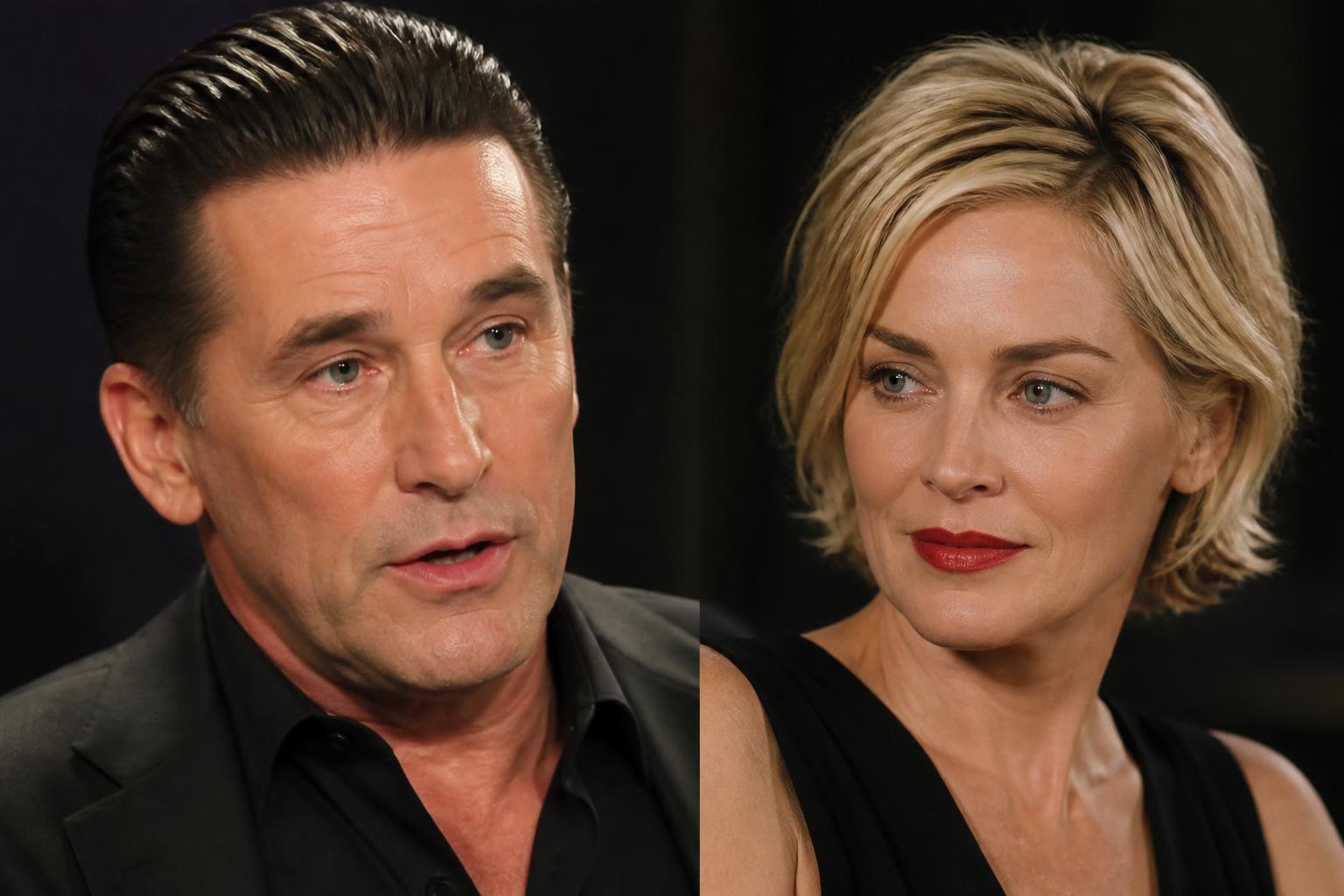
Billy Baldwin Says Sharon Stone Is Off His Set Forever
Billy Baldwin has apparently put Sharon Stone on a very short list: people he says he will “never, ever” work with again. The actor made the claim during a Tuesday episode of the Lisa Guerrero Unleashed podcast while revisiting their experience filming the 1993 erotic thriller Sliver.
According to Baldwin, the pair started out getting along before Stone stopped saying hello or goodbye to him for roughly three months. He described the resulting atmosphere as tense enough to make “everybody miserable,” though the account comes entirely from Baldwin’s retelling.
The most dramatic detail involves the movie’s last of four love scenes. Baldwin said he met with producers because he felt unable to film the sequence as written. He ultimately agreed to perform the scene, but asked not to kiss Stone, saying he was too uncomfortable to do it. The resulting encounter between his character, Zeke Hawkins, and Stone’s Carly Norris played out against a support column instead.
Baldwin also used the podcast appearance to challenge a claim Stone made in her 2021 memoir, The Beauty of Living Twice, and during its promotional interviews. The supplied report does not include the specific claim he disputed, and no response from Stone is provided here, so that portion remains a one-sided clash rather than a settled fact.
That distinction matters. Baldwin’s comments are public and specific, but they do not independently establish what happened behind the scenes or explain Stone’s side of the working relationship. What they do establish is that a more than 30-year-old co-star dispute has resurfaced with unusually definitive language—and that Baldwin appears perfectly willing to keep the “never again” door slammed.

Penélope Cruz and Javier Bardem Electrify Bunker’s Marriage Crisis
Penélope Cruz and Javier Bardem are the reason Bunker commands attention. Florian Zeller’s latest film places the real-life couple in a marriage that looks polished from the outside but begins to splinter under pressure, giving both actors room to weaponize every pause, glance and carefully withheld confession.
The setup is intimate before it becomes sinister. An architect is weighing a lucrative commission from a tech billionaire, and that professional opportunity opens into larger questions about money, conscience and what people are willing to excuse when the price is high enough. The film’s emotional center, however, remains the relationship rather than the billionaire-world provocation.
That focus connects Bunker to Zeller’s earlier work. After exploring dementia in The Father and depression in The Son, the writer-director again examines how a mental and emotional crisis rearranges family life. This time, the pressure lands on an outwardly contented marriage, where affection and alienation can occupy the same room.
The Hollywood Reporter praised the force of Cruz and Bardem’s performances while finding the film’s wealth commentary less persuasive. Variety likewise described the pair as brilliant in a tense isolation thriller, which gives the movie’s central casting a rare double-review endorsement. Stephen Graham adds a notable supporting performance, while Paul Dano and Patrick Schwarzenegger are also part of the ensemble.
Visually, the movie appears to understand that architecture can do some of the gossiping. Its central home contrasts an old-fashioned Victorian exterior with expansive modernist interiors of concrete, timber and glass, creating a polished enclosure where every level seems to offer another place for tension to hide. The controlled compositions, vivid color and spatial design were among the elements reviewers found compelling.
The catch is a late shift into violent-thriller territory. Both the praise and the reservations point to the same conclusion: Bunker is strongest when it stays close to two people who love each other and weakest when it forces its social critique into a more schematic genre engine. Still, Cruz and Bardem make that marital fault line difficult to ignore.