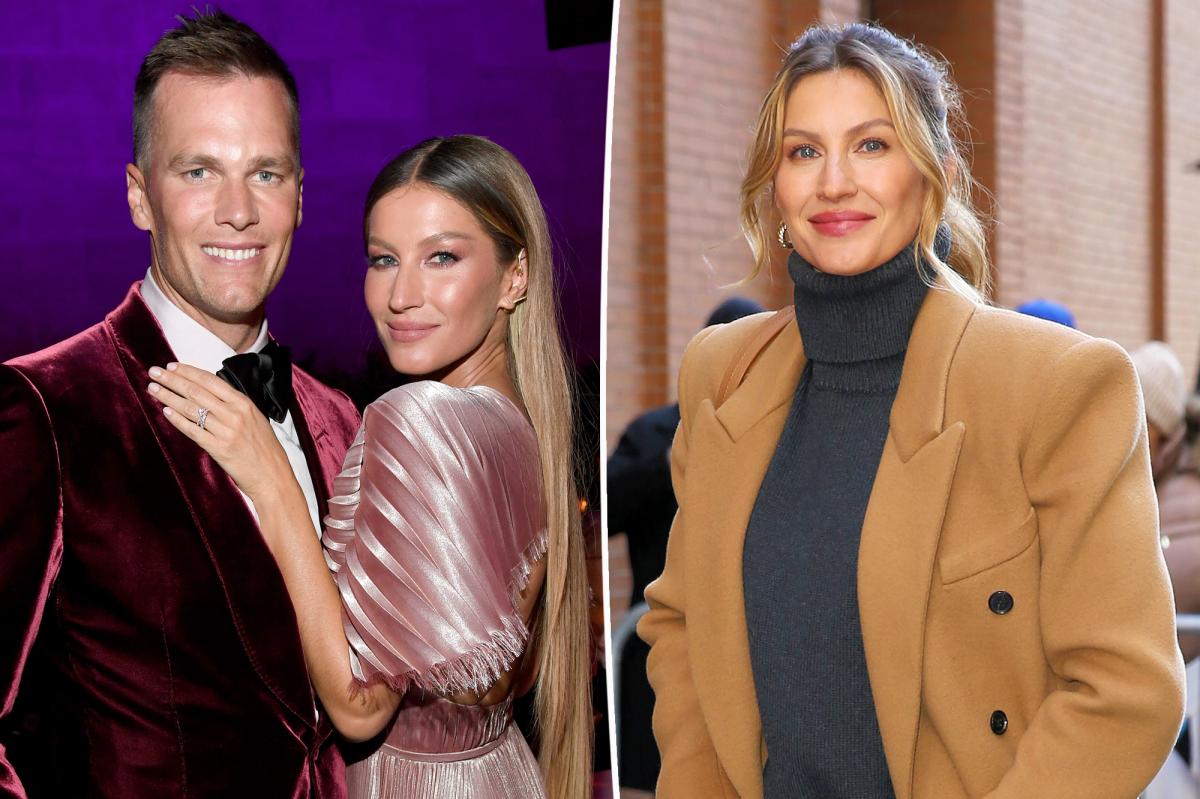
Gisele Bündchen Has Entered Her “The Universe Had Another Plan” Era
Four years after her split from Tom Brady, the supermodel is said to be looking back without bitterness — and with a very different life already in motion.
Gisele Bündchen is not looking back at her marriage to Tom Brady with a grudge. She is looking back with the spiritual equivalent of a beautifully lit candle, a deep breath and the phrase “the universe had another plan.”
Four years after the couple’s divorce, a source told People that Bündchen is “not bitter” about the end of the relationship and feels “grateful” for the years they spent together. That is a notably serene update for a split that once seemed to contain every ingredient in the celebrity-marriage stress test: football, fame, children, conflicting schedules, retirement drama and two extremely famous people trying to fit their lives around each other.
“She always thought she would be married to Tom for the rest of her life,” the source said, adding that the divorce was “very upsetting” and that Bündchen struggled to understand it at the time. But the current mood, at least according to the insider, is less “why did this happen?” and more “perhaps the plot was always headed somewhere else.”
The marriage that became a lifestyle brand
Bündchen and Brady dated for two years before marrying, then built the kind of celebrity family image that could have been designed by a luxury campaign creative director: the world’s most recognizable quarterback, the world’s most recognizable supermodel and a growing family moving between football seasons, fashion obligations and glossy vacation photos.
Bündchen also became stepmother to Brady’s son Jack, whom he welcomed with Bridget Moynahan in 2007. She and Brady later had two children together, son Benjamin and daughter Vivian. In public, the family story was one of blended-family warmth and high-performance domesticity. In private, according to accounts that have emerged since the split, the machinery of that life was considerably less smooth.
The couple announced their divorce in October 2022 after 13 years of marriage, saying their focus was their children. Around the announcement, Bündchen described the relationship as one in which they had simply “grown apart.” It was a clean phrase for a messy-feeling moment — the sort of language celebrities use when the real story is too layered to fit inside a joint statement.
The timing also kept the internet busy. Brady had announced his retirement from the NFL, then reversed course roughly a month later. The quarterback returned to football; the marriage did not. That sequence turned an already emotional breakup into a full-scale pop-culture narrative about priorities, sacrifice and whether anyone can really retire when millions of people still want to watch them throw a football.
Then came the handwritten-note lore
A new book, Brady: An American Story and the Price of Greatness by Lars Anderson, adds another layer to the split. According to claims described in the Page Six report, Bündchen made repeated attempts to save the marriage, including writing Brady a serious handwritten note about what she needed from him.
The book also claims that Bündchen eventually told Brady, “We’re not compatible.” A former teammate alleged that she was tired of living on Brady’s schedule and feeling somewhat in his shadow during football season. Another source questioned the balance between their careers, asking how often Brady supported Bündchen’s professional life in the same way she supported his.
It is a familiar celebrity-couple tension, except magnified to stadium size. Brady’s work came with a fixed public calendar, weekly performance and a culture that treats football as both occupation and identity. Bündchen’s career was equally enormous, but its demands were often folded into the assumption that she could make room for everyone else’s. The issue was not simply who had the bigger career. It was whose career became the household’s organizing principle.
That is why “we grew apart” has remained such a durable line. It sounds gentle, but it can contain years of renegotiating the same question: Whose schedule wins? Who gets to change their mind? Who is asked to wait? And what happens when the person who has been accommodating the most decides they are done accommodating?
Gisele’s post-Brady life is not exactly a quiet epilogue
Bündchen’s calm retrospective arrives after a major rewrite of her personal life. The model has since married jujitsu instructor Joaquim Valente, and the couple are parents to a 1-year-old son whose name has not been publicly revealed, according to the report.
That means the post-Brady chapter is no longer just about healing from a famous divorce or rediscovering independence. It is a new marriage, a new baby and a new family rhythm — one that exists outside the old NFL-centered orbit. The language of gratitude lands differently when the person saying it is not merely moving on, but visibly building another entire life.
Bündchen has also remained linked to the public imagination as the woman who once stood beside Brady through the most demanding years of his career. Brady, meanwhile, has been linked to model Irina Shayk and internet personality Alix Earle since the divorce. The former couple’s romantic lives have continued to generate headlines, but the newer details make the split feel less like an unfinished celebrity mystery and more like a marriage that reached its final season.
There is still a faintly cinematic quality to the whole timeline: the supermodel who thought she would stay married forever, the football icon who could not quite stay retired, the handwritten note, the phrase “not compatible,” the divorce announcement and, now, the spiritual reframe. The story has moved from public unraveling to private meaning-making.
And Bündchen’s reported attitude is the part people will text about because it is both gracious and a little devastating. “Not bitter” does not mean the ending was painless. “Grateful” does not mean the marriage worked forever. It means the past can be honored without being reopened — a polished, emotionally evolved way of saying the relationship mattered, the children matter more, and the next chapter is already very much underway.

Drew Campbell Got Evicted One Move Before a Win — and ‘Big Brother’ Is Suddenly Feeling Personal
The third-place finalist says the jury told him he likely would have beaten Taylor Brown, while Rick Devens took the $750,000 after cutting his self-described ‘Big Brother dad.’
There is no crueler sentence in reality television than “you would have won.” It arrives after the cameras stop rolling, after the confetti falls, after somebody else has collected the giant check — and it turns an almost-win into a personalized haunting.
That is the emotional aftershock Drew Campbell is carrying out of Big Brother 28. The 22-year-old surgical dental assistant finished in third place, only to learn at the live finale that the jury believed he might have beaten Taylor Brown in the final two. Campbell told Page Six that the six jurors he spoke with indicated things “might have gone well for me” against Brown.
“Which is kind of heartbreaking that I was that close,” he said.
Heartbreaking is doing a lot of work there. In the Big Brother economy, being close is not a consolation prize. It is a private screening of the ending you were supposed to have.
The finale’s nastiest little hypothetical
Campbell’s path to the finale had looked unusually promising. Both Brown and Rick Devens apparently intended to take him to the final two. Then Devens won the last Head of Household competition, made a deal with Brown and pulled the game’s sharpest trapdoor: Campbell was evicted in third place, while Brown went on to face Devens.
Devens, a 42-year-old Survivor alum, ultimately won the season with six of the seven jury votes. Campbell cast one of those votes for him.
That is what makes the post-finale conversation so deliciously painful. Campbell was not blindsided by the winner’s identity. He was not nursing a bitter jury vote or rewriting the season around personal revenge. He thought Devens played the best game — even after Devens cut him at the exact moment when loyalty would have been most valuable.
Campbell’s regret is aimed less at Devens than at himself. “That’s kind of where my strategy went wrong. I should have just won it,” he admitted. “Then maybe I would have won the whole thing.”
It is the purest possible Big Brother lesson: alliances are adorable, promises are decorative and the final Head of Household is the only friend who matters.
‘My Big Brother dad just cut me’
Campbell did not pretend the eviction was painless. Devens’ decision “definitely hurt in the moment,” particularly because Campbell had formed a close bond with him in the house. He described Devens as his “‘Big Brother’ dad,” which makes the late-game betrayal sound less like a strategic maneuver and more like getting dumped by someone who still expects to be invited to Thanksgiving.
Still, Campbell’s account of the aftermath is strikingly warm. After Devens won the $750,000 grand prize, the two men hugged amid the confetti. According to Campbell, Devens said he was sorry and that he loved him. Campbell said he loved Devens, too.
“No hard feelings, honestly,” he told Page Six.
That does not erase the knife twist. It just gives the knife a family nickname.
Campbell also said he has not had a chance to speak with Devens since the finale beyond that brief post-win exchange. He is, however, looking forward to reconnecting with Devens’ family — Miss Becca, Jack and Juju — and said he feels like he is part of the family now. The sentiment is sweet, slightly surreal and very on-brand for a show where strangers spend three months forming intense bonds before publicly ruining one another’s weekends.
The loyalty vote that says everything
Campbell was clear that Brown was never getting his jury vote over Devens. Even if he had been the person to cut Devens, Campbell said he still believed Devens deserved to win.
“Devens played the best game,” he explained. “If I cut him, I still think he was the best player and he should have won the game. So he was getting my vote no matter what.”
Then came the line that neatly separates strategy from affection: “And it’s not even because I love him, it’s just because he played a really good game. I can’t even be mad.”
That is an almost aggressively mature attitude for a man who had just been informed he may have beaten the runner-up sitting beside the winner. Campbell is not claiming the jury owed him anything. He is not suggesting Brown was undeserving. He is simply confronting the special agony of discovering that the version of the finale he feared was not the version that would have hurt most.
Had Devens taken Campbell to the end, Campbell says the jury feedback suggested he might have beaten Brown. Instead, Brown became the runner-up and Devens left with the money, the title and the kind of résumé that makes future reality-TV casting departments start circling.
He got the full experience — just not the ending
Campbell’s consolation is that he played for 87 days and made it all the way to the finale. “I got to be there the whole time,” he said. “I got the full experience. Mentally, I’m just glad to be a part of it.”
That is a lovely thought, but Big Brother is not designed to let anyone leave with only lovely thoughts. The show turns emotional intimacy into strategy, strategy into betrayal and betrayal into a reunion segment. Campbell now has to live with two endings: the one that happened, where Devens beat Brown, and the one the jury accidentally handed him, where he may have beaten Brown himself.
The most brutal part is that none of this requires a villain. Devens made the move he needed to make. Campbell failed to win the competition he needed to win. Brown accepted the path to the finale. The jury rewarded the player it thought played best. Everyone can be right, and Campbell can still be heartbroken.
That is the reality-TV magic trick: the game ends, but the alternate universe keeps airing in your head.

Khloé Kardashian Says She’d Never Join ‘Real Housewives’—But She Has One Extremely On-Brand Reality Show in Mind
The Kardashians star can handle family chaos, cameras and a little jail-adjacent selfie drama. Competitive Housewives energy? Apparently not her love language.
Khloé Kardashian has spent nearly two decades being filmed through family arguments, romantic disasters, wardrobe emergencies, questionable pranks and at least one unforgettable diamond-earring meltdown. She has survived the Kardashian reality-TV ecosystem since 2007, which is basically a graduate degree in televised chaos.
And yet, when it comes to joining The Real Housewives of Beverly Hills, Khloé is drawing a line so firm it might as well be a Calabasas property boundary.
During the Sept. 30 episode of her Khloé in Wonder Land podcast, she told Paige DeSorbo that she could not imagine signing on for Real Housewives—or, for that matter, another reality show outside the family machine. “I love them, but I have really only worked with my family and I can’t imagine,” Khloé said. “I feel like it’s competitive to get screentime and I’ve never lived like that because it’s family.”
There it is: the rare Kardashian admission that the camera is not always the easiest person in the room.
Khloé does not want to fight for the microphone
Khloé’s objection is not that she dislikes reality television. Quite the opposite. She has been doing it since she was a young adult, alongside Kourtney, Kim, Kendall, Kylie and Kris Jenner, and she clearly understands the particular comfort of making television with people who already know your worst habits.
Her issue is the social architecture of Housewives. In Khloé’s telling, the format requires a different kind of performance: competing for attention, forming an opinion on demand and, perhaps most importantly, talking about other people in ways that keep the episode moving.
“It’s cutthroat and you have to talk s–t about people,” she said, adding that she is “probably not” up for the job. DeSorbo agreed that a Housewife needs an opinion, and Khloé’s response was refreshingly unmanufactured: “And sometimes I don’t want to.”
That may be the most anti-Real Housewives sentence ever uttered by a woman who has spent years in a family where one raised eyebrow can become a full-season storyline.
The distinction is subtle but important. Khloé is not saying she has no opinions. The Kardashians have never been short on opinions. She is saying she does not necessarily want to turn every opinion into a job requirement, especially when the job comes with an implied obligation to sharpen it into conflict.
The Kardashian family has its own genre of mess
The reason Khloé can reject Housewives while remaining one of reality TV’s most recognizable veterans is that the Kardashian formula has always run on a different fuel. The family’s drama is intimate, recurring and deeply familiar. The fights can be huge, but they happen inside a system that already knows the cast’s history, alliances and emotional pressure points.
That family history is packed with scenes that still function as reality-TV shorthand: Kim taking selfies as Khloé headed to jail while Kris Jenner begged her to stop; Kim and Khloé’s handbag-related clash; Kourtney waxing Khloé before a date with then-husband Lamar Odom; Kris getting tipsy in Napa and greeting French Montana with a memorable insult; and the legendary “Todd Kraines” prank call from Scott Disick.
There was also Kim’s lost diamond earring, the moment Kourtney answered a full-body crisis with the immortal reminder that “there’s people that are dying.” The scene worked because it was not a random castmate manufacturing a feud for screen time. It was a family argument with years of context, sibling muscle memory and a built-in audience that already understood everyone’s role.
Khloé’s point is that she has never had to enter that kind of arena cold. Her co-stars were not strangers she needed to outmaneuver at a dinner party. They were her sisters, her mother and, over time, the partners and children orbiting the family story. Even when the fights became wildly watchable, the relationships existed before the cameras and continued after the episode ended.
That is a very different proposition from walking into a cast where everyone is, in some way, responsible for making sure their own storyline lands.
Her dream show is aggressively wholesome
So what kind of reality television would tempt Khloé away from the family business? Not a yacht, not a reunion couch and definitely not a dinner where someone has been accused of betrayal before the appetizers arrive.
She would love The Great British Bake Off. More specifically, she said she would be interested in hosting a children’s competition show, citing kids’ baking programs and American Ninja Warrior as the kind of television she enjoys. “I feel like I could do that,” she said.
The pivot is so perfectly Khloé that it almost feels like a pre-existing television pitch: Keeping Up With the Cupcakes, perhaps, with Kris Jenner in the judging room and at least one Kardashian wandering in to critique the frosting. Instead of competing for confessionals, Khloé could compete for the best pep talk. Instead of asking who started the rumor, she could ask who needs more sprinkles.
It also tracks with the version of Khloé that has often been most comfortable on television: the warm, teasing, high-energy family member who can make a scene funny without necessarily wanting to turn every interaction into a blood sport. A kids’ competition show would still give her a format, a camera and plenty of opportunities for dramatic reveals. It would simply swap the social maneuvering for sugar, obstacle courses and tiny contestants with better emotional regulation than most adults at a reunion.
The family can handle the Housewives universe without her
Khloé’s refusal leaves the Kardashian-Jenner family with no shortage of people who could theoretically bring a different flavor to Beverly Hills. Kris has the history, Kim has the scale, Kourtney has the deadpan, and the younger sisters grew up inside a level of fame that makes the phrase “personal brand” sound quaint.
But Khloé’s comments suggest that the appeal of the family’s own show is not simply access to famous people. It is the fact that the Kardashians do not need to audition for one another. The family can be funny, cruel, sentimental, absurd and occasionally all four in the same scene because the relationships are already there.
Kendall Jenner has previously described feeling out of place in her family and uncomfortable with the public life she inherited, even while acknowledging how lucky she is. That tension hangs over the Kardashian reality project: appearing on television may be part of the family’s shared history, but it does not mean every member experiences the performance in the same way.
For Khloé, the answer appears to be simple. She will keep doing reality television with her family, where the chaos comes preloaded and the arguments do not require an audition tape. But if a child needs help decorating a cake or conquering an obstacle course, she is apparently ready to report for duty.
Housewives can keep their taglines. Khloé wants the frosting bag.