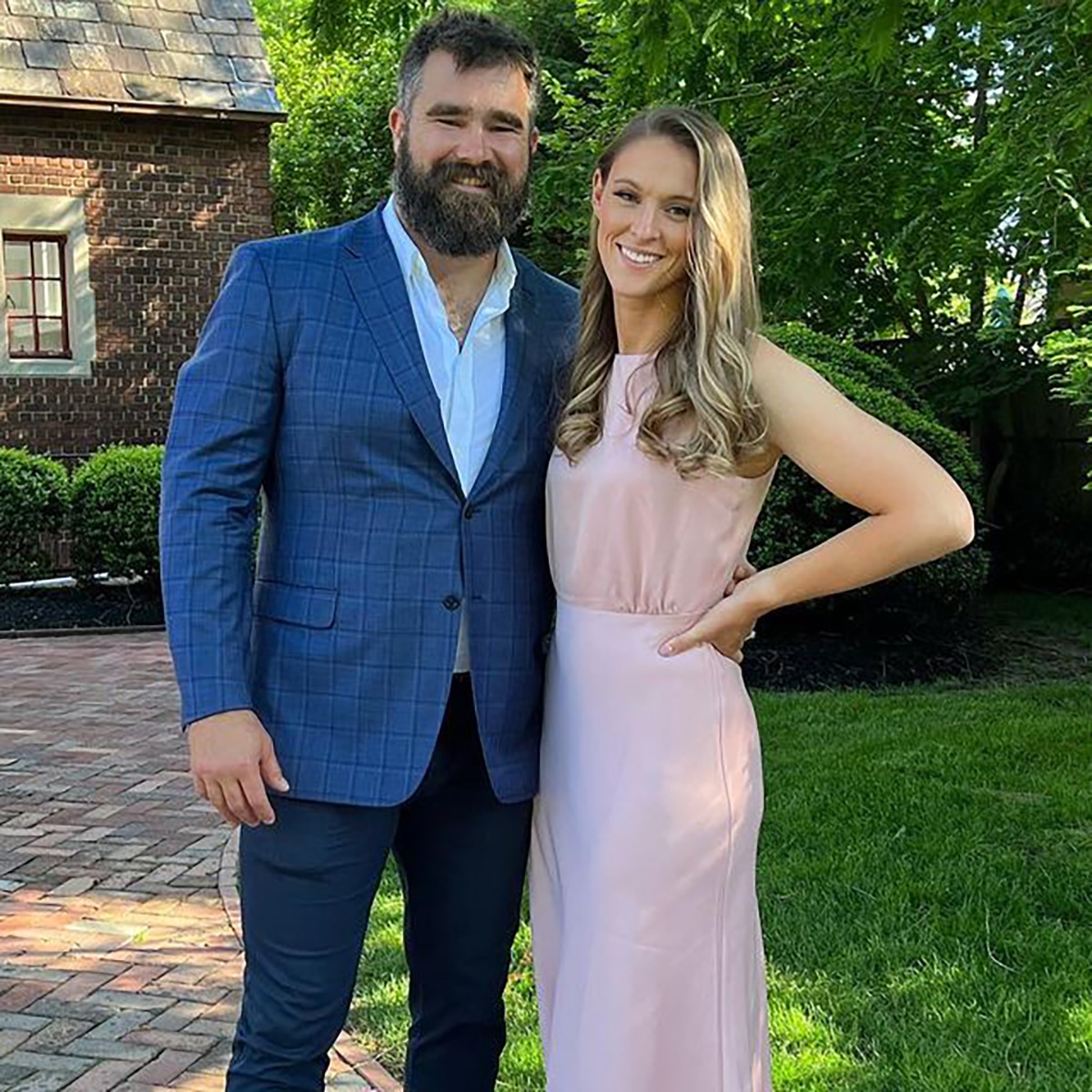
Kylie Kelce Has Chosen Violence in the Kelce Family Football War
Travis Kelce says his Eagles-loving sister-in-law would happily tell him “f--k you” over the Chiefs. Honestly, that may be the healthiest marriage-adjacent rivalry in America.
There are families who gather around the television on game day with matching snacks, polite opinions and the shared understanding that nobody is allowed to get too intense.
Then there is the Kelce family, where Philadelphia Eagles loyalty apparently outranks bloodline, sibling diplomacy and possibly the basic concept of keeping the peace at Thanksgiving.
On a recent episode of New Heights, Travis Kelce was discussing the Kansas City Chiefs’ upcoming matchup with the New York Jets alongside his brother Jason Kelce and the podcast’s longtime Jets-supporting producer, Jake Chatzky. The conversation eventually wandered toward the much more important question: how much allegiance does a person owe their family when football is involved?
Travis had an answer. His sister-in-law Kylie Kelce, he said, would tell him directly to “f–k you.” Not in a dramatic family-feud way. In a Philadelphia sports way: warmly, energetically and with the confidence of someone who has already chosen her side.
“I hope the Birds win,” Travis quoted her as saying.
Kylie Kelce Is Not Switching Teams for Anyone
Kylie, who is from Philadelphia and shares four daughters with Jason, has never treated her Eagles fandom as a casual accessory. She was “raised to bleed green,” as she put it on her podcast, and that is the sort of phrase that turns a sports preference into a personality trait.
Her position is wonderfully inconvenient: she can love Travis, support his career and still want his team to lose. Those feelings are not mutually exclusive. In fact, Kylie has already explained the rules of engagement. She will cheer for Travis’ accomplishments because he is family, while also rooting for the Eagles because Philadelphia is home and the organization remains part of her community.
That is the kind of carefully worded diplomacy usually reserved for royal families, international summits and group chats containing divorced friends. Kylie’s version is simpler: congratulations to Travis, go Birds.
Her balancing act became especially visible during the 2025 Super Bowl, when the Chiefs faced the Eagles. Kylie said she was “truly, as always, cheering Travis on,” while also acknowledging her close ties to people in the Eagles organization and the Philadelphia community. The Eagles ultimately won 40-22, giving Philadelphia the kind of victory that makes every previous “I love him, but…” disclaimer feel extremely satisfying in retrospect.
Travis Kelce Wants Loyalty — Except When It’s Funny
The best part of the latest New Heights exchange is that Travis does not appear offended by Kylie’s stance. He seems delighted by it. The Chiefs tight end has long understood that a family sports rivalry is most entertaining when nobody is pretending it is actually a crisis.
Jason, meanwhile, has the uniquely awkward position of being married to one of the Eagles’ most committed civilian ambassadors and related to one of the Chiefs’ biggest stars. He is not merely watching the game. He is living inside the NFL’s most marketable custody arrangement.
And then there is Jake Chatzky, who has been nicknamed “Jets Jake” by New Heights fans. When Jason pressed him to declare whether he would support the Jets or Travis ahead of the matchup, Chatzky tried to escape the question entirely.
“Don’t do this to me, Jason,” he pleaded.
Eventually, he promised to root for Travis. Travis immediately called him a “f–king phony” and told him not to lie to his face. It was an impressive amount of emotional intensity for a producer being asked to choose between his favorite team and the man whose name is on the podcast.
Kylie, at least, has no such problem. Her answer is apparently not a compromise. It is a boundary, a family tradition and a small act of Philly patriotism delivered straight to Travis’ face.
The Kelce Family’s Sports Politics Are Better Than Most Reality TV
The reason this keeps landing as celebrity news is that the Kelces have turned ordinary sports allegiance into an ongoing ensemble comedy. Jason is the former Eagles center with deep Philadelphia roots. Travis is the Chiefs star whose fame has expanded far beyond football. Kylie is the blunt, highly recognizable voice of the Eagles side, and the extended circle includes enough famous fans to make every matchup feel like a celebrity seating chart.
Philadelphia has Bradley Cooper, Kevin Hart, Will Smith, Quinta Brunson and Questlove in its corner, among others. Kansas City has Paul Rudd, Brad Pitt, Jason Sudeikis and Henry Cavill cheering for the Chiefs. This is not just a game; it is a regional personality test with a red carpet.
Even the celebrity loyalties come with their own lore. Kevin Hart’s Eagles devotion is famously theatrical. Paul Rudd’s Chiefs fandom is so established that a Chiefs game can feel like an unofficial Ant-Man premiere. Jason Sudeikis has his Kansas City connection through Ted Lasso, while Bradley Cooper has folded Eagles history into both his public identity and his film work.
But the Kelces have the advantage nobody else can manufacture: their rivalry is happening at family volume. Kylie does not need a campaign slogan or a courtside camera. She can simply look at Travis and tell him exactly what she thinks, which may be the most authentic sports commentary available in the celebrity ecosystem.
Love Is Temporary. The Eagles Are Forever.
There is something almost elegant about Kylie’s arrangement. She does not have to abandon the people she loves in order to maintain the team loyalty she was raised with. She can celebrate Travis, support Jason and still treat the Eagles as a permanent condition.
That is also why her threat to tell Travis “f–k you” reads less like a family scandal and more like a love language with excellent regional branding. The Kelces have made public affection messy, loud and competitive. Nobody is pretending that fandom disappears when romance, marriage or in-laws enter the picture. If anything, the stakes get funnier.
So when the next Chiefs-Eagles matchup arrives, expect the familiar split-screen: Travis in red, Kylie in green, Jason somewhere in the middle and the entire internet waiting to see who gets to talk the most trash afterward.
As for Kylie, her position is already clear. She can love the Kelces. She can cheer for Travis. She can show up for the family. But if the Eagles are playing, Philadelphia gets the last word—and probably a very direct one.
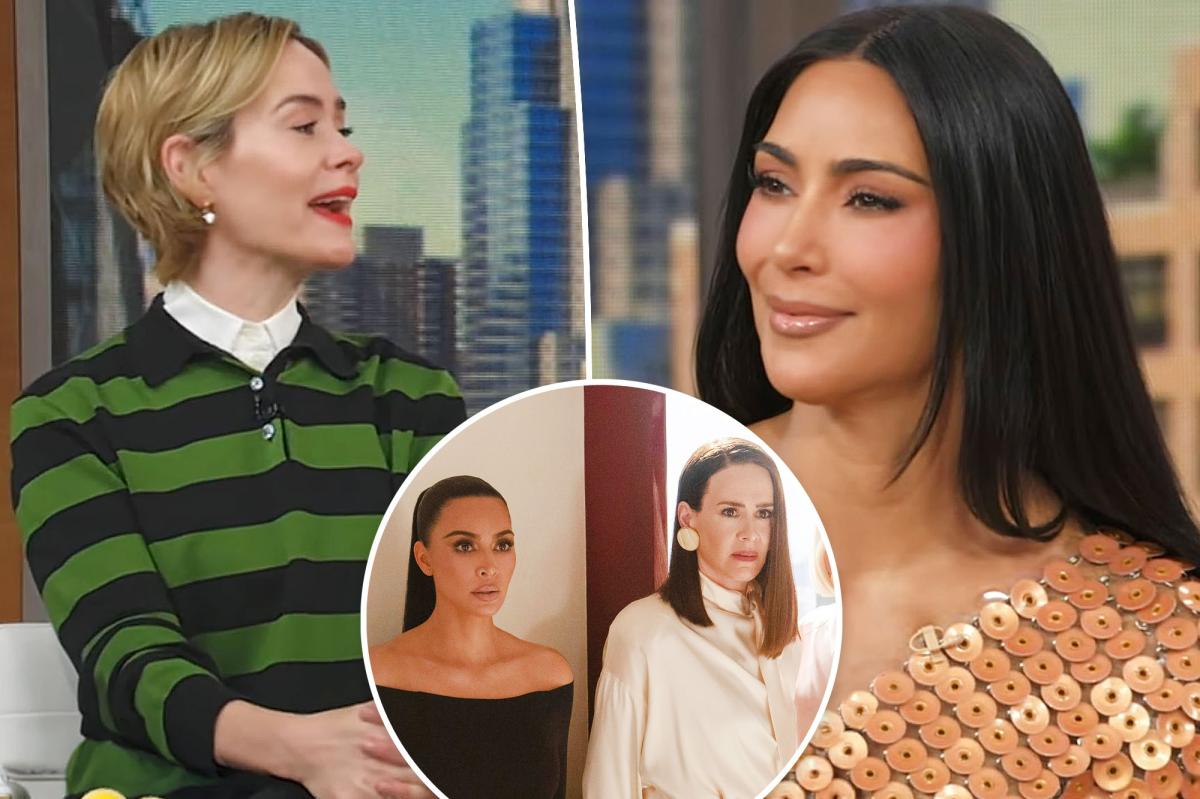
Kim Kardashian Thought Sarah Paulson’s Deep Legal-Drama Voice Was Real for an Entire Year
The “All’s Fair” co-stars have been working together long enough to be friends — and somehow Kim only recently discovered that Carrington Lane’s baritone is strictly for the job.
Kim Kardashian has spent years cultivating an image of total control: immaculate outfits, strategic silence, a business empire with color-coded corners, and the kind of confidence that suggests she could walk into any room already knowing where the best lighting is.
But on Wednesday’s “Good Morning America,” the “All’s Fair” star admitted to a spectacularly relatable failure of attention: she believed Sarah Paulson’s extremely deep legal-drama voice was Sarah Paulson’s actual voice.
Not for one scene. Not for one press day. For an embarrassingly long time.
Paulson, 51, plays Carrington Lane on the Hulu series, and the character apparently speaks in a register so low that Kardashian, 46, assumed the actress simply sounded that way in everyday life. The two women have been working together for more than a year, according to the interview, which makes the misunderstanding both more shocking and much funnier.
The voice Kim thought belonged to Sarah
“Kim thought I had a voice that was seven octaves lower than I actually have for longer than she should have thought that,” Paulson explained during the cast’s appearance.
It is a devastatingly specific accusation. Not “Kim was surprised.” Not “Kim got confused.” She thought Paulson’s natural voice was seven octaves lower than it is — a commitment to the bit that apparently survived months of filming, conversations and friendship.
Kardashian said she finally realized the truth while the cast was in Rome a few weeks ago for the show’s press tour. The moment came when Paulson spoke in her normal voice and Kardashian stopped long enough to ask the question that should, perhaps, have been asked considerably earlier.
“Wait a minute, that’s not your real voice?” Kardashian recalled saying.
Paulson’s response was immediate and emphatic: “NO! NO!”
Somewhere, Carrington Lane is still delivering a courtroom monologue in a voice that could plausibly make an entire boardroom reconsider its life choices. Meanwhile, Sarah Paulson is apparently just walking around sounding like Sarah Paulson, waiting for her friend to catch up.
“All’s Fair” has found its blooper-reel energy
The voice mix-up was not the only sign that the “All’s Fair” cast may be having more fun together than the show’s first season had with critics. Kardashian and Paulson also described themselves as the pair most likely to lose it during a scene.
Niecy Nash-Betts, who plays Emerald Greene, identified the two friends when the cast was asked who struggles to keep a straight face on set. “Those two fall apart,” she said.
That diagnosis apparently became serious enough that production once made Kardashian and Paulson get up and walk around the building to regain their composure. Kardashian remembered the incident as a moment when the two simply could not stop laughing, which is either charming behind-the-scenes chemistry or a logistical nightmare for whoever is trying to finish a legal drama on schedule.
Either way, it gives the series a much-needed off-camera subplot: Kim and Sarah versus the concept of behaving professionally.
Their friendship is especially amusing because the show itself is built around high-gloss legal warfare. Kardashian plays divorce lawyer Allura Grant, while the ensemble includes Paulson, Nash-Betts, Naomi Watts and Glenn Close. On screen, the atmosphere is presumably sharp suits, sharper dialogue and people making extremely expensive mistakes. Off screen, two of the cast members are being sent outside to calm down.
Kim’s other great set obsession: the food
Then came the revelation that may be even more Kardashian than the voice confusion: she is deeply invested in the production’s food.
Asked about the cast’s on-set habits, Kardashian volunteered that she eats the prop food. All of it. Constantly. After scenes are cut, she said, she may still be walking by asking whether she can take a plate of pie with her.
“I love to eat [the set food] the whole time,” she said.
“Do not let that tiny body fool you. She eats everything,” Nash-Betts added.
It is a perfect little celebrity interview detail because it punctures the polished fantasy without trying too hard to do so. Kim Kardashian, global beauty mogul and reality-TV veteran, is not above hovering around the craft-services table for a piece of prop pie. The image is less “untouchable icon” and more “woman who has noticed there is still dessert in the room,” which is exactly why it works.
It also gives “All’s Fair” an unusually persuasive behind-the-scenes food critic: Kardashian has apparently sampled the fake courtroom-world cuisine extensively and would like to take leftovers home.
A new season, a familiar Kardashian storyline
The timing of the interview is deliberate. Season 2 of “All’s Fair” premiered on Hulu Wednesday with its first three episodes, with new episodes scheduled weekly through Dec. 2. The series arrived with plenty of attention because of its all-star cast — and because its first season became a critical punching bag almost immediately after premiering in November 2025.
The Guardian called the show “Fascinatingly, incomprehensibly, existentially terrible,” a review so intense it practically deserves its own billing. Kardashian, however, has continued to show up for the project with the same determination she has brought to her legal ambitions.
That parallel is part of the larger Kardashian story. She plays a lawyer on television while pursuing a legal career in real life, though she did not pass the bar exam in her July 2025 attempt. At the New York premiere, she told Page Six that she does not really get embarrassed, arguing that the truly embarrassing thing would be criticizing someone who did not even try to study.
On “GMA,” though, she offered a different kind of embarrassment: the harmless, human kind where your famous friend has been performing a completely different voice in front of you for more than a year and you somehow never questioned it.
There is no grand scandal here, no suspicious timing and no celebrity feud hiding beneath the pie plate. Just Kim Kardashian discovering that Sarah Paulson’s Carrington Lane voice is a character choice, Sarah reacting as though this is the most obvious fact in the world, and an ensemble cast apparently one giggle away from being escorted around the block.
For a show that has already inspired some remarkably severe reviews, that may be the most promising thing about Season 2: at least its stars seem to be enjoying themselves. And if the legal arguments collapse, there is always prop dessert.
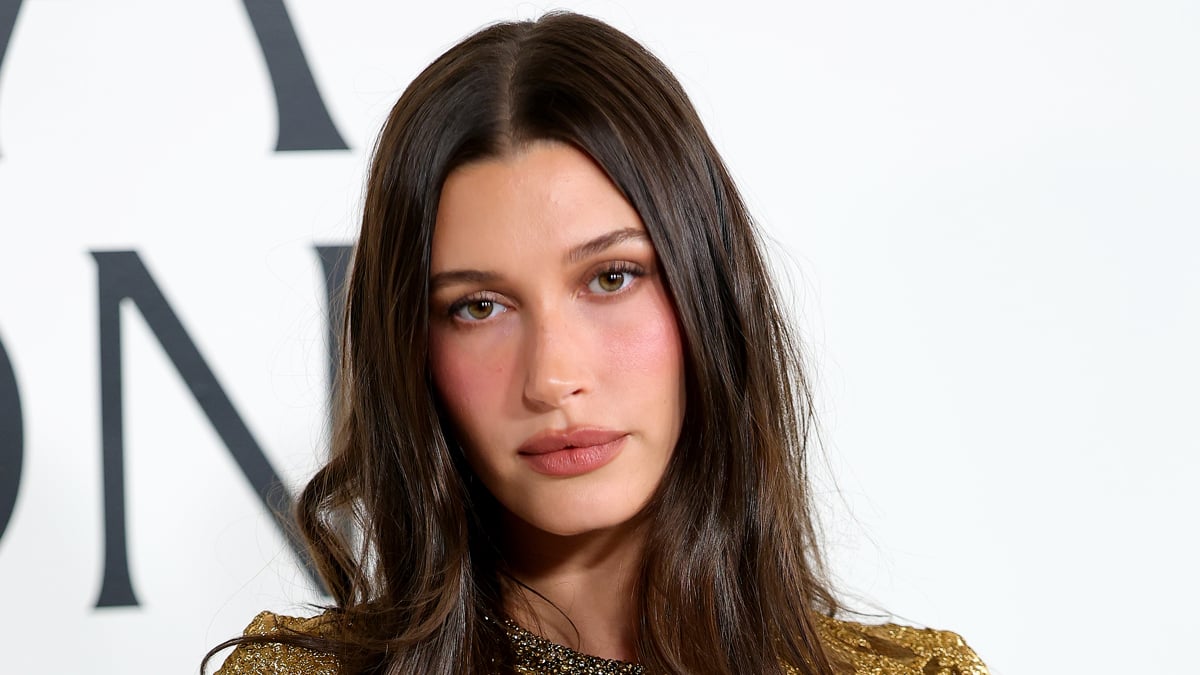
Hailey Bieber Put a Name to the Postpartum Struggle She Says Left Her Feeling Alone
In a candid WWD interview, the Rhode founder opened up about PMDD after welcoming her son with Justin Bieber — and why talking about it became part of her recovery.
Hailey Bieber is putting a name to the part of early motherhood that does not fit neatly into a soft-focus family photo. In a new interview with Women’s Wear Daily, the model and Rhode founder revealed that after giving birth to her son with Justin Bieber, Jack Blues, she struggled with premenstrual dysphoric disorder, or PMDD.
“After I had my son, I struggled with [PMDD] a bit, and there’s just not a lot of conversation or research around it,” Hailey said. That sentence lands because it is both remarkably specific and frustratingly familiar: a woman describing something serious while also explaining why she had trouble finding language for it in the first place.
PMDD is not simply a more dramatic version of having a bad week before your period. The Cleveland Clinic describes it as a severe form of premenstrual syndrome that can bring emotional and physical symptoms in the week or two before menstruation. Those can include irritability, anxiety, panic attacks, depression, exhaustion, insomnia, appetite changes, headaches and intense mood swings. The symptoms recur with the menstrual cycle, which can make the experience feel cyclical, confusing and difficult to separate from the enormous emotional and physical changes of new parenthood.
The postpartum conversation gets more complicated
Hailey did not frame her experience as a neat celebrity wellness lesson, and that is part of what makes the disclosure notable. She described the period after having her child as “a really intense and special journey,” while also pointing to everything that happens around pregnancy, childbirth and the transition into life with a baby.
That combination matters. Public conversations about postpartum health often get sorted into tidy categories: physical recovery, sleep deprivation, postpartum depression, the glowing joy of motherhood. PMDD does not sit comfortably in any one of those boxes. It is tied to the menstrual cycle, but it can arrive in the already emotionally loaded landscape that follows childbirth. For someone accustomed to having her appearance, marriage and lifestyle discussed in public, saying, essentially, this was happening inside my body and I did not have enough language for it is a different kind of reveal.
Hailey has spoken publicly before about health scares, including a mini-stroke in 2022. This latest disclosure is quieter and more intimate, but it follows the same instinct: taking an experience that could remain private and making it legible to other people. There is no dramatic social-media rollout attached to this one, no cryptic caption or suspiciously timed carousel. Just an interview answer that turns an invisible struggle into a subject people can actually discuss.
“Conversation… makes me feel less alone”
For Hailey, talking appears to be the point. “Conversation, for me personally, makes me feel less alone,” she said. “When we can identify with each other and have conversations relating to each other and talking about the things we’re dealing with and struggling with, I do think it makes it feel like less of a lonely journey.”
That is a particularly revealing line from someone whose public image is built around polish. Hailey’s world is usually presented through immaculate beauty imagery, fashion-week appearances, Rhode launches and the hyper-visible ecosystem of being married to Justin Bieber. But the most resonant part of this story is not the billionaire-adjacent backdrop. It is the very ordinary feeling underneath it: not knowing whether anyone else understands what is happening to you.
Celebrity disclosures can sometimes arrive packaged as brand extensions, complete with a product waiting at the end. This one does not, at least in the account of the interview. Hailey is not presenting PMDD as an aesthetic or turning a difficult period into a punchline. She is pointing to the lack of conversation and research, then explaining that conversation itself helped her feel less isolated.
A name can change the shape of the story
There is power in the distinction between “I felt terrible after having a baby” and “I was dealing with PMDD.” The first is broad enough to swallow almost anything: hormonal shifts, exhaustion, anxiety, pain, sadness, rage, or a body that no longer feels predictable. The second gives someone a term to bring to a doctor, a partner, a friend or a support group.
That does not make the condition simple, and Hailey’s comments are not a substitute for medical care. The Cleveland Clinic notes that treatment can help many people manage PMDD, and that speaking with a mental-health professional or joining a support group may also provide support. The point is less that a celebrity has solved the problem than that she has made the problem harder to dismiss.
It is also worth noticing what Hailey did not do. She did not offer a glossy “bounce back” narrative. She did not suggest that motherhood became effortless once she found the right routine. She acknowledged that pregnancy, childbirth and the aftermath can involve a lot of physical and emotional upheaval, even when the experience is also deeply meaningful.
For a culture that loves a celebrity transformation but gets awkward around the messy middle, that honesty is the actual headline. Hailey Bieber is still Hailey Bieber: famous, scrutinized and surrounded by an unusually polished public life. But in this conversation, she offered something far less polished and far more useful — a name for a struggle, and a reminder that saying it out loud can be the first way people stop feeling like they are experiencing it alone.