Wanda Maximoff Is Back—and Doctor Doom Wants Her Power
The VisionQuest finale kept Elizabeth Olsen offscreen until its second post-credit scene, then dropped her directly into the path of Avengers: Doomsday.
Spoilers for the VisionQuest finale ahead.
Marvel has spent years treating Wanda Maximoff like the most dangerous woman in the room and the most emotionally exhausted person in the multiverse. Now, apparently, she is both again.
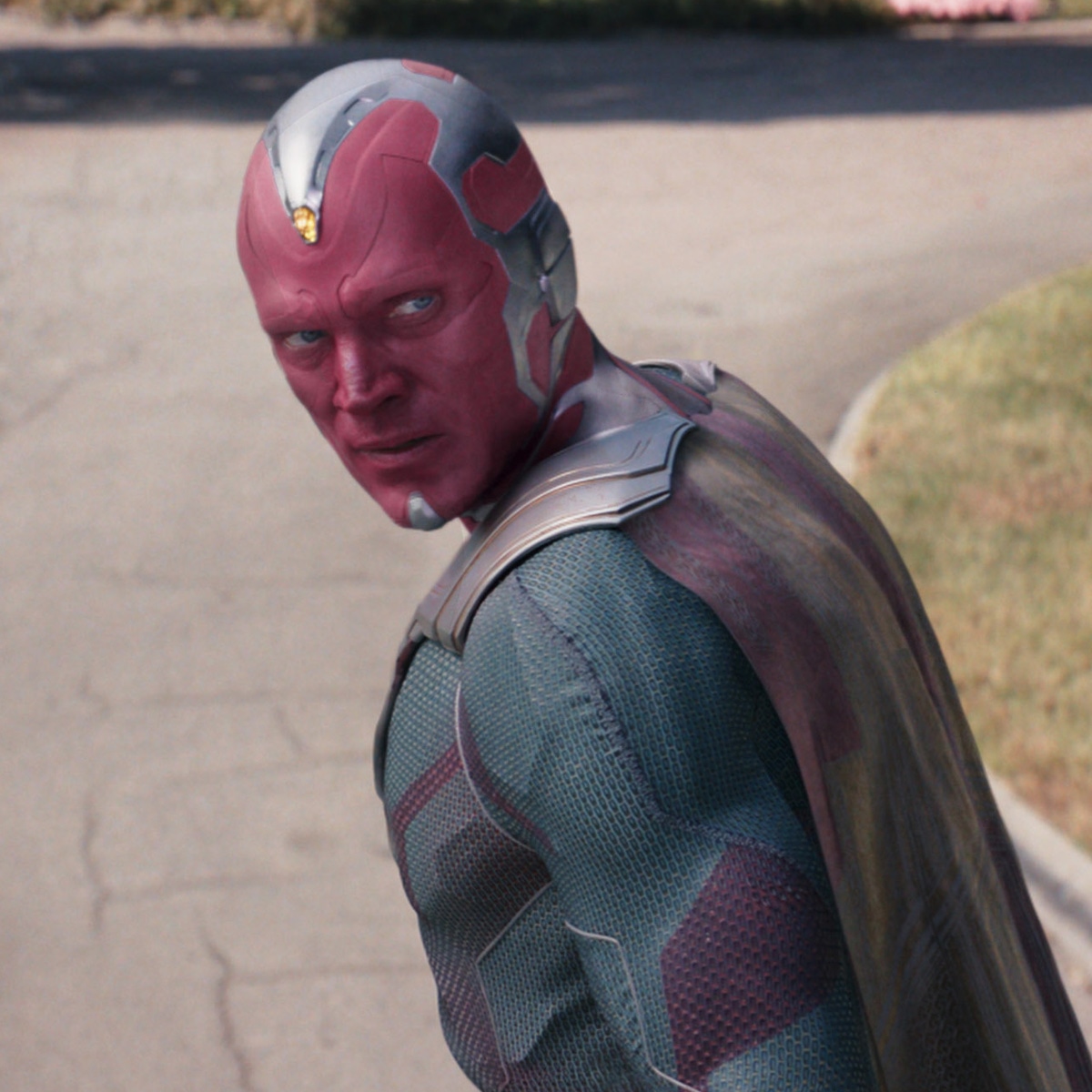
The second post-credit scene of the VisionQuest finale brings Elizabeth Olsen’s Scarlet Witch back into the MCU’s increasingly crowded group chat, with a revival that is less “surprise cameo” and more “Doctor Doom has plans for your trauma.” As Wanda lies buried beneath the rubble of Mount Wundagore—where she appeared to sacrifice herself at the end of Doctor Strange in the Multiverse of Madness—Robert Downey Jr.’s Dr. Doom lifts the debris and delivers the kind of ominous workplace introduction only Marvel could make sound romantic: “Scarlet Witch, awaken. Your power will be mine.”
And just like that, the woman who once rewrote reality in a suburban cul-de-sac has been pulled back into the story before Avengers: Doomsday, premiering Dec. 18. The MCU may have spent an entire series asking whether Vision could survive losing Wanda. Doom, apparently, would prefer to weaponize the answer.
Wanda’s absence was the point—until it very much wasn’t
Wanda never appears during VisionQuest’s eight episodes, despite being the emotional ghost haunting nearly every corner of Vision’s new life. The series reunites Vision, played by Paul Bettany, with Tommy Maximoff and Billy Maximoff after the family’s long, spectacularly complicated history of death, resurrection, alternate universes and grief.
VisionQuest’s finale centers on Vision and his sons confronting a grieving Ultron, played again by James Spader, as the artificial intelligence attempts to wipe out humanity. It is a very Marvel family reunion: one father trying to understand what he is, two sons carrying an impossible legacy, and an old enemy processing his feelings through an extinction-level event.
Wanda’s physical absence gives that story its shape. Vision is not simply looking for a missing wife. He is trying to exist after losing the person who defined so much of his emotional life, while also figuring out what kind of father—or version of a person—he can be now.
Showrunner Terry Matalas told E! News that the creative team had “lots of discussions” about bringing Wanda into the series, but worried that her appearance would pull attention away from Vision’s journey. In the finale, Vision speaks about losing her as if she is still present in the room. That was enough, at least for this chapter.
“She can’t just be back,” Matalas said. “There has to be a story behind that.”
Well, congratulations to everyone involved: there is now a story, and it begins with a supervillain excavating her from a mountain.
Doctor Doom has entered the Wanda era
The timing is not subtle. Wanda’s return lands directly ahead of Avengers: Doomsday, where the multiverse’s surviving heavy hitters—including the original Avengers, Wakanda’s champions, the Fantastic Four and the X-Men—are expected to collide with Doom’s existential threat.
Wanda is not just another powerful player in that lineup. She is a walking crisis of grief and consequence, a character whose abilities have repeatedly turned emotional devastation into a global emergency. In WandaVision, her pain reshaped an entire town. In Doctor Strange in the Multiverse of Madness, her desperation to reclaim her children sent her across universes and into a confrontation with the version of herself she could no longer recognize.
That history makes Doom’s interest in her power feel especially pointed. He is not waking up a random superhero. He is reaching for one of the MCU’s most volatile forces at precisely the moment when the franchise is building toward a multiversal war.
There is also a deliciously nasty contrast in the setup. Wanda’s previous arc was about surrendering the fantasy of controlling reality so she could stop hurting everyone around her. Doom’s first move is to pull her out of the rubble and announce that he intends to claim what she can do. Her redemption, meet his acquisition strategy.
Neither the finale nor the post-credit scene explains what Wanda has been doing since Mount Wundagore, how Doom found her or whether she is being revived willingly. It does establish one thing: her story was never as finished as that collapse made it look.
Vision’s family drama just became a multiverse problem
Before the post-credit scene, Vision tells Tommy that it “stands to reason” they could meet their mother again. It is a small line with enormous franchise consequences, especially after VisionQuest spends so much time refusing to make Wanda’s return easy.
Spader, whose Ultron provides one of the finale’s more complicated echoes of Vision’s past, explained that Wanda’s absence was essential to the show’s emotional architecture. “Sometimes someone’s presence is only magnified by their lack thereof,” he told E! News. For Vision, the void had to remain a void. If Wanda were suddenly standing in front of him, the loss would change shape before he had finished confronting it.
Now the void has been filled with a question: what happens when the person Vision mourned returns not for a quiet family reconciliation, but as a potential weapon in Doom’s war?
That is the particular trick of Wanda’s MCU history. She can be a mother, a wife, a villain, a tragic heroine and a cosmic-level threat without the story ever letting those identities sit comfortably together. Even her resurrection arrives with emotional baggage, supernatural debt and a man in a metal mask declaring ownership of her abilities.
There is no word yet on how large Olsen’s role will be in Avengers: Doomsday, and the finale does not reveal whether Wanda will fight Doom, resist him or become one of the forces he believes he can control. But Marvel has made the important part clear: the Scarlet Witch is awake, and the universe is about to remember why that is never a casual development.

Dave Portnoy Reopens the Sofia Franklyn War — and Brings a Very Personal Grudge to Her New Memoir
The Barstool founder says he has “no relationship” with his former employee and “hates her guts,” accusing Franklyn of directing people toward Business Insider during their fallout.
Some celebrity feuds age gracefully. They become a tasteful distance, a vague podcast reference, maybe one suspiciously timed unfollow. The Dave Portnoy–Sofia Franklyn situation has chosen a different lifestyle: it is still throwing furniture.
Franklyn’s new memoir, Daddy Issues, arrived Nov. 10 with a long-awaited account of the implosion that ended her partnership with Alex Cooper on Call Her Daddy. One day later, Portnoy — Franklyn’s former boss and the founder of Barstool Sports — walked onto The Toast podcast and supplied the kind of emotional headline that makes a memoir release feel less like a book launch and more like a match being struck in a dry room.
“I have no relationship with Sofia,” Portnoy told hosts Claudia and Jackie Oshry. “None. I hate her guts.”
There is no elegant subtext there. No “we’ve grown apart.” No “I wish her well.” Just a full-volume declaration from a man who apparently saw the memoir’s publication date and decided his contribution would be an extremely hostile director’s commentary.
The old Call Her Daddy fracture gets a new antagonist
Franklyn and Cooper co-hosted Call Her Daddy until 2020, when contract negotiations led to their very public split. Cooper continued the podcast alone, eventually taking it to SiriusXM, while Franklyn built Sofia with an F. The breakup became one of the defining podcast dramas of the streaming era: two young hosts, one enormously valuable brand, and enough residual resentment to keep the story circulating long after the microphones moved to different rooms.
Daddy Issues is Franklyn’s first detailed account of that feud, according to Page Six. Portnoy’s appearance on The Toast makes clear that the memoir does not stay neatly inside the Cooper-Franklyn chapter. It also revisits Franklyn’s relationship with Barstool and the sexual-misconduct allegations made against Portnoy in Business Insider investigations published in November 2021 and February 2022.
Portnoy denied those allegations at the time, saying the sexual encounters described were consensual. He sued Business Insider for defamation; the lawsuit was ultimately dismissed. That legal history matters here because his anger toward Franklyn is tied, in his telling, to the way information reached the publication — and to what he believes Franklyn did during their falling-out.
Portnoy’s version: “If you have any dirt”
During the podcast interview, Portnoy said Franklyn had posted Instagram Stories asking people with damaging information about him to contact her. He said the posts were later deleted, describing the campaign as lasting roughly a week or two while she was angry with him.
Jackie Oshry framed the question around Franklyn’s account in Daddy Issues: people had allegedly reached out to her, and when Business Insider contacted her, she directed the outlet toward them. Portnoy said he knew about the situation as it unfolded.
“Yeah, 100%,” he said when asked whether he was aware Franklyn discussed the matter.
Portnoy also connected the Business Insider reporting to a woman he said he had hooked up with, who later dated Cooper’s childhood best friend. According to Portnoy, that woman eventually said on a podcast that Franklyn helped her approach Business Insider. Portnoy characterized the woman’s account as unreliable and said the story had been driven by Franklyn. Those are Portnoy’s claims about the episode, not an independent finding about what happened.
The result is a particularly combustible triangle: Franklyn, whose memoir revisits the professional and personal fallout around Call Her Daddy; Cooper, whose name remains woven into the origin story; and Portnoy, who says the conflict spilled into allegations he insists were fabricated. The entire saga is less a clean timeline than a series of overlapping grievances, each person occupying the center of their own version.
A memoir release with a built-in sequel
Franklyn has not been quoted in the Page Six report responding to Portnoy’s podcast appearance. That silence may be temporary, accidental or strategic; either way, the timing is deliciously awkward. Her book arrives, her former co-host is once again part of the conversation, and her former boss is now using a rival podcast as a public stage to say he hates her.
It is also a reminder of why the Call Her Daddy fallout remains so sticky. The original drama was about contracts and control, but the afterlife has been about narrative ownership: who gets to explain the breakup, who gets to define the betrayal, and who gets to turn the explanation into content. The dispute has migrated from podcast feeds to memoir pages to Instagram Stories to a new round of podcast clips, with every platform offering its own version of the same old question: who got wronged first?
Portnoy’s appearance is not a calm rebuttal. It is a flare shot into the sky. He did not merely disagree with Franklyn’s account; he made the personal nature of the feud the headline, then attached his allegations about her role in the Business Insider story to it.
Franklyn’s book may have been intended to give her side a permanent form. Instead, it has reopened the group chat for everyone who has been following the saga since 2020 — and added a new voice shouting from the other end of the thread.
For now, Daddy Issues has done exactly what the most combustible celebrity memoirs do: it has turned old history into present-tense content. The podcast war is not back because it ever really left. It was simply waiting for the next person to hit publish.
Taylor Swift May Be About to Turn ‘New Heights’ Into the World’s Most Powerful Tailgate
Travis Kelce casually volunteered his superstar wife for the podcast’s next big live event — and Jason immediately imagined her firing the stage crew.
Travis Kelce has apparently decided that the only thing missing from the Kelce brothers’ increasingly gigantic podcast empire is Taylor Swift in production mode. Not as a guest this time. Not as a surprise cameo. As the person who can apparently make a stage happen.
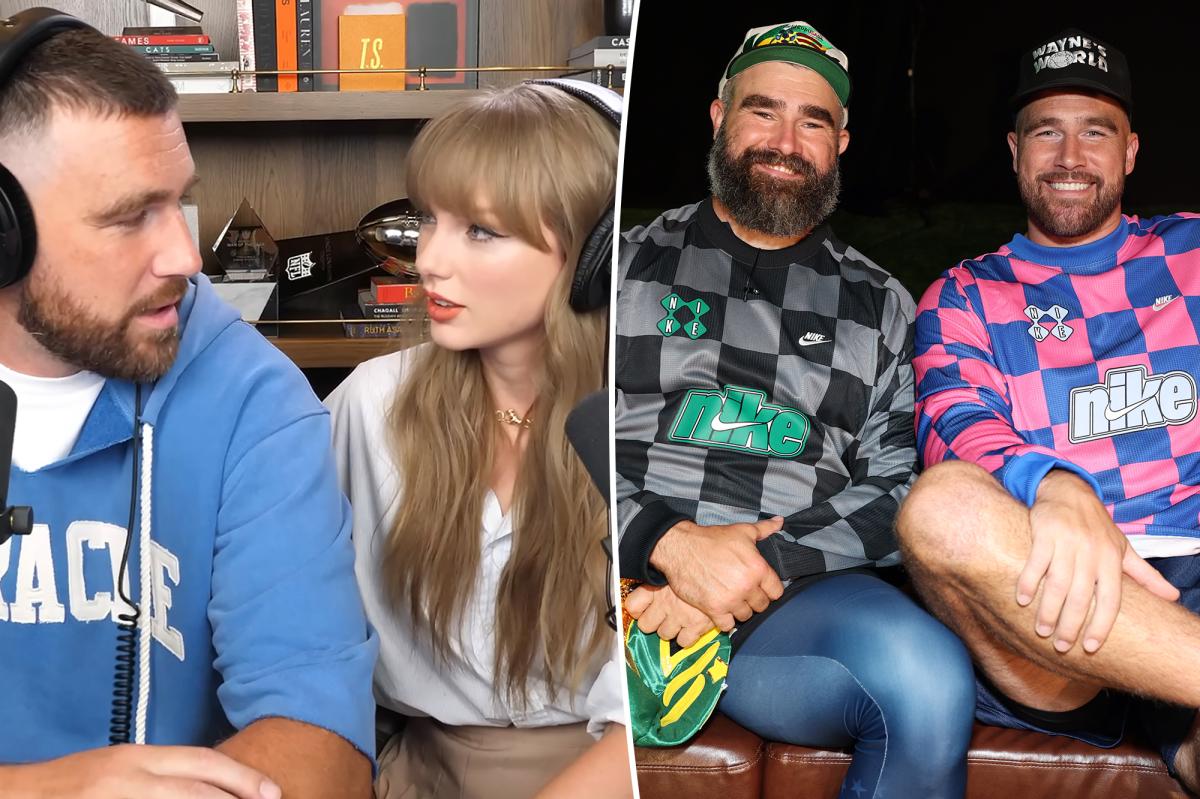
During Wednesday’s episode of New Heights, Travis and Jason Kelce recapped the podcast’s latest live tailgate in Philadelphia, where the brothers tried to solve one of the oldest problems in sports entertainment: how do you get a crowd of people to watch the thing they came to watch?
The answer, according to Jason, was a stage. The answer, according to Travis, may be his wife.
“Do you know anybody who knows anything about stages?” Jason asked after praising the setup at Stateside Live!, where the event featured male and female sumo wrestling competitions, hobby horsing and the sort of high-energy programming that sounds like it was designed by a group chat with no adult supervision.
“Yeah, I actually do,” Travis replied, laughing. “I’ll see what my wife can cook up.”
That is a very funny line on its own. It is also the kind of sentence that only makes sense in the Taylor Swift-Travis Kelce cinematic universe, where “my wife” is not merely a spouse but a touring-industrial complex with enough logistical muscle to make a live podcast feel like a small music festival.
The Kelce brothers have discovered the stage
Jason said the Philadelphia tailgate was the “best” live event the brothers had hosted so far, largely because the stage gave people a clear view of the action. Previous events in Philadelphia and Kansas City had struggled without one, he explained, because attendees could not always see what was happening.
This is less glamorous than a celebrity soft launch, but much more revealing about what New Heights has become. The podcast is no longer just two brothers talking football into microphones. It is a traveling social event, a sports-world variety show and, increasingly, a very polished extension of the Kelce family brand.
The stage apparently changed the entire mood of the tailgate. It turned a loose crowd into an audience. It made the sumo wrestling visible. It gave the hobby horses their moment. It created the infrastructure required for people to film, watch, cheer and immediately send clips to friends who were not there.
Jason’s problem is that most tailgates do not come with a stage. His proposed solution was to build one themselves. Travis’ proposed solution was to ask Taylor Swift what she could arrange.
Jason then supplied his imagined version of Swift’s response: “The companies I deal with are not going to f— around with you dumb f—ks.”
Whether that is an accurate impression of Swift’s private vocabulary is not the point; it is a perfect sibling joke. Jason sees Taylor as the terrifyingly competent adult in the room, while Travis gets to play the guy who knows someone who knows someone. It is also a neat glimpse at how casually her professional machinery now appears in their shared public life.
Taylor already knows how to break the podcast
Swift has appeared on New Heights only once so far, in August 2025. That single episode became the podcast’s most-watched installment, pulling in more than 10 million YouTube views in 16 hours, according to Page Six, and outperforming the records previously set by episodes featuring guests including Jason’s wife, Kylie Kelce.
She also used the episode to announce her 12th studio album, The Life of a Showgirl, released Oct. 3, 2025. The appearance was not just a celebrity visit; it was a fully operational pop-culture event. Swift arrived with a major announcement, the Kelces got their biggest audience yet, and the podcast suddenly occupied the same attention economy as a late-night appearance or a carefully timed magazine cover.
Travis later called Swift “so magical” and noted that the episode became Apple’s No. 3 podcast episode of the year. The math is almost beside the point. One appearance was enough to make the podcast’s ceiling look less like a ceiling and more like a suggestion.
So when Travis jokes that she might help with the next live production, the punchline comes with a very obvious second layer: Taylor Swift could genuinely change the scale of the thing.
Imagine the Swift-Kelce tailgate industrial complex
The fantasy is easy to picture. A New Heights live event with Travis and Jason onstage, Taylor somewhere near the controls, a crowd of football fans mixed with Swifties, and at least one segment that becomes unavoidable on social media by lunchtime.
It would also be a spectacular collision of their professional ecosystems. Travis brings the NFL, locker-room comedy and the brothers’ deliberately chaotic energy. Taylor brings stadium-level event planning, an audience trained to analyze every entrance and a demonstrated ability to turn a podcast episode into appointment viewing.
The resulting event would not need to be a concert to feel like a Taylor Swift production. A better stage, sharper sightlines, surprise guests, a few immaculate transitions and one suspiciously well-timed announcement would probably be enough to send the internet into full detective mode.
For now, the only actual plan discussed on the episode was Travis saying he would see what his wife could “cook up.” Neither Taylor nor the podcast has announced that she is joining a future tailgate or taking over its staging. But the joke lands because the idea feels both absurd and completely plausible.
That is the strange power of the Swift-Kelce marriage as a pop-culture partnership. A throwaway line about event production instantly sounds like a possible era. A spouse’s practical favor becomes a potential crossover. A podcast that began as football talk now has a credible route to becoming a traveling spectacle with its own mythology.
And if Taylor does eventually appear at a New Heights tailgate, Jason has already written the first line of the trailer: the companies she deals with are not going to f— around.