Pilot Pete Went From Soft Launch to Central Park Proposal to Twins in One Very Busy Season
Peter Weber and Jadeyn Carr have turned a low-key summer Instagram debut into an engagement announcement, a twin pregnancy and the kind of timeline that makes the Bachelor universe look positively serene.
Peter Weber is engaged, expecting twins and apparently moving through major life milestones at the speed of a man who has finally decided to stop overthinking the group date.
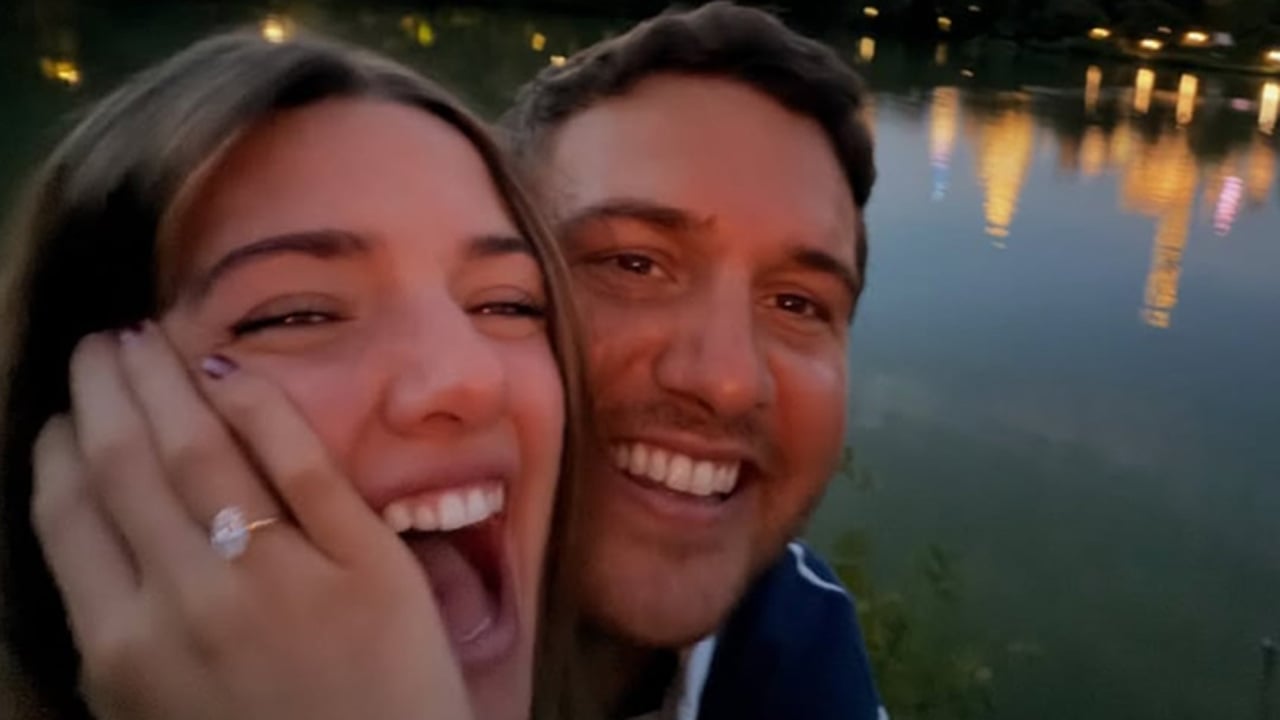
The Bachelor alum announced Wednesday evening that he proposed to his pregnant girlfriend, Jadeyn Carr, in New York City. The setting was Central Park; the announcement was a carousel of couple selfies; the caption was wonderfully direct: “Marry Me @jadeyncarr.” No cryptic black-and-white teaser. No suspiciously cropped hand. No three-week rollout of champagne emojis. Just Peter, Jadeyn, a big smile and a new oval diamond doing the most important work in the slideshow.
In one of the photos, Jadeyn shows off the ring while playfully placing her hand over Peter’s head. It is a very specific kind of engagement energy: romantic, happy and just unserious enough to suggest that nobody involved is trying to turn a proposal into a luxury-brand campaign. Peter looks thrilled. Jadeyn looks equally ready to make the ring the main character.
The relationship went public only in August
The speed of this romance is what makes the announcement feel especially juicy. Peter and Jadeyn did not spend years feeding the public a carefully portioned love story. According to Just Jared, Peter first went public with the relationship on August 13, sharing photos of the pair enjoying summer activities, including a fair outing and time with his family.
That is a classic soft launch with unusually little interest in pretending it is a soft launch. There were couple photos, family proximity and the general message that this was not merely a person Peter happened to be standing next to at an event. Then September brought an even bigger announcement: Peter and Jadeyn revealed that they were expecting twins.
Now, less than three months after the relationship appeared on his Instagram, there is a proposal in Central Park and a caption that reads less like a teaser than a formal change-of-status notice. From “here are some summer photos” to “please call her my fiancée” in one season: efficient, cinematic and extremely online.
Peter’s Bachelor history makes the clean break feel louder
Peter, 35, became known as “Pilot Pete” during his Bachelor run, a nickname that has always carried a little turbulence with it. His public romantic life was once the sort of television event that could inspire entire group chats: heightened feelings, dramatic decisions and the persistent sense that nobody had quite landed the plane.
That is why this announcement has a different texture from the usual Bachelor alumni engagement. The franchise thrives on romantic suspense, but Peter’s latest update is notably free of suspense. The caption does not ask followers to guess whether he and Jadeyn are still together. It does not tease a relationship reveal or offer a strategically vague “life lately.” It says the question has been asked, the answer was yes and the ring is already on the finger.
There is also something almost comically decisive about the sequence. Peter and Jadeyn went public in August. They announced twins in September. In November, they got engaged. The timeline is so concentrated that it feels less like a celebrity relationship rollout and more like someone hitting fast-forward on a romantic montage.
Of course, the couple’s announcement is about more than social-media pacing. They are preparing to become parents to twins, and the engagement arrives inside that much larger life change. But the internet experiences celebrity milestones through posts, captions and carefully selected images, which means the public-facing story is inevitably about the choreography too. This one is a master class in skipping the filler.
The ring photo understood the assignment
Even the visual language of the announcement is refreshingly uncomplicated. Central Park gives the proposal a recognizable New York backdrop without turning it into a production. The selfies keep the mood personal. Jadeyn’s oval diamond is visible, but the photographs do not appear to be built around a staged close-up so much as the natural chaos of two people who have just crossed a major line together.
And then there is the hand-over-the-head pose, which may be the most revealing image in the carousel. It is not the frozen, solemn display of a woman presenting a jewel to the internet for inspection. It is playful and a little bossy. Peter is smiling through it. The ring is there, but so is the relationship’s apparent sense of humor.
That matters because engagement announcements can easily become glossy exercises in public relations. This one lands more like a personal post that happens to have arrived with a plot twist. The proposal is romantic, the diamond is unmistakable and the caption is short enough to leave room for everyone else to react.
And react they did, because this is exactly the kind of celebrity update designed to detonate in group chats: a recognizable Bachelor face, a new fiancée, a twin pregnancy already in the storyline and a timeline that makes “taking it slow” look like a concept from another universe. Fans are now looking back at the August photos with the benefit of hindsight, treating every fairground smile and family appearance like an early chapter in a story that suddenly reached its engagement scene.
Neither Peter nor Jadeyn needs to explain the pace. Their Instagram has already done the talking. They met the public with a relationship, returned with twins and came back with a ring. The Bachelor may have taught Peter how to survive romantic spectacle, but this time he appears to have skipped the roses entirely and gone straight to Central Park.
Congratulations to the couple—and to the future twins, who are already entering the world with a more dramatic relationship timeline than most adults manage in a decade.
Trisha Paytas Made $100,000 in One Week — From the Kitchen Floor to the Creator Economy Penthouse
The Just Trish host casually dropped a six-figure YouTube week on Watch What Happens Live, then explained why internet fame is less a jackpot than a wildly unpredictable full-time job.
Trisha Paytas has spent nearly two decades proving that the internet’s most powerful business model may simply be refusing to leave the room.
On a recent episode of Watch What Happens Live with Andy Cohen, the longtime YouTube personality was asked about the most money she had ever made from the platform in a single week. Her answer arrived with the loose, almost suspiciously casual energy of someone discussing a grocery bill: “Maybe $100K.”
Maybe.
That is the most Trisha Paytas possible way to reveal a six-figure payday. No keynote presentation. No venture-capital vocabulary. Just a kitchen-floor content veteran, sitting under studio lights, dropping a number that would make most people immediately start reconsidering their career path.
The kitchen floor has entered its Wall Street era
Paytas has been making videos since joining YouTube in 2007, back when “creator economy” sounded like a phrase invented by someone trying to sell a conference ticket. Her early brand was built on volume, personality and a willingness to turn practically any setting into a set: cars, bedrooms, hospital rooms, and, famously, the floor.
Now she hosts the Just Trish podcast, maintains a main YouTube presence, creates ASMR and lifestyle content, and has spent years moving between platforms as audiences and algorithms change. She is also a mother of three, sharing children Malibu, Elvis and Aquaman with her husband, Moses Hacmon. The shift from filming constantly before marriage and children to building a more flexible, multi-platform schedule is part of the larger Paytas story: this is not one viral clip paying one lucky bill. It is a personal media company with a famously unpredictable cash register.
Paytas has been candid that her YouTube income can swing dramatically. In comments to Polyester Zine in 2023, she described a period when she posted every day and made around $100,000, followed by another stretch in which the same relentless schedule brought in closer to $8,000.
That contrast is the part aspiring influencers may want to screenshot. The glamorous headline is $100,000. The less glamorous footnote is that the upload button does not come with a guaranteed salary.
Her secret is not one platform. It is chasing the moment
Paytas has never treated YouTube as a single-lane highway. She has moved through vlogs, mukbangs, ASMR, lifestyle videos, podcasting, paid content and elaborate pop-culture recreations, adjusting her attention toward whichever format is working at that moment.
“When something is good I just focus on it,” she said, a sentence that sounds simple until you consider how many careers have been flattened by refusing to notice that the internet has moved on.
Her approach is less “build a brand and stick to the plan” than “find the oxygen and breathe there.” When long-form video is strong, she posts. When audio is having a moment, she leans into the podcast. When a particular kind of visual content performs, she follows it. Paytas has managed to remain culturally legible through several generations of online fame because she understands that the internet rewards consistency but pays attention to reinvention.
That hustle has also included OnlyFans, where she posted from 2020 to 2023, along with social content and ASMR. She has described filming three or four days a week, sometimes with Hacmon helping set up shots, and even continuing to work around the birth of her children. It is a less polished picture of influencer success than the usual luxury-suited montage. The empire is built in fragments, often between domestic responsibilities, with a ring light nearby.
Then there is the $50,000 video problem
Paytas is not only earning from content; she is also willing to pour serious money back into it. In 2024, she told British Vogue that she had spent $50,000 on a single video and watched the budget climb from there.
One example was her lavish recreation of “Scream” from High School Musical 3, with Paytas playing Zac Efron’s Troy Bolton. It is an extremely Paytas proposition: part tribute, part costume spectacle, part financial dare. The kind of project that makes sense only if you understand that, for a creator, the line between content and event has nearly disappeared.
Traditional celebrity asks whether a production will make money. Internet celebrity asks whether the production will become a moment. Paytas has spent years gambling that a big enough, strange enough, committed enough idea can pull viewers back into her orbit. Sometimes that means a profitable week. Sometimes it means spending tens of thousands of dollars to keep the machine visually interesting.
She has also said that, over the course of a decade, she spent more than $12 million. That admission puts the $100,000 week in a different light. It is not just a dazzling personal-income reveal; it is a glimpse at the churn behind online fame, where revenue arrives loudly and expenses can leave just as quickly.
Going viral pays — and follows you home
Paytas knows better than most that internet fame comes with a permanent archive. “Be prepared for backlash for the rest of your life,” she told British Vogue. “Going viral is cool because you can make a lot of money, but it’ll stick with you forever.”
That line may be the real thesis of her career. The same attention that can turn an ordinary week into a $100,000 week can also preserve every chaotic era, impulsive confession and questionable decision in high definition. There is no clean exit from the content cycle because the old content never fully disappears. It waits, searchable and remixable, for the next cultural weather change.
Paytas’s latest number lands in a wider creator economy where people openly discuss income that once belonged behind closed doors. Jeffree Star has spoken about making $50,000 during some TikTok live streams. Love Is Blind alumni Deepti Vempati and Natalie Lee have said they each made hundreds of thousands through influencing after appearing on the show. Heidi Montag and Spencer Pratt, meanwhile, pushed back on assumptions that their post-wildfire TikTok surge had made them millions, with Spencer telling E! News that the week brought in $3,500 from thousands of videos.
The figures are wildly different, but the lesson is consistent: online money is not distributed according to conventional celebrity math. A reality star can become a full-time influencer. A makeup mogul can make a fortune while cooking bacon on live video. A woman who once filmed on her floor can end up discussing a six-figure week beside Andy Cohen.
Trisha Paytas did not present her $100,000 as a carefully managed financial milestone. She presented it as one particularly good week in an unstable, exhausting, occasionally absurd career. Which may be why the number hits so hard. In the Paytas economy, the floor is still the office, the camera is still the boss, and payday can arrive wearing a wig.
Wanda Maximoff Is Back—and Doctor Doom Wants Her Power
The VisionQuest finale kept Elizabeth Olsen offscreen until its second post-credit scene, then dropped her directly into the path of Avengers: Doomsday.
Spoilers for the VisionQuest finale ahead.
Marvel has spent years treating Wanda Maximoff like the most dangerous woman in the room and the most emotionally exhausted person in the multiverse. Now, apparently, she is both again.
The second post-credit scene of the VisionQuest finale brings Elizabeth Olsen’s Scarlet Witch back into the MCU’s increasingly crowded group chat, with a revival that is less “surprise cameo” and more “Doctor Doom has plans for your trauma.” As Wanda lies buried beneath the rubble of Mount Wundagore—where she appeared to sacrifice herself at the end of Doctor Strange in the Multiverse of Madness—Robert Downey Jr.’s Dr. Doom lifts the debris and delivers the kind of ominous workplace introduction only Marvel could make sound romantic: “Scarlet Witch, awaken. Your power will be mine.”
And just like that, the woman who once rewrote reality in a suburban cul-de-sac has been pulled back into the story before Avengers: Doomsday, premiering Dec. 18. The MCU may have spent an entire series asking whether Vision could survive losing Wanda. Doom, apparently, would prefer to weaponize the answer.
Wanda’s absence was the point—until it very much wasn’t
Wanda never appears during VisionQuest’s eight episodes, despite being the emotional ghost haunting nearly every corner of Vision’s new life. The series reunites Vision, played by Paul Bettany, with Tommy Maximoff and Billy Maximoff after the family’s long, spectacularly complicated history of death, resurrection, alternate universes and grief.
VisionQuest’s finale centers on Vision and his sons confronting a grieving Ultron, played again by James Spader, as the artificial intelligence attempts to wipe out humanity. It is a very Marvel family reunion: one father trying to understand what he is, two sons carrying an impossible legacy, and an old enemy processing his feelings through an extinction-level event.
Wanda’s physical absence gives that story its shape. Vision is not simply looking for a missing wife. He is trying to exist after losing the person who defined so much of his emotional life, while also figuring out what kind of father—or version of a person—he can be now.
Showrunner Terry Matalas told E! News that the creative team had “lots of discussions” about bringing Wanda into the series, but worried that her appearance would pull attention away from Vision’s journey. In the finale, Vision speaks about losing her as if she is still present in the room. That was enough, at least for this chapter.
“She can’t just be back,” Matalas said. “There has to be a story behind that.”
Well, congratulations to everyone involved: there is now a story, and it begins with a supervillain excavating her from a mountain.
Doctor Doom has entered the Wanda era
The timing is not subtle. Wanda’s return lands directly ahead of Avengers: Doomsday, where the multiverse’s surviving heavy hitters—including the original Avengers, Wakanda’s champions, the Fantastic Four and the X-Men—are expected to collide with Doom’s existential threat.
Wanda is not just another powerful player in that lineup. She is a walking crisis of grief and consequence, a character whose abilities have repeatedly turned emotional devastation into a global emergency. In WandaVision, her pain reshaped an entire town. In Doctor Strange in the Multiverse of Madness, her desperation to reclaim her children sent her across universes and into a confrontation with the version of herself she could no longer recognize.
That history makes Doom’s interest in her power feel especially pointed. He is not waking up a random superhero. He is reaching for one of the MCU’s most volatile forces at precisely the moment when the franchise is building toward a multiversal war.
There is also a deliciously nasty contrast in the setup. Wanda’s previous arc was about surrendering the fantasy of controlling reality so she could stop hurting everyone around her. Doom’s first move is to pull her out of the rubble and announce that he intends to claim what she can do. Her redemption, meet his acquisition strategy.
Neither the finale nor the post-credit scene explains what Wanda has been doing since Mount Wundagore, how Doom found her or whether she is being revived willingly. It does establish one thing: her story was never as finished as that collapse made it look.
Vision’s family drama just became a multiverse problem
Before the post-credit scene, Vision tells Tommy that it “stands to reason” they could meet their mother again. It is a small line with enormous franchise consequences, especially after VisionQuest spends so much time refusing to make Wanda’s return easy.
Spader, whose Ultron provides one of the finale’s more complicated echoes of Vision’s past, explained that Wanda’s absence was essential to the show’s emotional architecture. “Sometimes someone’s presence is only magnified by their lack thereof,” he told E! News. For Vision, the void had to remain a void. If Wanda were suddenly standing in front of him, the loss would change shape before he had finished confronting it.
Now the void has been filled with a question: what happens when the person Vision mourned returns not for a quiet family reconciliation, but as a potential weapon in Doom’s war?
That is the particular trick of Wanda’s MCU history. She can be a mother, a wife, a villain, a tragic heroine and a cosmic-level threat without the story ever letting those identities sit comfortably together. Even her resurrection arrives with emotional baggage, supernatural debt and a man in a metal mask declaring ownership of her abilities.
There is no word yet on how large Olsen’s role will be in Avengers: Doomsday, and the finale does not reveal whether Wanda will fight Doom, resist him or become one of the forces he believes he can control. But Marvel has made the important part clear: the Scarlet Witch is awake, and the universe is about to remember why that is never a casual development.