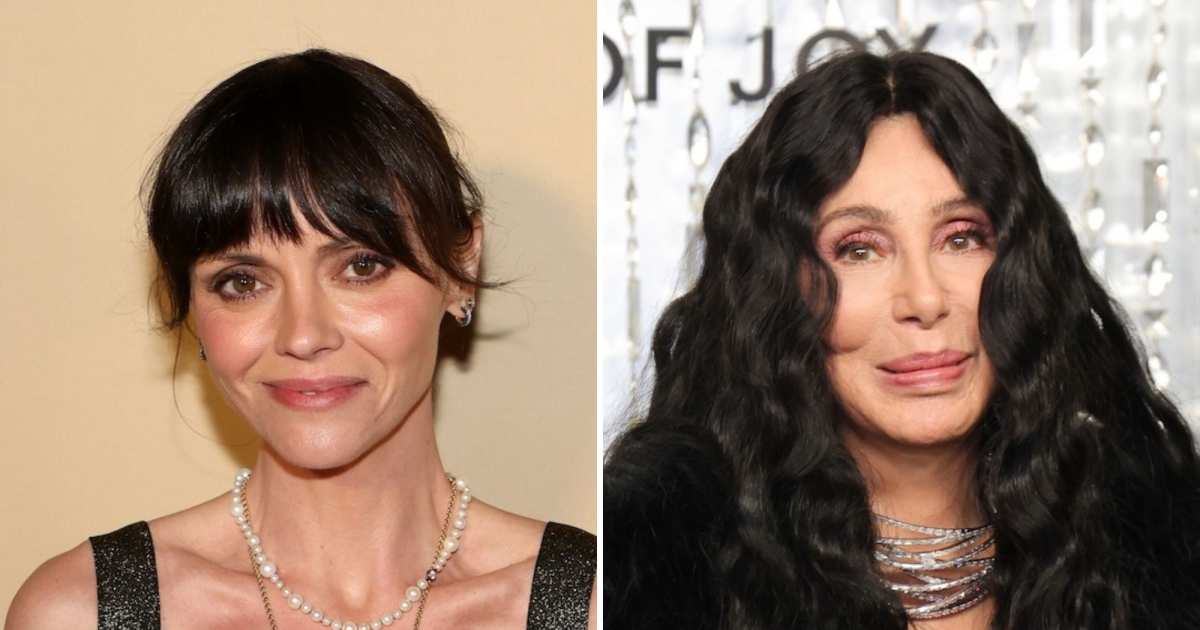
Christina Ricci Says Cher Still Holds a Grudge Over One Very ’90s Voicemail
The Mermaids reunion we deserve is apparently one phone call away — if Cher ever decides to answer.
Some Hollywood friendships fade gently into the background. Others remain suspended in amber, preserved inside one unanswered voicemail from the late ’90s. Christina Ricci’s friendship with Cher appears to belong firmly to the second category.
Appearing on Watch What Happens Live With Andy Cohen, Ricci was asked about her relationship with her former Mermaids costar. Her answer was not the breezy “we still text sometimes” response one might expect from a beloved mother-daughter pairing in a nostalgic ’90s classic.
“I’m not [still in touch]. Unfortunately, she’s still mad at me, she holds a grudge,” Ricci said.
And just like that, a decades-old celebrity friendship became the kind of story you immediately send to the group chat with the words: Wait, what happened between Cher and Christina Ricci?
The feud, as Ricci tells it, began with a magazine interview
Ricci said the trouble started when she was 19 and participated in a joint magazine interview with Cher. According to Ricci, Cher said “all these things that were not that amazing” about her during the conversation.
That alone might have been enough to create a very understandable young-star panic. But Ricci said Cher later left her a voicemail explaining that journalists were always trying to get the worst out of people and apologizing for how the comments had landed. Ricci, still 19, did not call her back.
There it is: the tiny hinge on which the entire emotional door apparently swung shut. Cher believed she had reached out to explain herself. Ricci, young and hurt, let the message sit. Decades later, Ricci says Cher remains upset that she never returned the call.
Andy Cohen, visibly stunned by the plot development, pointed out that Ricci had spoken warmly about Cher on the show before. He then summarized the apparent problem: Cher was mad because Ricci did not return the message.
“Yes,” Ricci agreed.
It is an almost comically simple misunderstanding, except for the fact that it involves two famous people, one intimidating pop icon and enough time for several generations of iPhones to come and go. The emotional architecture is pure old Hollywood: a young actress, a misinterpreted interview, a voicemail, a silence that becomes a legend.
Ricci still sounds completely enchanted by Cher
The striking part of Ricci’s story is that there is no scorched-earth energy here. She did not arrive on the couch to drag Cher. If anything, she seemed determined to explain why Cher’s anger made sense from Cher’s point of view.
Ricci said she could absolutely imagine being Cher and thinking, essentially, “I’m going to call this young person and explain to her that they misquoted me,” only to receive no response. She even acknowledged the audacity of her own teenage silence.
“I would be so pissed,” Ricci said. “I get it.”
That is the difference between a celebrity feud and a celebrity postmortem. Ricci’s version does not ask us to choose sides so much as marvel at the bizarre fragility of relationships formed under studio lights. One person thought she was protecting the other. The other thought she had been insulted. Then nobody managed to reset the conversation.
Ricci turned to the camera with a message for her former costar: “Love you, Cher, I love you so much.”
Which is both touching and, in its own way, an open invitation. Cher, the line is active. The voicemail saga can still end. Someone just has to pick up.
Mermaids was more than a movie to Ricci
The story lands because Mermaids was not merely one credit among many in Ricci’s career. It was her film debut, and the movie placed her opposite Cher while Winona Ryder played her older sister, Charlotte Flax. Ricci played Kate, the daughter of Cher’s free-spirited Rachel, in a film that has remained a durable piece of ’90s pop culture.
Ricci has previously described Cher as a major source of support on the set. In a 1999 interview with Rolling Stone, Ricci recalled that Cher’s early encouragement helped her land the role after six auditions. She also said she would hide in Cher’s trailer to avoid doing schoolwork because her tutor was too intimidated to knock on the door.
That detail makes the current story even better. This was not a casual professional pairing where two actors exchanged polite greetings between takes. Ricci was a child star who had found a protective, glamorous adult figure in the middle of a complicated production. Cher, in Ricci’s telling, took her under her wing.
Ricci revisited that dynamic in a 2024 interview with Entertainment Weekly, saying Cher understood that a young performer might not know what was happening behind the scenes — power struggles, tensions or other issues — and could mistakenly assume everything was her fault. Ricci said Cher did not want her to feel insecure.
So the alleged grudge is hovering over a genuinely affectionate history. Ricci’s memories of Cher are not being rewritten as fake or foolish. They remain warm, even while one old hurt continues to sit between them like an unopened message.
A Cher-Christina Ricci reunion would break the internet
There is an obvious temptation here to imagine the reunion special: Cher in a spectacular outfit, Ricci laughing nervously, Andy Cohen asking the question everyone is thinking and a producer quietly checking whether the segment can accommodate a surprise video call.
But the appeal is not just nostalgia. It is the specificity of the conflict. Celebrity estrangements usually arrive wrapped in dramatic language — betrayal, disrespect, boundaries, irreconcilable differences. This one apparently began with an interview that went sideways and a voicemail from a famous woman to a teenager who did not call back.
That is not a scandal. It is more recognizable than that. It is the strange little human error that becomes impossible to correct because too much time passes and both people build a story around the silence.
Ricci has apparently tried reaching out since then and said she received “radio silence.” Cher has not publicly responded to Ricci’s account in the source material. For now, the Mermaids mother-daughter bond exists in a particularly modern form: preserved through interviews, old memories and one extremely consequential missed connection.
Still, Ricci’s final message was unmistakable. She adores Cher. She understands why Cher was angry. And she would clearly like the door reopened.
All Cher has to do is leave a voicemail. This time, Christina Ricci might actually call back.
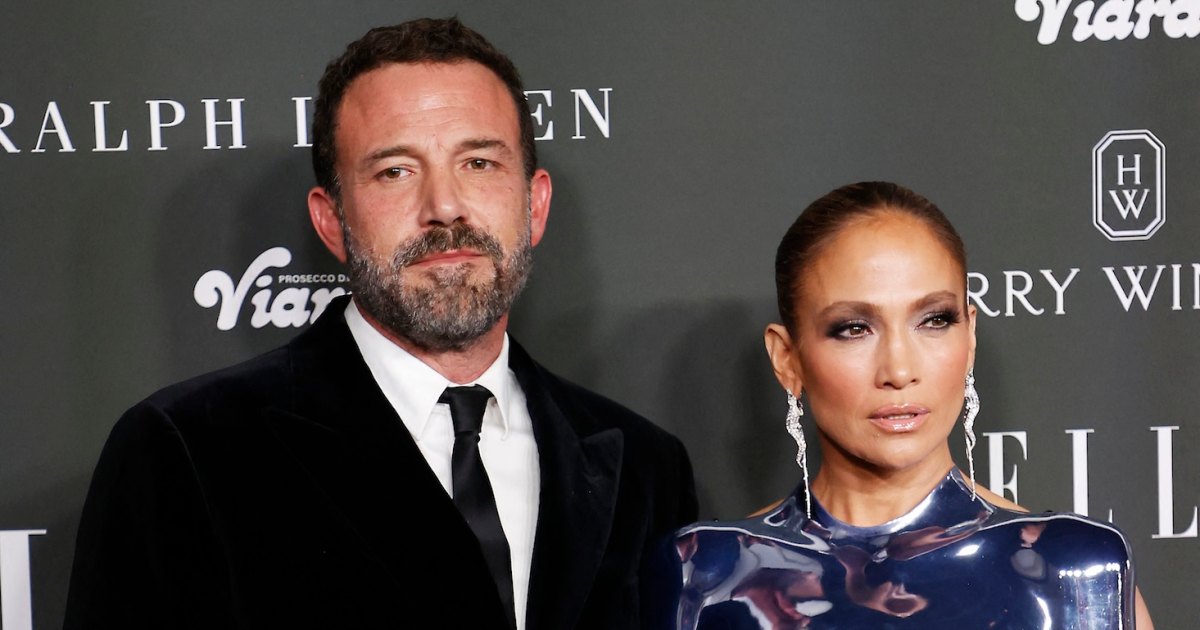
Jennifer Lopez Is Done Romanticizing the Bennifer Sequel
On Benny Blanco’s podcast, Lopez called her divorce from Ben Affleck “disappointing” on every level—and admitted that her next love story, if there is one, will look very different.
Jennifer Lopez has spent decades making romance look like a full-time job: the grand entrance, the cinematic kiss, the diamond, the comeback, the matching aura. Now she is looking back at her marriage to Ben Affleck and saying, in the most J.Lo way possible, that the whole production left her deeply disappointed.
“It was such a hard, disappointing last situation on every level,” Lopez said on the Friends Keep Secrets podcast hosted by Benny Blanco. “On every level, it was so disappointing. I don’t ever want to delve into that.”
That last sentence is doing a lot of work. Lopez is not dragging Affleck, reconstructing the marriage on-air or turning the divorce into a limited podcast series. She is doing something more interesting: acknowledging that the great romantic revival did not deliver the happy ending everyone had spent years imagining, then closing the door before the conversation becomes another episode of Bennifer: The Discourse.
The sequel had everything except a sequel ending
Lopez and Affleck first dated and got engaged nearly two decades before they married in 2022. Their early-2000s romance became one of pop culture’s defining celebrity pairings, complete with paparazzi saturation, tabloid mythology and a nickname so durable it survived an entire generation of internet slang.
When they found their way back to each other, the reunion arrived with the kind of narrative symmetry Hollywood usually has to manufacture. The couple married in 2022, years after the first version of their relationship had collapsed under the weight of public attention. It looked, from a distance, like the romantic sequel had finally beaten the original ending.
Then Lopez filed for divorce in 2024. The divorce was finalized in 2025, ending a marriage that had lasted two years and turning the couple’s much-celebrated second chance into one of the most closely watched celebrity splits in recent memory.
Lopez’s new comments are notable because they do not try to polish that timeline. She called the ending “hard” and “disappointing,” without pretending that disappointment is an elegant synonym for growth or that a famous love story becomes less painful because it made excellent headlines.
J.Lo’s romance era is being replaced by a recovery era
The bigger revelation is not that Lopez was hurt. It is that she says she has stopped treating partnership as the central plot.
“Even if I was in a relationship, I’m not talking about that. I’m done with that part of my life,” she said, adding that the next time would be “different.”
For Lopez, who described herself as a “serial monogamist” moving from one relationship to the next in hopes of finding the thing, that is a striking adjustment. Her public life has long been braided together with her love life: Ojani Noa, Cris Judd, Marc Anthony and Affleck, with each relationship becoming part of the larger J.Lo mythology. She has also been candid about how work and romance can crowd the same emotional real estate. In a 2024 Australian radio appearance, she called herself more of a “love addict or a workaholic than everything else.”
Now she says the Affleck divorce forced a pause. Rather than immediately searching for another relationship to fill the space, Lopez said she sat with the heartbreak and did the internal work she needed to heal.
“It changed me. I allowed it to change me,” she said.
That is a very different energy from the woman who once seemed to approach love like an ambitious creative project: identify the feeling, build the look, release the image, move into the next chapter. This version of Lopez is less interested in announcing a new era than in admitting that the old one cost her something.
The breakup advice is surprisingly unglamorous—and very J.Lo
Lopez’s advice for people going through divorce was not to retaliate, disappear into a makeover or turn the ex into a villain. It was to behave in a way that leaves you proud when you look back.
“I can look back at these situations and be like, even as painful as some of them were — so bad, life-shifting pain and hurt — I can look back and be like, I loved completely,” she said. “I acted in a way that I’m proud of as a human. I didn’t treat anybody in any way I would be ashamed of. I always tried in the moment. I did my best in the moment with what I knew.”
It is a remarkably controlled statement from someone whose personal life has so often been consumed as spectacle. Lopez is not claiming that every decision was perfect. She is saying that she wants to remember herself as someone who showed up fully, even when the outcome was brutal.
And then, because she is still Jennifer Lopez and cannot resist giving heartbreak a little theatrical lighting, she acknowledged the impulse to lash out when pain gets ugly. “You’re in so much pain, you want to hurt somebody else,” she said, before returning to the standard she has tried to hold herself to: be the best person you can be, especially when it is hard.
Could the next J.Lo love story be no love story at all?
There is a tempting celebrity-news reflex to treat every breakup interview as a teaser for the next relationship. Who will she date? Is someone already waiting in the wings? Will there be a soft launch, a suspicious dinner, a black-and-white carousel posted at exactly the right hour?
Lopez is asking us not to do that this time. She said she hopes to find love again, but also made clear that she is not discussing a current relationship, if one exists. For once, the headline is not a new man, a new ring or a new romantic reset. It is the pause between chapters.
That pause may be the most unexpected twist in the Bennifer story. The first time around, the relationship ended before either person had the chance to become the version of themselves they are now. The second time, the fantasy got its wedding—but not its forever. Lopez is left with the less photogenic work of figuring out what she wants when romance is not being used as proof that everything has finally fallen into place.
She has called her divorces hard and disappointing. She has also said she loved completely and did her best with what she knew. That is not a fairytale ending, exactly. It is sharper than that: a woman who got the comeback, got the wedding, got the sequel and is now choosing not to pretend the ending was satisfying.
J.Lo may still believe in love. She just seems finished letting it run the entire show.
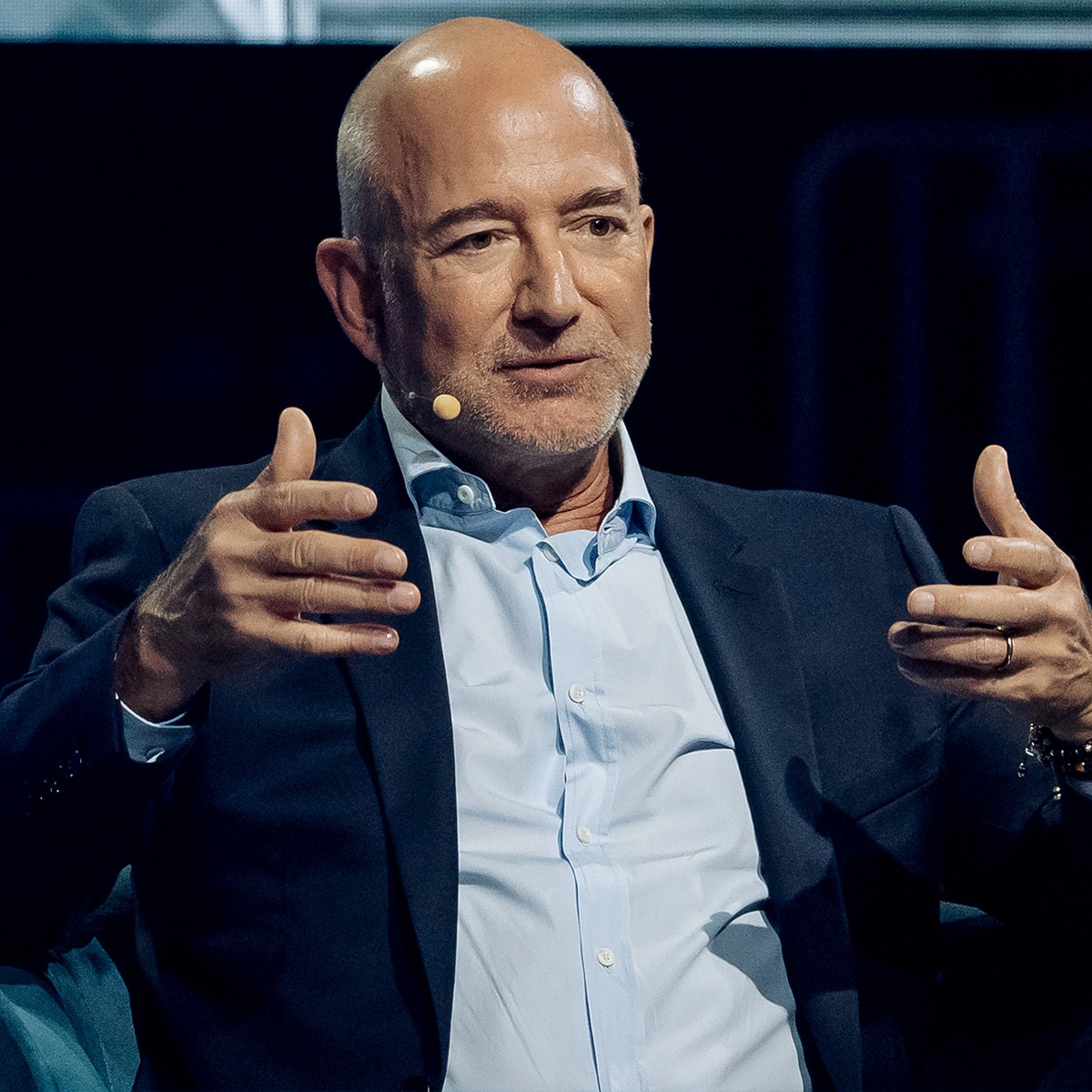
Jeff Bezos Says Robert Pattinson Won Bond in a Five-Man Screen-Test Knife Fight
The Amazon boss says the process came down to costumes, real sets, three scenes each—and one very immediate conclusion: “He is James Bond.”
Robert Pattinson did not apparently stroll into the James Bond job on the strength of vibes, a tuxedo fitting and the general fact that he has spent years looking like he knows something you don’t.
According to Jeff Bezos, the incoming 007 had to survive a full old-fashioned audition gauntlet—and beat four other finalists in the kind of elaborate screen-test drama that sounds less like casting and more like a very expensive school play where everyone is armed.
Speaking at Semafor’s Silicon Valley & The World event, Bezos described Amazon MGM’s selection process for the next Bond as “really tight,” with the final decision made on Friday, Nov. 13, just days before the choice was publicly revealed. The former Twilight heartthrob ultimately emerged as the successor to the cinematic spy throne, with Dune director Denis Villeneuve attached to steer the new era.
The Bond shortlist was basically a group chat full of leading men
Bezos said the studio began with “a big group” before narrowing the field to five finalists. E! News, citing Variety, identified the rumored group as Pattinson, Jack Lowden, Josh O’Connor, Jacob Elordi and Callum Turner—an extremely concentrated dose of brooding British and British-adjacent screen presence.
That lineup alone explains why the internet had so much to say. Lowden brings prestige-drama steel. O’Connor has the aristocratic melancholy of a man who has been betrayed in a period costume. Elordi is already fluent in playing beautiful men whose emotional weather system is considered a public emergency. Turner has the movie-star looseness of someone who could order a martini while late to a flight.
And then there was Pattinson: the former vampire phenomenon who spent the years after Twilight making a career out of being impossible to pin down. He has played a haunted billionaire, a nervous criminal, a deranged lighthouse keeper and a caped superhero, often with the distinct energy of a man who has wandered into the wrong movie and decided to make it everyone else’s problem.
For Bond, that unpredictability is not a bad thing. It may be the whole point.
Amazon MGM did not just ask them to read sides
Bezos said the finalists underwent “real, old-fashioned screen tests,” complete with full costumes, real sets and other actors. Each performed three different scenes, meaning the decision was not based on one perfectly lit walk through a doorway or a single close-up designed to make the internet lose its mind.
Instead, the studio spent several hours reviewing the tests together on that final Friday. Bezos called all five men “amazing,” but said the room quickly moved toward Pattinson.
“There was something special about Rob and his performance,” Bezos said. “It was immediately undebated.”
That is a wonderfully ruthless phrase. Not “we had a lively discussion.” Not “everyone brought valuable perspectives.” Immediately undebated. The Bond equivalent of a restaurant table taking one bite and silently agreeing to order another round.
Bezos also admitted the team initially had a reason to hesitate: Pattinson was already famous. The producers were, he said, “slightly biased against him” because they wondered whether Bond should go to somebody more unknown. That tension is baked into the role now. Every new 007 needs to feel familiar enough to sell the fantasy, but not so overexposed that audiences see the actor’s entire search history the moment he adjusts his cufflinks.
During the screen tests, however, that concern apparently evaporated. “We all gravitated toward Rob,” Bezos said. “In the screen tests, it was so obvious he is James Bond.”
From “spider monkey” to special-ops enforcer
Pattinson’s own reaction has been considerably more polished than the internet’s inevitable attempts to process Edward Cullen carrying a license to kill.
In a statement shared after the casting news, Pattinson called Bond “one of the most legendary characters in cinema” and described being entrusted with 007 as “the honor of a lifetime.” He thanked Villeneuve, producer Amy Pascal, David Heyman, Tanya Lapointe and Amazon MGM Studios, calling the role a dream come true and expressing excitement about the partnership ahead.
Still, the cultural whiplash is delicious. Pattinson has spent much of his adult career dodging the gravitational pull of the franchise that made him globally famous. Twilight turned him into a teenage fantasy object; later projects allowed him to become stranger, rougher and more artistically slippery. The Batman brought him back to blockbuster scale, but with a grim, sleep-deprived Bruce Wayne who looked like he had not answered an email since 2019.
Bond asks for a different kind of control. The character needs the tailoring, the danger, the flirtation, the deadpan and the ability to make an international crisis look like an interruption between drinks. Pattinson’s appeal has always included the sense that there is a private joke happening somewhere behind his eyes. In a Bond film, that could read as charm—or as the first sign that 007 is about to do something spectacularly ill-advised.
Either way, the screen-test story suggests the studio did not choose him simply because he is famous enough to fill a theater. They put him in the machinery of Bond—costume, sets, scenes, supporting performers—and decided the machinery looked more convincing with him inside it.
The almost-Bonds will haunt the rollout
The rejected finalists will now become part of the Bond mythology, because that is how this franchise manufactures intrigue even before cameras roll. Fans will imagine Lowden in the tux, O’Connor behind the wheel, Elordi delivering the introduction and Turner making the martini order look unfairly effortless.
That speculation is part of the fun, but Pattinson’s casting already has the more compelling story: the studio tried to talk itself out of choosing the obvious movie star, then watched the tests and stopped arguing.
In the end, the new Bond was not decided by a mysterious whisper campaign or a last-minute celebrity fantasy. He won in a room, in costume, across three scenes, while a billionaire and a filmmaker watched five contenders fight for the same iconic silhouette.
And apparently, once Robert Pattinson put it on, the room saw the tuxedo before it saw the man.