
Conor Kennedy’s Rio Wedding Had Christ the Redeemer, Samba Dancers and One Very Carolyn Bessette Dress
The Kennedy heir and Brazilian pop star Giulia Be turned their already-legal marriage into a three-day Rio love letter — complete with beach volleyball, historic churches and a football check-in.
Conor Kennedy and Brazilian pop star Giulia Be were already married on paper. Rio de Janeiro, apparently, was where they wanted the full cinematic universe.
The couple celebrated their wedding with a three-day party across the city earlier this month, trading the usual banquet-hall choreography for Christ the Redeemer, Ipanema beach volleyball, samba dancers and a historic mansion in Jardim Botânico. It was part wedding, part destination vacation, part extremely well-cast travel editorial — and, naturally, the Kennedy family brought the cameras along.
Kennedy and Giulia Be, whose full name is Giulia Bourguignon Marinho, reportedly held a private civil ceremony in Los Angeles in March, according to Vogue. The Rio festivities, which began Oct. 8, were the larger celebration: a way for the Brazilian singer to bring Kennedy’s family and friends into her world while giving the family’s famously mythologized name a tropical new backdrop.
She said no to Massachusetts
Marinho had a very clear vision for the wedding location. Earlier this year, she told Brazilian outlet Globo that Rio was “the only chance to bring all of [Kennedy’s] friends and all of his family to Brazil” and that she wanted to show them a good time.
Her position on the alternative was even more direct. “My love, I love you, but I’m not getting married in Massachusetts,” she recalled telling her then-fiancé.
Honestly, the woman understood the assignment. Massachusetts might offer Kennedy family history, old-money architecture and enough autumn foliage to power a prestige miniseries. Rio offered beaches, mountains, historic streets and the kind of skyline that does not require a filter. The couple’s three-day itinerary made the choice look less like a rejection of tradition than an upgrade to something deeply personal to the bride.
The festivities reportedly opened with a welcome party in the hills of Alto da Boa Vista. Guests then played beach volleyball on Ipanema before heading up Corcovado Mountain for a blessing beneath the Christ the Redeemer statue. That is not a casual wedding stop. It is a location with built-in grandeur, sweeping city views and the unmistakable energy of a couple determined to make their family album look like a tourism campaign.
Marinho told Vogue, “We wanted to celebrate not just the wedding, but also Rio de Janeiro, the city we love.” She described being at Christ the Redeemer with their family as a moment she would never forget.
The dress had a Kennedy echo
For the blessing, Marinho wore a Calvin Klein slip dress that Vogue noted evoked the understated elegance of Carolyn Bessette Kennedy, the late wife of Conor’s uncle John F. Kennedy Jr. It was a pointed but graceful style reference: not a costume, not a logo parade, just the clean lines and low-volume glamour associated with one of the most scrutinized fashion figures in the Kennedy orbit.
The choice gave the wedding a little extra visual intrigue. Giulia Be is a pop star with her own public identity and a Brazilian home base; the slip dress nodded toward Kennedy mythology without swallowing her inside it. The effect was less “trying to become a Kennedy” than “knowing exactly which chapter of the family’s visual history photographs best.”
The ceremony itself took place at Igreja Nossa Senhora do Carmo da Antiga Sé, a church in Rio’s historic center. The building dates back to 1808, when the Portuguese royal court arrived in Brazil, and it served as a royal chapel and cathedral. The setting supplied the old-world drama, while the surrounding area offered the city’s more lived-in texture: historic squares, waterfront views and the nearby Praça XV de Novembro flea market.
Then came the reception at Instituto Brando Barbosa in Jardim Botânico, a neighborhood known for the Rio de Janeiro Botanical Garden and its lush historic grounds. If the couple wanted a single aesthetic to summarize the weekend, it was apparently “royal chapel meets tropical garden party,” with a little celebrity-family spectacle folded in.
Even the family photos had a plot
Robert F. Kennedy Jr. shared photos from the celebrations on social media, giving the public a glimpse at the family’s Rio takeover. The images included the wedding party beneath Christ the Redeemer, Cheryl Hines dancing with a Brazilian dancer and the newly married couple checking their phones for updates on the Seminoles-Cardinals game.
That last detail is particularly charming because it punctures the polished destination-wedding fantasy at exactly the right moment. Yes, there was a monumental statue, a historic church and a glamorous pop star in a Calvin Klein slip dress. But there was also a sports score to monitor. Even the most photogenic wedding weekend has somebody asking what happened in the fourth quarter.
Hines, Kennedy’s wife, appeared in the family images alongside former NASCAR driver Danica Patrick, while the Rio festivities made room for both Kennedy-family familiarity and Brazilian celebration. The bride commented on one of the Instagram posts, “Love you, Bobby,” and added that it made her happy to see everyone enjoying her hometown.
That warmth is the real through line here. This was not just a wedding imported into an exotic location for the sake of scenery. The scenery was the point. Marinho wanted Kennedy’s relatives and friends to experience the city as she knows it, and the celebration moved accordingly: from the hills to the beach, from the mountain to the church, from the historic center to the botanical district.
Conor Kennedy, a grandson of the late Sen. Robert F. Kennedy and a son of Robert F. Kennedy Jr., arrived with one of the most recognizable surnames in American public life. Giulia Be brought a Brazilian pop-star sensibility and a hometown big enough to hold the occasion. Together, they produced a wedding that managed to be grand without feeling trapped in Kennedy formalwear — a family event with a Rio pulse.
And somewhere between the samba dancers, the Christ the Redeemer blessing and the football updates, the couple found the sweet spot: glamorous enough for the family archive, relaxed enough to feel like an actual party, and stylish enough to make Massachusetts seem like a nonstarter.

Kevin Pollak Says Rip Torn Was Hollywood’s Unbeatable Chaos Champion
On The Rich Eisen Show, Pollak remembered a Canadian Bacon set where paranoia, Nixon’s enemies list and one truly unhinged hotel-room shout became part of the daily weather.
There are eccentric actors, there are difficult actors, and then there is Rip Torn: a man who apparently treated every film set like a low-budget political thriller in which the enemy was always nearby and possibly staying in the next hotel room.
Kevin Pollak did not hesitate when The Rich Eisen Show asked him to name the “craziest” actor he had ever worked with. “Oh, jeez. It’s not even a competition,” Pollak said, selecting Torn with the speed of someone who had been waiting years for the question.
The story he told is less a Hollywood anecdote than a complete little ecosystem of beautiful disorder. It involves a John Candy movie, a Four Seasons in Toronto, a suspiciously thin wall, Richard Nixon’s enemies list and a line about milking someone “like a cow” that would make even the most seasoned gossip columnist pause mid-coffee.
Every day came with a new suspect
Pollak worked with Torn on Canadian Bacon, the satirical film starring Candy that was released after Candy’s death. According to Pollak, Torn kept his castmates guessing by deciding, on a rotating basis, that someone around him was out to get him.
“Every day Rip would decide someone in the cast or crew was out to get him,” Pollak recalled. It sounds like a premise for a prestige comedy about actors trapped in a snowbound production, except Pollak presented it as the ordinary rhythm of the shoot: call time, costume, camera, determine the day’s imagined adversary.
There was also, apparently, a recurring historical footnote. Pollak said Torn repeatedly mentioned that he had been included on former President Richard Nixon’s enemies list.
“If a day also went by without Rip Torn saying, ‘I was on Nixon’s list.’ All right, we got it,” Pollak joked.
When Eisen asked what Torn had done to earn that distinction, Pollak’s answer was the verbal equivalent of a shrug from a man who knew better than to open that door.
“Well, no one wanted to ask, quite frankly,” he said.
The hotel room next door had its own programming
The Nixon material, however, was only the appetizer. Pollak then turned to a story involving fellow actor Kevin O’Connor, O’Connor’s new bride and the room next door to Torn’s at Toronto’s Four Seasons.
For weeks, the newlyweds reportedly heard Torn shouting through the hotel’s thin walls. Rather than simply endure the nightly performance, they began cataloging it, compiling their own top 10 list of the most memorable lines.
The number one entry, according to Pollak, was Torn yelling at a sex worker: “I said milk it like a cow.”
It is a sentence so aggressively strange that it arrives with its own sound effects. It also explains why Pollak’s answer landed differently from the usual celebrity stories about a co-star being late, demanding or fond of an impractical trailer. This was not “he liked to keep everyone on their toes.” This was a man allegedly turning a luxury hotel room into an off-Broadway production with no posted closing time.
Pollak’s anecdote is a recollection of behavior he says he heard about from colleagues and is not a newly documented incident. Neither Torn, who died in 2019, nor the people involved can respond to the story now. But the tale fits the larger public image of an actor whose intensity could make even a supporting role feel like an event.
Rip Torn was built for memorable entrances
Torn’s career was much bigger than his reputation for unpredictability. He earned an Academy Award nomination for Cross Creek, worked across film, television and theater, and became instantly recognizable to different generations through projects including Men in Black and The Larry Sanders Show.
As producer Artie on The Larry Sanders Show, Torn played the exhausted, razor-sharp backstage operator who seemed capable of managing a network crisis, insulting a talk-show host and locating a bottle of something strong before the commercial break. The role earned him six consecutive Emmy nominations and a win in 1996.
That performance made his particular brand of mayhem feel almost inevitable. Torn could project authority and volatility at the same time, the rare actor who appeared capable of knowing exactly what was happening while also possibly making the situation much worse.
Pollak, himself a veteran of The Marvelous Mrs. Maisel, Tulsa King and decades of film and television, has worked with enough personalities to make his “not even a competition” assessment feel pointed. He was not naming the most famous actor, the most demanding actor or the most technically gifted actor. He was naming the one whose off-camera mythology apparently came with recurring characters, political history and a hotel-room soundtrack.
The legend survives because the details are impossible
Hollywood has never been short on stories about actors who were intense, private or eccentric. Most of them blur together: the method habits, the late arrivals, the mysterious dietary rules. Torn’s legend has more texture. It includes a paranoia loop, a Nixon callback and a list made by a neighboring couple who decided the only reasonable response was archival.
That is the magic of Pollak’s memory. It does not try to tidy Torn into a saint, a villain or a misunderstood genius. It leaves him as a force of nature with excellent line delivery and apparently no interest in letting a hotel corridor remain quiet.
Some actors leave behind a filmography. Rip Torn left behind a filmography and the feeling that, somewhere, someone is still telling a story about the time he made an entire production wonder who was next.
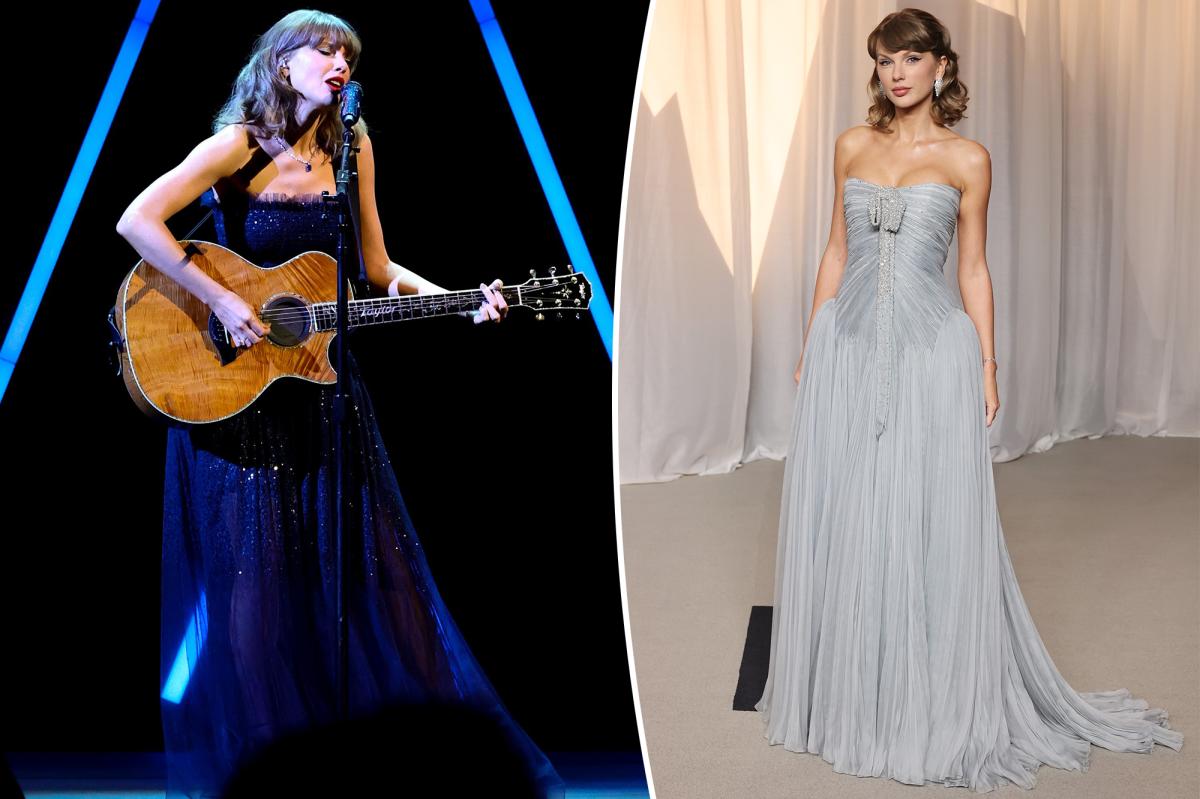
Taylor Swift Turned the Academy Museum Gala Into Her Own Sparkling Movie Premiere
In a pale-blue Dior gown and a glittering performance look, Swift debuted “The Fate of Ophelia” live for a room packed with Hollywood royalty.
Taylor Swift did not merely attend the Academy Museum Gala. She arrived looking like the missing heiress in a very expensive fairy tale, then turned the evening into a miniature Taylor Swift festival.
Swift, 36, took the stage Saturday night at the Academy Museum of Motion Pictures’ sixth annual gala in Los Angeles for her first live performance of “The Fate of Ophelia,” the chart-topping song that has already become one of the defining titles in her current era. Videos shared online captured the debut, which came after Swift had already made a red-carpet entrance in a pale-blue Dior gown that practically demanded its own orchestral score.
The dress was strapless, floor-length and made from pleated silk, with a beaded bow providing the kind of polished finishing touch that says Cinderella, if Cinderella had a global stadium tour and a personal relationship with dramatic album rollouts.
The song got its live-action close-up
For the performance itself, Swift changed into a strapless sparkling gown and moved through a set built for a room that understood both cinema and spectacle. Alongside “The Fate of Ophelia,” she performed “Love Story,” “Blank Space” and “I Knew It, I Knew You,” her original song from “Toy Story 5.”
That set list had a neat little Taylor-verse logic to it. “Love Story” is the fairytale classic; “Blank Space” is the razor-sharp character study; “The Fate of Ophelia” brings the doomed-literary-drama energy; and “I Knew It, I Knew You” places her squarely in the business of making even an animated movie soundtrack feel like an event.
Swift has been treating live appearances as carefully timed punctuation rather than routine promotion. In June, she surprised the crowd at Travis Kelce’s Tight Ends & Friends concert by joining Lainey Wilson for “Love Story.” Earlier that month, she performed “I Knew It, I Knew You” at the Los Angeles premiere of “Toy Story 5,” where she also joined Randy Newman for “You’ve Got a Friend in Me.” Now, at the Academy Museum Gala, she has given another major song its first stage life.
It is a very Swiftian way to keep the public conversation moving: do not simply release the song, let everyone wonder when and where it will become a moment.
Hollywood’s fanciest room got a pop-star intermission
The audience was stacked with the sort of names that make a gala photo feel like a studio lot with better lighting. The evening honored filmmaker and composer John Carpenter, Oscar nominee Colman Domingo and Oscar winner Charlize Theron. Gala co-chairs Tom Ford, Robert Rodriguez, Steven Spielberg and Kate Capshaw were also in attendance, while the host committee included Jessica Alba, Adrien Brody, Georgina Chapman, Kirsten Dunst, Regina Hall, Kate Hudson, Jessica Lange, Greta Lee, John Legend, Chrissy Teigen, Rami Malek, Demi Moore, Olivia Munn, Da’Vine Joy Randolph, Seth Rogen and Teyana Taylor.
That crowd gives Swift’s performance a particular kind of gloss. This was not a conventional concert stop or an awards-show medley engineered around a trophy. It was a room devoted to film, surrounded by people who understand the mechanics of image-making, suddenly watching one of pop’s most controlled image-makers put on a show.
The Academy Museum announced Swift’s appearance on Oct. 8, with museum director and president Amy Homma calling her “an extraordinary talent whose work resonates around the world.” The booking made sense on paper. Swift’s recent public career has increasingly blurred the line between musician, director, actor-adjacent cultural figure and full-time curator of her own mythology.
From the VMAs to the museum, she is still making entrances
The gala was Swift’s biggest public appearance since the 2026 MTV Video Music Awards, where she made history by surpassing Beyoncé as the show’s most-awarded artist. At that ceremony, she accepted the inaugural MTV VMA Artist Director Honors from Dakota Johnson, then used the end of her speech to debut the music video for “Patient Zero,” featuring Johnson and Colin Farrell.
She also accepted Video of the Year for “The Fate of Ophelia,” making the gala performance feel less like a random encore and more like the next chapter in a carefully staged campaign. The song had already won its awards-show coronation; now it received the live treatment in a room where the visual language mattered almost as much as the music.
Swift told the VMA audience that she had been involved in roughly 60 music videos, writing and directing 18 of them, and credited fans for making that work rewarding. The Academy Museum appearance offered another reminder of why her music videos and performances travel so effectively online: they arrive with a clear silhouette, a strong costume and enough narrative bait to keep people replaying the clips.
On this night, the silhouette was unmistakable. Pale-blue Dior on the carpet. Glittering gown under the lights. A title borrowed from tragedy. A room full of movie stars. Taylor Swift has spent years proving that a pop performance can function like a premiere, and at the Academy Museum Gala, she skipped the metaphor entirely.