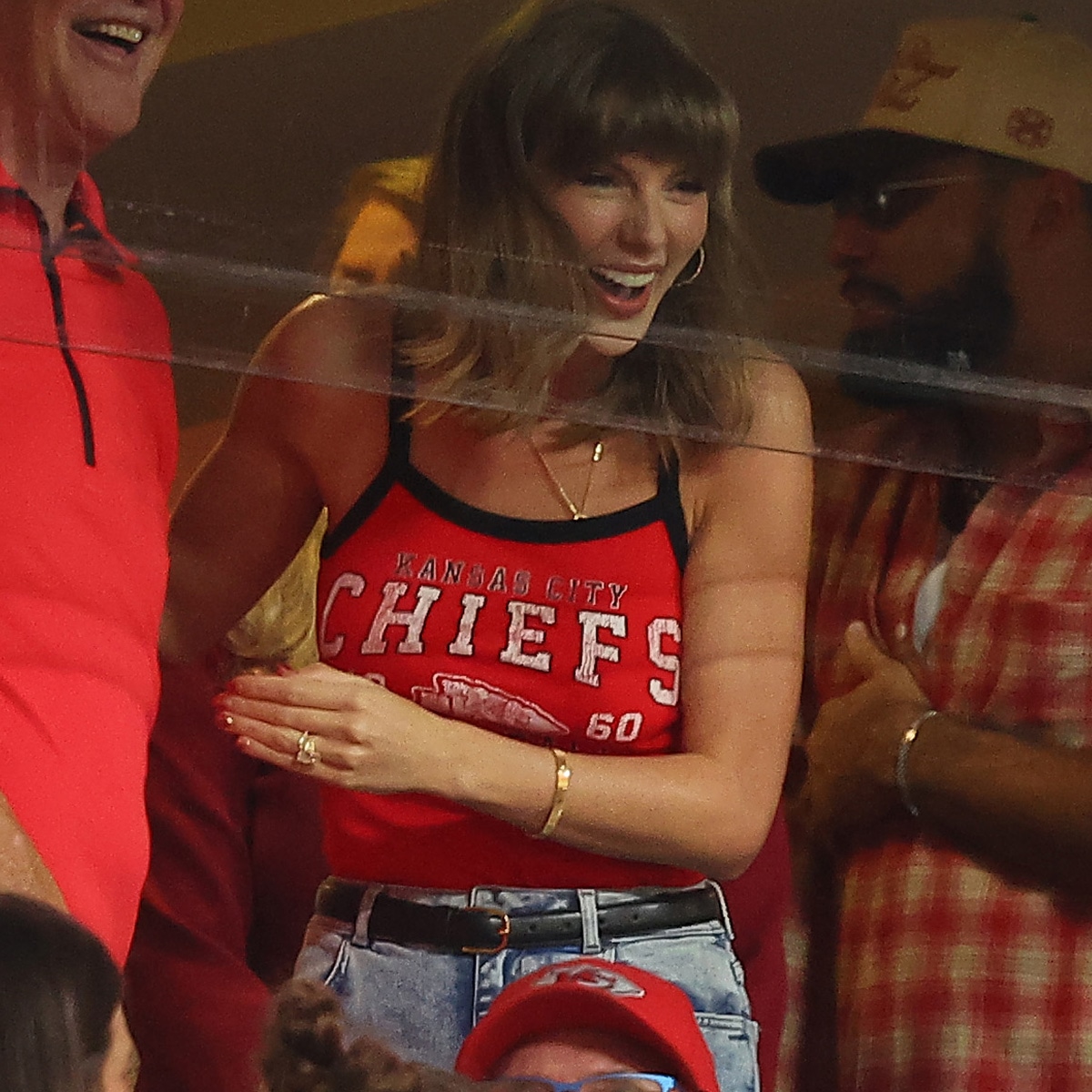
Taylor Swift’s Chiefs Game-Day Wardrobe Has Become Its Own Love Language
From a red lip and distressed denim to a custom jersey-number puffer, Swift’s football fits turned the suite into a very expensive episode of relationship television.
Taylor Swift does not simply attend a Kansas City Chiefs game. She arrives with a plot, a color story and at least one accessory that knows exactly whose name is on the jersey.
That is the particular magic of Swift’s game-day wardrobe: it manages to be celebrity dressing, girlfriend dressing, stadium dressing and highly legible pop mythology all at once. According to E! News’ latest look back at her Chiefs appearances, the singer’s football fits have moved from casual first-date energy to full-scale visual world-building. There are red lips, tiny shorts, designer corsets, team jackets, custom coats and enough carefully placed crimson to make Arrowhead Stadium look like a Swiftie convention with a scoreboard.
The clothes are not incidental. They are the message, delivered in denim, leather, cashmere and the occasional piece of merchandise with Travis Kelce’s number hiding in plain sight.
It started with “I just came to watch my guy”
Swift’s first appearance at Arrowhead Stadium in September 2023 was comparatively low-key by Swiftian standards: a white DÔEN tank, distressed Ksubi denim shorts, a Chiefs windbreaker and New Balance sneakers. It was relaxed enough to suggest spontaneity, but polished enough to make clear that “I threw this on” was not the assignment.
Then came the New Jersey game against the Jets, where Area denim shorts reportedly sold out after Swift wore them with Christian Louboutin boots and a loose leather shirt from Gant. This was the first crucial lesson of the Swift football era: a stadium outfit could behave like a music-video costume and a retail alert at the same time. The venue was MetLife, the guest list included Blake Lively and Ryan Reynolds, and Swift’s red lip did what red lips do best—made the whole thing feel instantly iconic.
By October, the wardrobe had acquired connective tissue. She wore a Chiefs jacket from WEAR by Erin Andrews, the sports reporter’s line, after Andrews had been publicly associated with helping connect Swift and Kelce. It was a small fashion choice with a giant subtext: the outfit could nod to the romance without ever having to explain it.
That is Swift’s particular talent. She lets a garment carry the wink.
Then the suite became a runway
As the relationship became more public, the looks got more deliberate—and much more fun. A Balenciaga corset appeared under the Chiefs jacket. An Erimish bracelet echoed Kelce’s jersey number. A long red fleece coat and signature lipstick turned a December game into a monochrome fantasy. On Christmas Day, she added a Santa hat bearing his number, because apparently even holiday dressing needed a little tight-end branding.
There is a difference between dressing in team colors and dressing inside a narrative. Swift’s game-day clothes increasingly belonged to the second category. A cream varsity jacket carried the team logo and a “Tay-Tay” patch. A custom puffer by Kristin Juszczyk, wife of San Francisco 49ers fullback Kyle Juszczyk, incorporated Kelce’s number. When Swift wore a cashmere Guest in Residence sweater from friend Gigi Hadid’s brand while celebrating with Kelce after the AFC Championship win, the look landed somewhere between luxury loungewear and soft-launch propaganda.
None of this reads as accidental, even when the pieces are casual. The styling keeps balancing access and distance: she is close enough to be in the family suite, but still dressed like the most famous person in the building. She can stand beside Kelce in a cozy sweater, then appear at the Super Bowl in a Dion Lee crochet corset, Area crystal-slit jeans and a black-and-white palette that makes “supportive partner” look suspiciously like “headlining act.”
The result is a visual language of public affection without the need for a caption. A bracelet does the flirting. A number does the tagging. A coat does the announcing.
Swift’s real trick is making fandom look expensive
By the 2024 and 2025 seasons, the game-day wardrobe had become more fashion-editorial. There was a Versace denim corset with GRLFRND shorts and thigh-high red latex boots. There was an oversized tee worn as a dress with thigh-high boots. Vivienne Westwood plaid arrived with knee-high platforms, followed by a red-and-black Versace tweed blazer and skirt paired with a Victoria’s Secret silk corset top.
These looks did not try to disguise the fact that football had become a new stage. They embraced it. Swift was not dressing like a lifelong sports dad in a polo shirt; she was dressing like Taylor Swift at a football game, which is its own emerging category of American celebrity costume.
Even the more communal moments had styling intelligence. E! notes Swift walking into Arrowhead with Kelce’s mother, Donna, and her father, Scott, in a Louis Vuitton cashmere zip-up. Another appearance paired a Charlotte Simone coat with a vintage Chanel hat. For the AFC divisional playoff game, she returned after more than two weeks away in head-to-toe Chanel with Canada Goose gloves. The outfit said winter weather, yes, but also: absence makes the wardrobe grow more dramatic.
And when the Chiefs lost the Super Bowl, the clothes did not retreat. Swift arrived in bedazzled denim shorts and a $1,300 Alaïa ribbed bodysuit. The team could have a bad night; the outfit was not going to take the blame.
That may be why the looks continue to fascinate. They are not just examples of celebrity styling, and they are not merely evidence of Swift’s ability to sell out a pair of shorts. They are a running record of how a highly scrutinized romance can be made playful, public and visually coherent. The outfits turn the stadium into a shared language: red for the Chiefs, a number for Kelce, a designer label for the Swift machine, and just enough wink to keep the whole thing from feeling like corporate dress-up.
For her first NFL game after marrying Kelce, E! places Swift in another red-and-cream gingham Guest in Residence dress. It is a neat evolution from the windbreaker-and-sneakers beginning: still team-minded, still approachable, but now unmistakably hers.
Swift’s football wardrobe has never really been about blending in with the crowd. It is about making the crowd part of the look. And if the game happens to come with a touchdown celebration, a famous suite and a husband whose jersey number keeps turning up in the accessories? Even better. That is not an outfit repeating. That is a franchise.
Brooklyn and Nicola Kiss in Paris as the Beckhams Rally Around Victoria’s Fashion Show
One couple, two Paris itineraries, and a family drama that has somehow turned Fashion Week into a very expensive group chat.
Paris Fashion Week has many traditions: impossible shoes, tiny sunglasses, a celebrity sighting every six feet and at least one family drama unfolding in couture lighting. This week, the Beckham saga supplied all four.
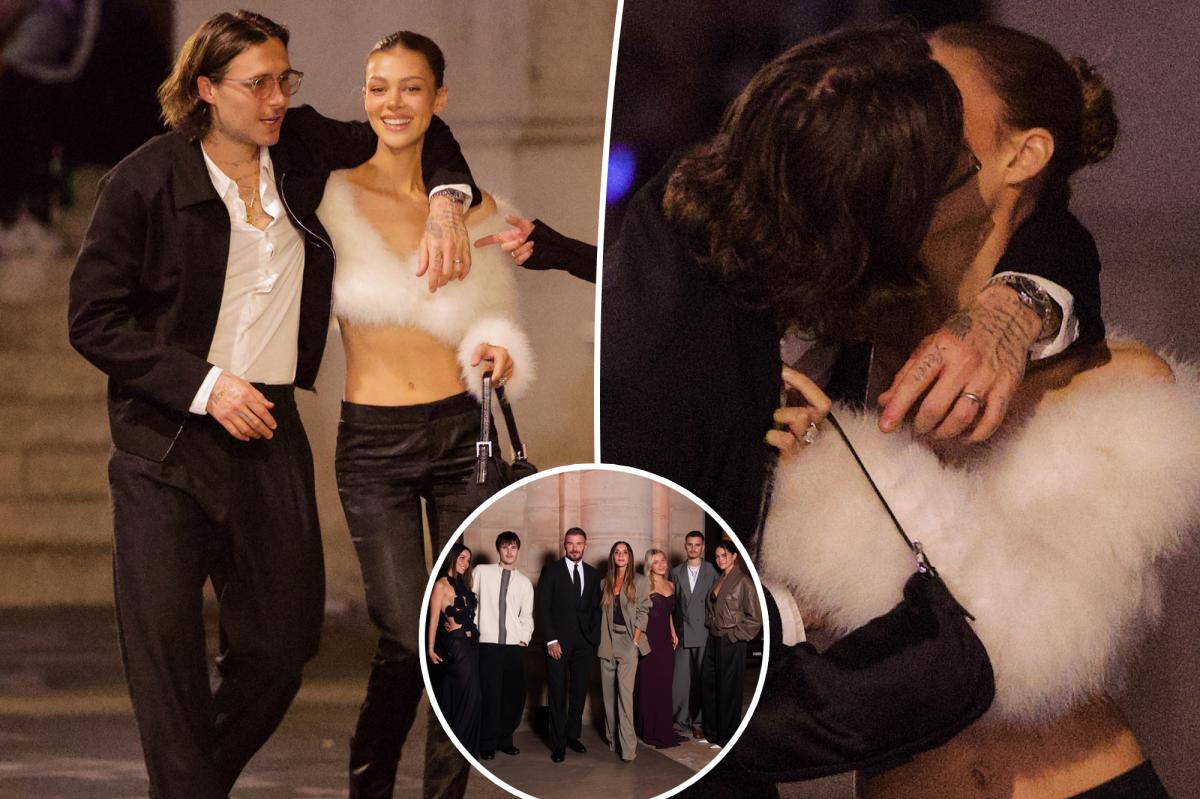
On Friday, Brooklyn Beckham and Nicola Peltz were photographed kissing and strolling through Paris, looking happy and very much like a couple on their own romantic itinerary. Across town, or at least in a very different corner of the Beckham family universe, Victoria Beckham presented her spring/summer 2027 collection with David Beckham, Harper, Cruz, Romeo and the younger men’s girlfriends gathered around her.
The visual contrast was almost aggressively tidy: Brooklyn and Nicola in their loved-up lane; the rest of the family assembled for Victoria’s major fashion night. In a family already communicating through carefully observed appearances, the timing did not exactly whisper.
Paris, but make it two separate worlds
Brooklyn’s absence from his mother’s show comes after months of public estrangement from his parents and siblings. He and Nicola were not photographed at Victoria’s presentation, while David shared images from the event and praised his wife publicly.
“We are so proud of you, yet again you show your elegance, passion & beauty in how you want people to feel in your clothes,” David wrote, adding that the family felt “so lucky to be part of your beautiful night.” He finished with a very Beckham flourish: French and patriotic heart emojis, plus a declaration that they “couldn’t be prouder.”
It was a warm, polished family tableau — the kind of image that would once have been filed under celebrity domestic bliss. Instead, it landed against the backdrop of Brooklyn’s continued absence, making the group photo feel less like a casual backstage snap and more like a public statement of togetherness.
Meanwhile, Brooklyn and Nicola offered their own statement without saying anything at all: a kiss on the Paris streets, a stroll, and the familiar visual language of a couple closing ranks. They have been posting affectionate images throughout the year, including photos Brooklyn shared in August of the pair cuddling in bed.
The feud is no longer hiding in the margins
The tension became impossible to treat as mere family awkwardness earlier this year, when Brooklyn posted a lengthy statement saying he did not want to reconcile with his family. He wrote that he was “not being controlled” and was standing up for himself, while accusing his parents of controlling the family narrative in the press.
He also claimed that his parents interfered in his relationship with Nicola and tried to damage their marriage. In the same post, Brooklyn alleged that Victoria behaved inappropriately toward him at his wedding and that his parents pressured him over rights to his name before the couple’s Florida nuptials. Those are Brooklyn’s allegations; neither David nor Victoria has publicly addressed every claim individually.
Victoria later spoke about the situation in an interview with the Wall Street Journal, without naming Brooklyn. “We’ve always tried to be the best parents that we can be,” she said, adding that she and David had spent more than 30 years in the public eye trying to protect and love their children. It was a classic Beckham response: measured, affectionate and notably short on details.
That restraint has left the family’s public appearances doing a lot of the talking. Who is in the photo. Who is not. Who is standing beside whom. Which couple is together at the same event. Which couple is photographed elsewhere, looking blissful enough to make the separation feel intentional even when nobody says that it is.
The Saint-Tropez near-miss made this feel familiar
This is not the first time the family has appeared to orbit the same French holiday without quite occupying the same space. In August, Brooklyn and Nicola were vacationing near his parents in Saint-Tropez while spending time on Brooklyn’s godfather Elton John’s yacht. The couple went ashore for ice cream, while David and Victoria were photographed dining at a restaurant only minutes from the spot.
That episode had all the ingredients of a glossy European farce: yachts, gelato, famous parents, famous in-laws and the possibility of an accidental encounter at the exact wrong restaurant. Nobody needed to announce a confrontation. The geography did the work.
Now Paris has offered a sequel, only with a fashion-show finale. Victoria had one of the most visible nights on the fashion calendar. David made sure the occasion was celebrated online. The younger siblings and their partners appeared alongside the brand founder. Brooklyn and Nicola, meanwhile, were photographed in the city sharing a kiss.
Fans think the timing is meaningful, and the internet is naturally treating the split-screen as a new chapter in the Beckham family drama. But the most compelling part is not whether the kiss was staged as a message or simply a kiss between two married people in Paris. It is that, in this family, private decisions have become public choreography.
A kiss, a runway and the politics of being seen
Brooklyn and Nicola have never been shy about looking united. Their relationship has survived wedding speculation, post-wedding scrutiny and years of headlines about friction with the Beckham family. Their public displays of affection now carry an extra layer because the couple’s partnership is positioned against the family Brooklyn says he no longer wants to reconcile with.
That makes every romantic image feel slightly more loaded than a standard celebrity PDA. The kiss says they are together. The location says Paris. The night says Victoria’s show. The lack of an appearance at the presentation says, at minimum, that Brooklyn and Nicola were not participating in the family’s most visible gathering of the evening.
On the other side, David’s post presented Victoria surrounded by the people who did attend, with the kind of supportive caption designed to leave no doubt about the family’s pride in her. It was not a direct response to Brooklyn. It did not need to be. Celebrity families rarely need to name the missing person when the photograph is already doing the arithmetic.
And so the Beckhams continue their strange new tradition: communicating through proximity, absence, affectionate captions and suspiciously well-timed public moments. Victoria gets the runway. David gets the family portrait. Brooklyn and Nicola get the Paris kiss. Everyone gets photographed.
In another family, this might be a scheduling conflict. In the Beckham cinematic universe, it is a full Fashion Week subplot — one with excellent lighting, a romantic French backdrop and absolutely no sign that the group chat is calming down.
Phil Collins and Paul McCartney Finally Ended Their 24-Year Feud — Over One Very Loaded Little Word
A rare Beatles book, a bruised ego and a phone call about charity have officially closed one of music’s strangest long-running celebrity grudges.
Some celebrity feuds arrive with diss tracks, courtroom filings and coordinated paparazzi walks. Others begin with a Beatles book and one allegedly patronizing adjective.
Phil Collins and Paul McCartney have apparently chosen the second, much more British route.
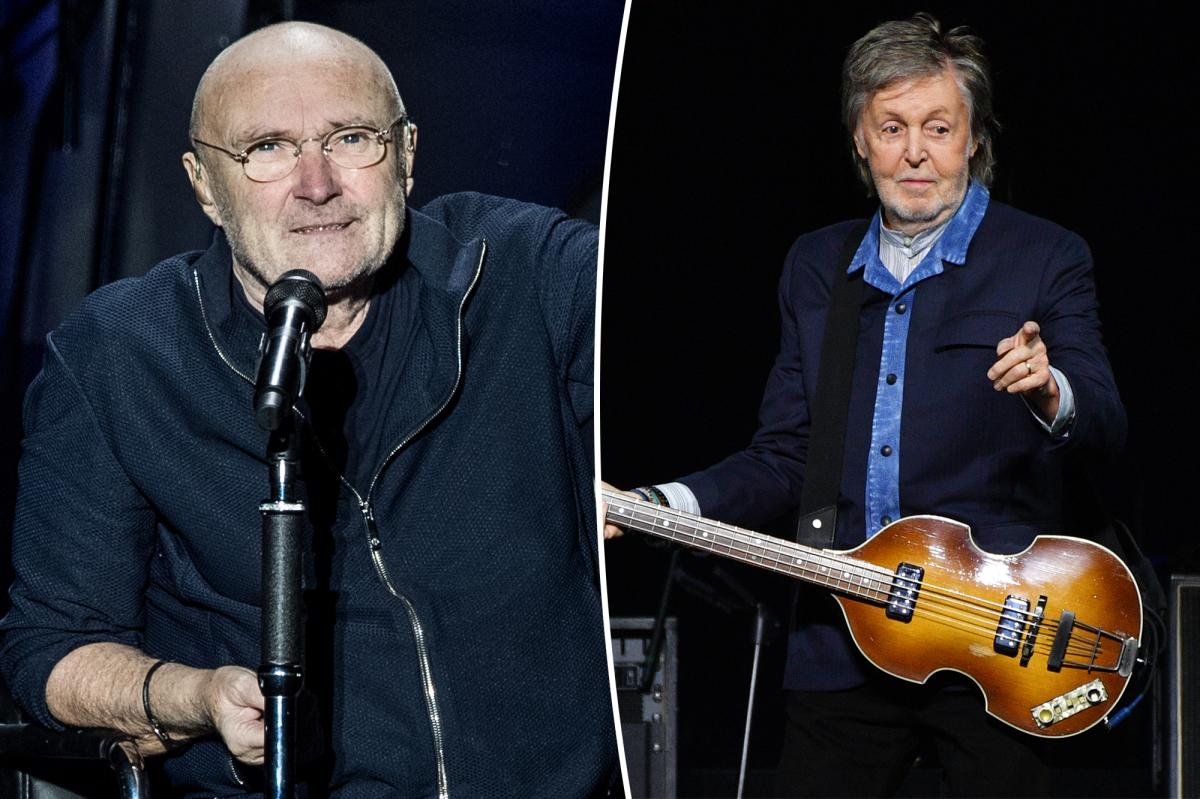
Collins, 75, revisited his famously odd 24-year estrangement from McCartney, 84, during an interview on Piers Morgan Uncensored. The good news: the bad blood is over. The even better news: the story remains gloriously awkward, because the entire saga appears to have been powered by a single word Collins heard in 2002 and never quite forgot.
That word was “little.”
The feud began with a Beatles collectible and a bruised ego
The scene was the Queen’s Jubilee Concert at Buckingham Palace in 2002. Collins, then already an enormous star as the former Genesis drummer and solo hitmaker, brought a rare first edition of Hunter Davies’ book about The Beatles and asked McCartney to sign it.
According to Collins’ recollection, McCartney turned to his then-wife Heather Mills and said, “He’s a big Beatles fan, is our little Phil?”
Collins’ internal response was immediate and considerably less diplomatic: “You arsehole.”
To be fair, Collins has repeatedly acknowledged that he may have inflated the insult in his own mind. During the Morgan interview, he said he “probably made more of it than he meant” and admitted that he did, in fact, make more of it. But once a tiny slight has been filed away by a famous person with a long memory, it can apparently achieve the staying power of a classic album.
Collins has said the comment landed badly because he felt McCartney had treated him condescendingly before. The issue resurfaced publicly years later, when Collins discussed it while promoting his 2016 memoir, Not Dead Yet. He recalled McCartney responding to the account by email, saying he was disappointed and telling him not to be “sacrosanct” — a word Collins said he was not sure he understood, but which nevertheless left “a bad taste” on both sides.
Imagine being one of the most successful musicians alive and still thinking about whether a former Beatle called you small in front of his wife. Celebrity: it is just like us, except the signed book is worth considerably more.
Then McCartney made the first move
The reconciliation began with a charity auction. Collins told Morgan that he had been asking fellow musicians whether they had memorabilia they would be willing to donate for an auction benefiting the King’s Trust.
McCartney apparently heard about it and called him.
The conversation did not stay on auction logistics. McCartney brought up the estrangement and asked Collins, “What is all this about?” That question has the energy of a man discovering that an old office tension has somehow survived multiple decades, several royal concerts and the entire rise of social media.
Collins told him, “I wish I’d never said it. I wish I’d never said it.” McCartney, for his part, said he thought they were already good.
And then, in Collins’ telling, they kissed and made up.
That phrase is doing a lot of work here. There was no grand public summit, no dramatic backstage embrace released to the tabloids, no carefully staged photograph of two legends smiling beside a peace treaty. Just a phone call, a difficult conversation and two men deciding that a 24-year grudge was perhaps no longer worth carrying.
Collins still managed one final jab. He said McCartney had clearly been bothered by the situation because “he likes to be liked, as we all do … maybe him more than some other people.” The feud may be over, but apparently the director’s commentary remains available.
It’s the most rock-star way to resolve a very un-rock-star problem
There is something almost charmingly miniature about the original offense. This was not a creative betrayal or a stolen publishing credit. It was not a relationship implosion or a spectacular awards-show snub. It was a Beatles superfan asking a Beatle to sign a book, then interpreting a familiar-sounding remark as a condescension grenade.
That tension is what made the feud so durable. Collins was not some random admirer hovering at the edge of McCartney’s orbit. He was a global star in his own right, a musician whose songs — “In the Air Tonight,” “Against All Odds,” “You’ll Be in My Heart” — occupy their own permanent wing of popular culture. Yet in the story he tells, the Beatles’ mythology briefly reduced him to exactly what he did not want to be: the little fan asking for approval.
McCartney’s version of the encounter is not included in the Page Six account, and Collins has allowed that the original comment may not have carried the weight he assigned to it. That ambiguity is practically the entire plot. A remark that may have been teasing, affectionate or simply careless became a private grievance, then a published grievance, then an email grievance, and finally a phone-call grievance.
It is also a reminder that old celebrity feuds often survive because nobody wants to be the first person to admit the whole thing got weird. The longer the silence lasts, the more ceremonial it becomes. Eventually, someone has to say: Why are we still doing this?
Full circle, with one last sting
Collins later told the Sunday Times that he was glad they had talked because McCartney is “part of my life.” He also said he wished he had never made the comments, while acknowledging that the original incident did happen as he remembered it.
That is a surprisingly generous ending for a feud built on wounded pride. It leaves room for both things to be true: Collins felt slighted, and McCartney may not have intended to create a decades-long emotional subplot. The two musicians have known each other since long before the disagreement, including the era when their paths crossed publicly in the 1980s. The grudge was a chapter, not the whole biography.
Still, “we kissed and made up” is a very satisfying final line for a story that began with a signed Beatles book. Somewhere, that first edition is presumably still sitting in Collins’ collection, carrying the atmosphere of a diplomatic incident.
And somewhere in the great celebrity archive of inexplicably persistent beefs, Phil Collins and Paul McCartney have finally moved from “ancient history” to “slightly embarrassing anecdote.” The peace may be genuine. The sting of “little” may be gone. But the phrase has now achieved immortality — which is more than most adjectives can say.