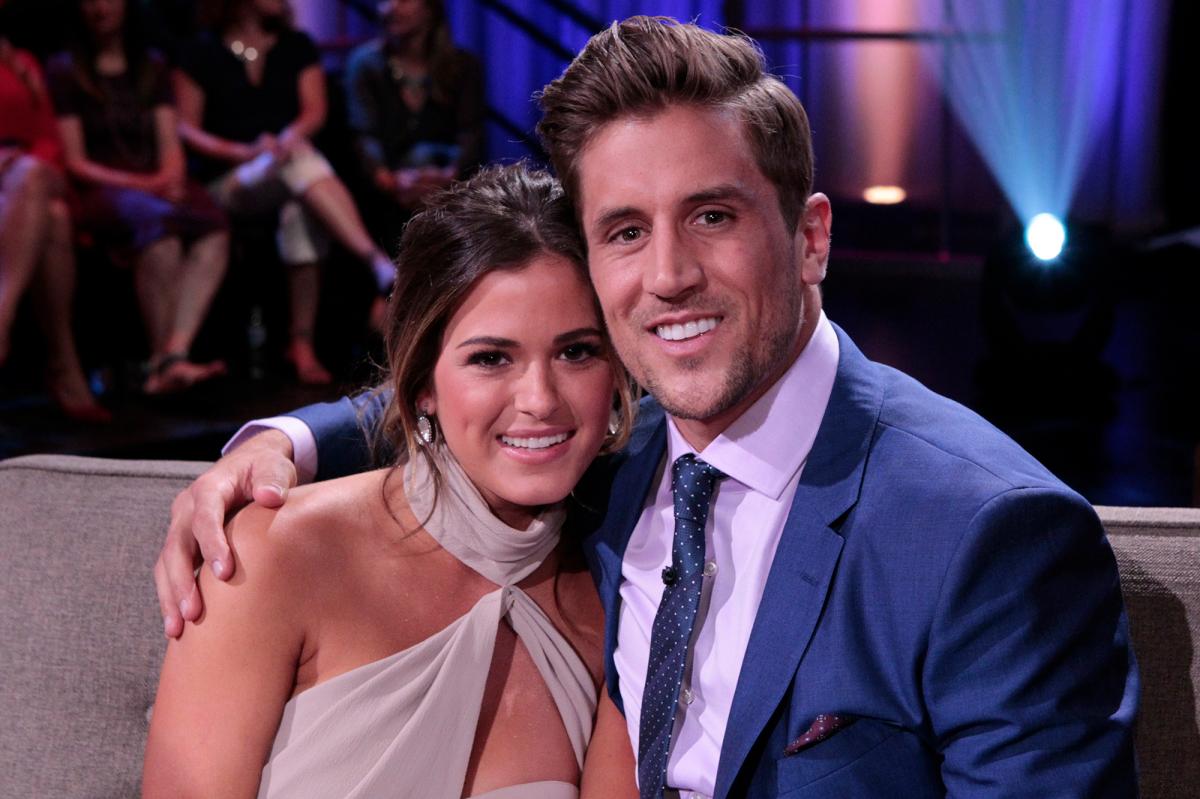
JoJo Fletcher Says Bachelor-Nation Gossip “Wrecked” Her and Jordan Rodgers — Then They Did the Most Un-Reality-TV Thing Possible
Ten years, two postponed weddings, one new baby and a famous-family media storm later, the former Bachelorette couple says their survival strategy was simple: leave the bubble.
JoJo Fletcher and Jordan Rodgers were supposed to be a fairy tale. Instead, they got the full Bachelor Nation experience: a televised proposal, a relationship immediately placed under a microscope, headlines Fletcher says were “so far from the truth,” and a famous-family subplot involving one of the most recognizable surnames in football.
Now, nearly a decade after their season of The Bachelorette ended, Fletcher is looking back at the part of the love story that did not make for a particularly dreamy montage. The scrutiny, she told Page Six, “wrecked” the couple during the early days of their relationship — a surprisingly candid admission from a pair whose entire public identity was built around making it out of reality TV together.
“We were like, ‘Why are they saying this and this?’” Fletcher said. “I think part of that contributed to some of the stresses that we had as a new couple and a new relationship trying to figure out life together.”
The engagement came with a side of chaos
Fletcher and Rodgers met in 2016, when she was the lead on Season 12 of The Bachelorette. He proposed during the finale, delivering the kind of glossy, emotionally engineered ending the franchise has perfected. But the moment the cameras stopped rolling, the couple had to figure out how to become an actual couple while the audience continued treating them like a season-long plot twist.
That transition was especially noisy because their romance arrived at a moment when social media was becoming an even more aggressive second screen for reality television. Fletcher said the media was “obsessed with the show” when they came off the series, and the couple found themselves reacting to coverage while still trying to learn basic things about one another outside a mansion, a rose ceremony and a production schedule.
“We had a pretty tough year,” Fletcher said. She has been open about that period before, but the new comments sharpen the picture: the fairy tale was not necessarily falling apart because of one dramatic betrayal or a single explosive fight. It was being strained by the weird pressure cooker of becoming a real couple in public, with strangers confidently narrating the relationship in real time.
That is the less glamorous sequel to a reality-TV proposal. Everyone else gets to debate whether the couple is genuine; the couple has to decide who is doing the dishes, how to handle work, and whether the person they met on television still fits into the life waiting outside it.
Then came the Rodgers family subplot
Jordan’s last name also guaranteed that the couple’s story would never be only about Jordan and JoJo. During Fletcher’s season, his family became a major storyline when he introduced her to his parents and his brother Luke in Chico, California — while addressing his strained relationship with his famous older brother, NFL quarterback Aaron Rodgers.
Luke spoke openly on the show about the pain of the estrangement. “It pains both of us,” he said at the time. “We miss our brother.” The family conflict created a media frenzy that followed the couple beyond the finale, adding another layer of public drama to an already exposed relationship. Aaron has since said the family is working on rebuilding its relationship, but for Fletcher and Jordan, the old storyline remains part of the archive of their very public beginning.
It is hard to imagine a more chaotic launch package for a new engagement: get engaged on national television, absorb a wave of romantic speculation, and become adjacent to a family story involving one of the most discussed quarterbacks in the country. All while trying to work out whether your relationship can survive the trip home.
Their anti-Bachelor strategy was almost aggressively normal
Fletcher says the move that helped them most was also the least dramatic one. They got out of the franchise bubble as quickly as possible.
“We went straight back to our normal lives,” she said. “We were straight back to work. We didn’t stay and we didn’t do all this and that event and that party.”
In a universe powered by reunion specials, sponsored appearances and increasingly elaborate reality-TV crossover events, that sounds almost radical. The couple did not try to stretch the finale into a permanent lifestyle. They stepped away from the pageant of being a Bachelor Nation success story and dealt with the untelevised version of their relationship instead.
Fletcher said that was important because, after a show ends, couples are suddenly expected to navigate “real problems and real life obligations and responsibilities” while everyone else assumes they have already reached the happily-ever-after. The real work, she suggested, began after the cameras stopped rewarding them for being romantic.
“We’ve always kept choosing each other and we kept choosing to work through it,” she said.
Ten years later, the plot twist is that it worked
Fletcher and Rodgers married in May 2022, after postponing their wedding twice because of the COVID-19 pandemic. On Dec. 23, 2025, they welcomed their first child, a daughter named Romy Blair Rodgers, following an emergency C-section.
That timeline gives the couple’s early chaos a very different afterlife. The headlines that once felt catastrophic now look, in Fletcher’s words, “so silly.” A decade after they met, they have a marriage, a baby and enough distance from the franchise to laugh at the melodrama that once seemed capable of swallowing them whole.
“He really is my best friend,” Fletcher said of Rodgers. She also described meeting him through the show as “a really funny story to tell,” which may be the most emotionally healthy possible ending for a relationship that began under studio lights and public suspicion.
Fletcher was speaking to Page Six while discussing her partnership with Mucinex 12HR Cold & Fever Multi-Symptom, and motherhood has given her a new perspective on the importance of looking after herself. “When you become a mom, you don’t get to feel sick,” she said, adding that the product helped her get through the day.
But the bigger message from her retrospective is not that Bachelor couples can magically escape the machinery that made them famous. It is that Fletcher and Rodgers eventually stopped performing the machinery’s idea of a perfect relationship. They left the parties, went back to work, endured the noise and kept making private decisions inside a very public story.
That is not the fantasy the franchise sells. It is messier, less photogenic and considerably more convincing: the proposal was televised, the pressure was real, and the happily-ever-after had to be built somewhere the cameras could not follow.

Olivia Culpo Has a Birth-Day Backup Plan—and It Involves Her Sister, a 49ers Schedule and a Hospital Handoff
With Christian McCaffrey in the middle of NFL season, Aurora Culpo says she is ready to step in when her pregnant sister goes into labor.
Olivia Culpo’s second baby is apparently arriving with a birth plan, a backup plan and the kind of family group chat logistics that could qualify as a minor military operation.
Her husband, San Francisco 49ers running back Christian McCaffrey, has football commitments to navigate. Her sister Aurora Culpo has a four-month-old baby of her own, two older children, a fiancé and, by her own admission, absolutely no real concept of balance. Still, Aurora says she is ready to show up at the hospital if Olivia goes into labor on a night when McCaffrey is tied up with the team.
“I said, ‘I’ll come and stay with you at the hospital if he can’t be there that night,’” Aurora told Page Six while co-hosting a Winnie the Pooh 100th Anniversary celebration at her home with Nicole Williams English.
It is a very Culpo-family solution: glamorous on the surface, deeply practical underneath, and complicated by a professional sports calendar that refuses to respect anyone’s preferred delivery window.
The backup plan is very much a sister thing
Olivia and McCaffrey announced their pregnancy in May, sharing the news with their daughter, Colette, who is 14 months old, and their dog, Oliver. Now, with Olivia’s due date approaching, Aurora says the family has already discussed what happens if the 49ers star cannot immediately leave his football duties.
“We had that conversation,” Aurora said, describing the possibility of McCaffrey being on the field when Olivia needs support. “If Olivia does need me to come stay with her in the hospital, I am ready.”
That offer comes with its own domestic juggling act. Aurora welcomed her daughter Selene with fiancé Zac Duvernet on May 15 and is also mom to Soleil, 5, and Remi, 7. Selene is currently in a sleep regression, which means Aurora is volunteering for hospital duty while operating on the sort of sleep schedule usually reserved for new parents, touring musicians and people who have accidentally adopted a puppy.
Olivia even asked the obvious question: doesn’t Aurora need to be home with Selene? The answer, at least for now, is that the family will figure it out. Aurora told Page Six she is prepared to be there if her sister calls.
Olivia’s delivery plan is already on the calendar
Olivia has not shared an exact due date, but Aurora teased that her sister is due “any day.” The timing matters because Olivia has also spoken publicly about how she plans to deliver.
In a “Get Ready With Me” TikTok post, Olivia said she is planning a C-section. She explained that she had a C-section in July of last year and that a VBAC—vaginal birth after cesarean—was not an option for her this time.
That planned date could make the McCaffrey family’s scheduling problem slightly less chaotic. A planned procedure offers more predictability than waiting for labor to begin without warning, although the NFL season still supplies the unavoidable wild card. The family may have a date on the books, but football has a way of turning even the neatest calendar into an obstacle course.
Olivia’s pregnancy has unfolded alongside a particularly visible chapter of her life. She and McCaffrey married in 2024 after a high-profile relationship that made sports-and-fashion crossover look almost suspiciously seamless. She has continued sharing pregnancy updates and style moments online, while McCaffrey has remained in the middle of the season with the 49ers.
Now the glamorous maternity content meets the unglamorous question every working parent understands: who is actually getting to the hospital, and who is watching the kids?
Aurora is balancing babies, a wedding and Winnie the Pooh
Aurora’s offer to become Olivia’s hospital companion arrives during her own extremely full season. She is caring for a newborn, raising two older children, planning a wedding and hosting a family-friendly event at home. It is less “having it all” than continuously moving one responsibility into the tiny gap left by another.
“Maybe at some point there’ll be more balance in my life,” Aurora said. “But I don’t think I’ve found a balance yet. So today, it’s Winnie the Pooh. Tomorrow, it’s going to be something else.”
The line is funny because it is also painfully accurate. One minute, Aurora is discussing interactive Disney dolls inspired by Winnie the Pooh and his friends; the next, she is working out how to be present for her sister’s birth while her own baby is waking through the night. Celebrity family life often gets presented as a seamless sequence of coordinated outfits and beautifully lit announcements. Aurora’s version sounds more like a running group text with several people asking who has the car seat.
For Olivia, the arrangement also reflects the particular realities of becoming a parent while married to a professional athlete. McCaffrey’s job is highly public, physically demanding and governed by a schedule that can change the emotional temperature of an entire weekend. His presence at the birth is clearly important to the couple, but so is having someone trusted ready to step in if the timing goes sideways.
The next Culpo baby is coming into a very busy family calendar
Olivia and McCaffrey are already parents to Colette, while Aurora’s household includes three children of three different ages and stages. Add a wedding, a football season and a baby expected “any day,” and the Culpo family calendar has officially entered its maximalist era.
There is no exact delivery date to circle yet, and neither Olivia nor McCaffrey has said that Aurora will definitely be the person beside Olivia when the baby arrives. What is clear is that the sisters have talked through the possibility, and Aurora says she is ready if the call comes.
That may be the most relatable detail in this entire celebrity pregnancy plot: even with a planned C-section, a famous husband and a family full of people accustomed to cameras, nobody gets to control the exact moment a baby decides to make an entrance. The best they can do is keep the hospital bag close, watch the football schedule and make sure one sister is ready to answer the phone.

The *NSYNC Millions Were Apparently a Myth: Lance Bass Says His First Check Was Just $10,000
The boy-band economy was less private jet, more $35-a-day allowance — and Bass says the people cashing in were not the five men singing “Bye Bye Bye.”
There are few pop-culture images more aggressively associated with money than *NSYNC at the turn of the millennium. The matching outfits. The stadium tours. The number one albums. The merchandise flying off shelves while five impossibly famous men became the faces of an entire teen-pop economy.
So it is fairly jarring to hear Lance Bass say that, behind the choreography and the screaming fans, the band’s personal finances were giving “school trip spending money.”
During Thursday’s episode of The Zach Sang Show, Bass claimed that he received a per diem of just $35 a day while *NSYNC was rising to global fame. He also said the group’s first check arrived only after years of success — and was for $10,000.
“Our first check was $10,000,” Bass recalled, saying it came after “years of number one albums” and “sellout tours.” The alleged explanation from the people around the band was brutal in its simplicity: “You should be grateful for that. You’ve been working for free for two, three years now.”
Famous, yes. Rich, apparently not so much.
Bass, now 47, was not describing a mildly disappointing royalty statement. He was describing the financial reality of being one-fifth of one of the biggest acts on the planet — a group whose songs were everywhere, whose videos dominated television and whose branded merchandise became its own cultural weather system.
“I don’t know how many millions I made off of merchandise because merchandise was insane,” he said. But the money he personally saw from *NSYNC, he claimed, was “hardly at all.”
That distinction is the entire plot twist. The band could be making millions around him without the band members themselves becoming millionaires. It is the kind of revelation that makes the glossy machinery of late-’90s pop look suddenly less like a fantasy and more like an extremely successful corporate arrangement in which the talent was apparently the last department to get paid.
“People think I’m so filthy rich from *NSYNC, but no,” Bass insisted. “Not at all.” He said he did well after the group went on hiatus in 2002 and is proud of what he built afterward, but that the major payday did not happen during the band’s imperial phase.
In other words: the fame was immediate, the money was complicated, and the financial afterglow was apparently not automatic.
The Lou Pearlman factor makes the story even darker
Bass attributed the imbalance to the record label and Lou Pearlman, the late manager and creator of the Trans Continental organization that helped launch *NSYNC. “The label” and Pearlman, Bass claimed, “made a f–k ton.”
Pearlman was later jailed after being convicted of money laundering, bankruptcy fraud and conspiracy, and died in prison in 2016. His name has long been tied to one of pop music’s most notorious business scandals, which makes Bass’s account land with an especially unpleasant aftertaste: the group’s public image was all sparkle, while the back-end story was allegedly governed by contracts, deductions and people with considerably more control.
Bass said he no longer carries resentment, but he did not pretend the arrangement was fair. “Everyone kept saying, ‘You’re young, you’re young,’” he recalled. “Well, who cares if you’re young? You still need to make a living and set yourself up for the future.”
That is the line that cuts through the nostalgia. The standard defense of young stars is that they are inexperienced, lucky to be there and surrounded by adults who know better. Bass’s point is that youth may explain why someone signs a bad deal; it does not make the consequences less real. And a career built around a finite window of fame is exactly the kind of career where money should matter early, not only after the screaming stops.
“We were famous, but we were not rich”
This is not the first time Bass has punctured the fantasy that *NSYNC’s success translated neatly into personal wealth. During a 2023 appearance on SiriusXM’s The Jess Cagle Show, he said, “We were famous, but we were not rich.” He also said he made “way more money after *NSYNC than I did during *NSYNC.”
That earlier comment now reads less like a surprising aside and more like the opening chapter of a story he has been telling for years: the band’s cultural value was enormous, but the individual members’ financial reward allegedly lagged far behind it.
Bass has also made clear that he does not view the entire experience as a mistake. He said being part of *NSYNC changed his life and trajectory, and that the group’s support system helped keep the five members grounded. Justin Timberlake, JC Chasez, Chris Kirkpatrick, Joey Fatone and Bass were, in his telling, more than a manufactured pop product; they were also four “brothers” navigating an absurd level of attention together.
That affection is what makes the money story more complicated than a simple scandal headline. Bass is not saying the band was worthless to him. He is saying the people profiting from its value were not necessarily the people performing it.
And that is why the $35-a-day detail is so sticky. It is absurdly small beside the scale of *NSYNC’s fame, but it also makes the whole era suddenly legible. The group was selling a dream of limitless wealth while its members were allegedly being told to be grateful for pocket money and a first check that arrived years too late.
The image of *NSYNC remains glossy: silver suits, synchronized choreography, “Bye Bye Bye” and a cultural footprint that still refuses to leave. Bass’s version adds the unglamorous caption underneath: being the product is not the same as owning the profit.