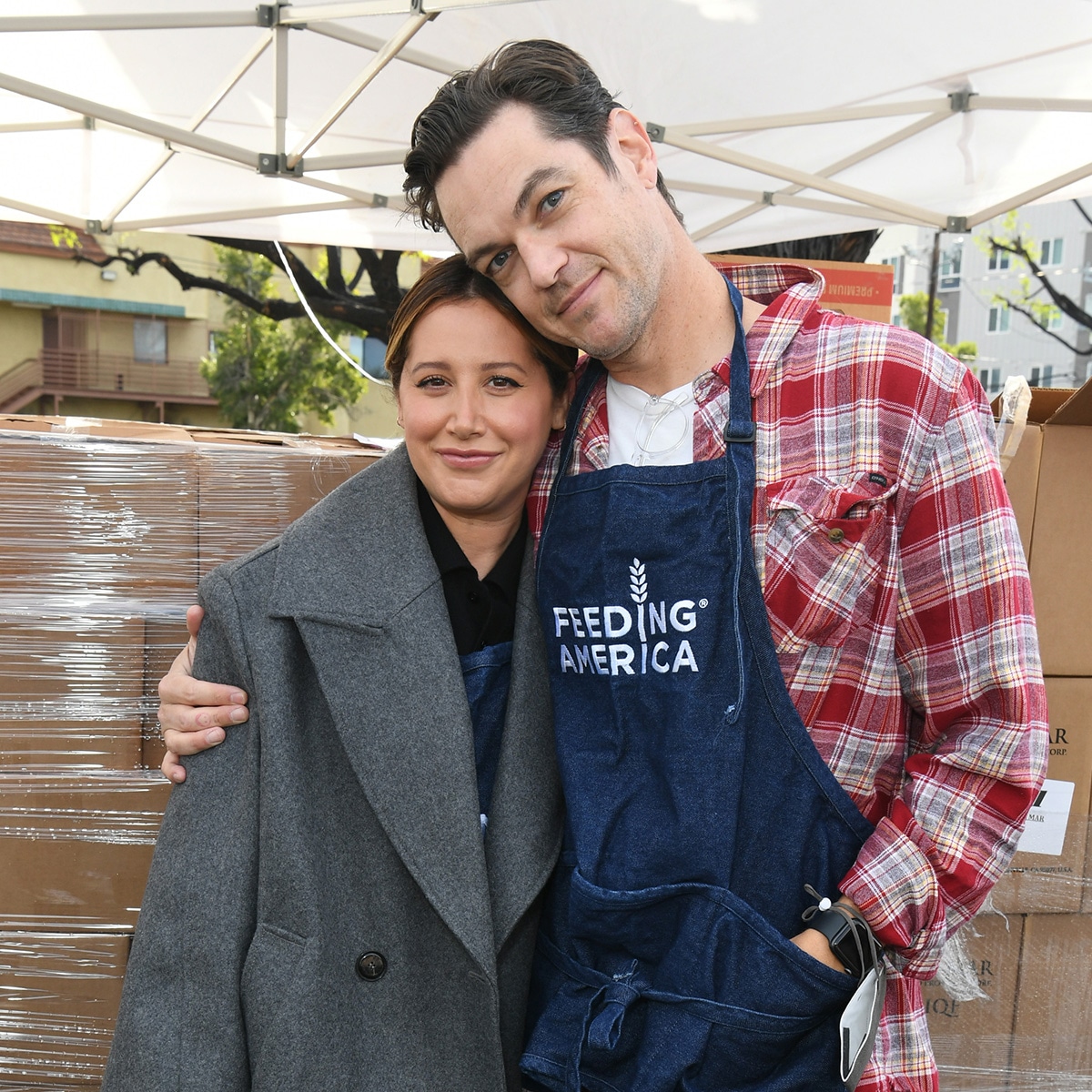
Ashley Tisdale Says Postpartum Depression Made Her Want to Divorce Christopher French
The former High School Musical star opened up about the year her marriage felt impossible—and why French’s calm became a lifeline instead of a plot twist.
Ashley Tisdale is giving the phrase “new-parent fog” a much more honest meaning. On her husband Christopher French’s Recovering podcast, the former High School Musical star revealed that postpartum depression after the birth of their first daughter put such intense pressure on their marriage that she tried to divorce French “so many times.”
It is a startling sentence, especially from a couple who have spent more than a decade presenting a relatively low-drama version of celebrity marriage. Tisdale and French married in 2014, welcomed daughter Jupiter in 2020 and now also share a younger daughter, Emerson. But the story she told on the Sept. 30 episode was not about a relationship collapsing under fame. It was about a mother experiencing a hormonal and psychological crisis she did not yet have language for—and a husband watching the person he loved become unreachable.
“You dealt with a lot of that and we had difficulty during that first year,” Tisdale told French. “I tried to divorce you so many times. But you’re so grounded and calm and knew to just let it blow over.”
The part nobody had properly named
Tisdale said she believed she was prepared for motherhood because she had already worked through anxiety and felt equipped to handle the emotional demands of having a child. Then postpartum depression arrived and made all her carefully collected coping tools feel useless.
“I was so proud of myself for dealing with the anxiety stuff and being like, ‘OK, now I am ready to have a child because I feel like I’m equipped emotionally to be able to do that,’” she said. “But then I got hit with postpartum depression which is really hormonal and all the tools that I learned and knew to use, you can’t use.”
That distinction matters. Anxiety had given Tisdale a familiar set of warning signs and strategies. Postpartum depression, as she described it, changed the entire operating system. She recalled becoming overwhelmed in ordinary situations, including nearly having a panic attack while sitting in traffic. The symptoms were intense, but she said no one diagnosed her at the time.
The diagnosis eventually came from her doctor after the symptoms began to clear around Jupiter’s second birthday. Tisdale remembered the moment with a mix of relief and disbelief: “I remember feeling so much better when the two-year birthday came and she was like, ‘Oh, you had postpartum depression.’ I was like, ‘What? How did you not know to tell me this?’”
There is an especially cruel timing to that realization. By the time she had a name for what had happened, she was already emerging from it. The experience had been real for years, but the explanation arrived late, like a label mailed after the package had already been opened.
French saw the mood shifts up close
French’s account made the story even more intimate. He remembered Tisdale being loving and happy with their newborn one moment, then experiencing what he described as an abrupt, total mood change minutes later.
“Everything had changed,” he recalled. He described watching her lie on the floor and cry in pain, while he felt helpless to fix what was happening. His role became less about solving the problem and more about making the stressful mechanics of life with a newborn slightly easier so Tisdale could get through the crisis.
That is not the glamorous version of a celebrity marriage, and thank God for that. There is no polished anniversary caption here, no carefully arranged couple photo pretending parenthood is just matching pajamas and a well-lit nursery. There is a partner admitting that he could not make the depression disappear, and a woman acknowledging that her own mind had made the marriage feel like an emergency exit.
Tisdale’s comments also make clear that the divorce talk was part of the illness and the strain surrounding it—not a report that the couple is currently separating. French’s calm, in her telling, helped keep those moments from becoming permanent decisions. Neither partner framed the period as easy, but both described it as something they lived through together.
The second time came with a different script
Tisdale said her postpartum experience after welcoming her second child was not as severe. “It’s pretty cool doing it again and not having that experience,” she said, calling the first episode the hardest part of becoming a mother.
That contrast is quietly huge. The arrival of another baby did not simply repeat the first chapter. Tisdale knew more about what she had experienced, had a clearer history to bring to her doctors and family, and was no longer encountering the same symptoms as a nameless personal failure. The second time did not erase what happened after Jupiter, but it gave her a different vantage point on it.
For a public figure whose early career was built on bright, tightly choreographed teen fantasy, Tisdale has become increasingly candid about the unchoreographed parts of adulthood. She has spoken publicly about anxiety before, but this conversation lands differently because it places mental health inside the architecture of a marriage and a family. The headline is the divorce confession. The substance is the delayed diagnosis, the panic, the confusion and the way postpartum depression can make someone feel estranged from the life they thought they wanted.
It also complicates the internet’s favorite relationship shorthand. A marriage can be loving and still be under enormous pressure. A partner can be supportive and still be unable to rescue someone from a medical condition. A mother can adore her child and still feel lost after giving birth. None of those truths cancel the others out.
Tisdale and French’s story is compelling because it refuses the tidy version. There was a baby, a marriage, a mental-health crisis and a long stretch before anyone named it. There were moments when Tisdale wanted out, moments when French could only stay steady, and eventually a clearer understanding of what had been happening.
Celebrity culture usually turns marriage trouble into spectacle: suspicious unfollows, courthouse sightings, a breakup statement with the emotional temperature of a corporate memo. Tisdale offered something messier and more useful. Sometimes the dramatic sentence is not “we’re over.” Sometimes it is “I tried to divorce you because I was sick, and you waited for me to find my way back.”

Raven-Symoné Has Entered Her Diaper Era—and Her Wife Is Fully on Board
On Tea Time, the Disney alum gave period care a wildly personal makeover: disposable diapers, saggy jeans, a baby T-shirt and a whole lot of Rugrats energy.
Raven-Symoné has never been especially interested in behaving like a normal celebrity. Why offer a polished little lifestyle anecdote when you can announce, with complete conviction, that you wear a disposable diaper during your period and sometimes pair it with a baby T-shirt and a pacifier?
That was the wonderfully strange dispatch from a recent episode of Tea Time, the podcast Raven hosts with her wife, Miranda Pearman-Maday. The conversation began with period care and quickly swerved into what can only be described as Raven’s private domestic cinematic universe: saggy jeans, “diaper booty,” a little Rugrats homage and a spouse who can apparently tell what is happening from the sound of her walk.
“What I’m obsessed with are diapers,” Raven said. “I am obsessed with the menstrual cycle diaper.”
There are celebrity overshares, and then there are celebrity overshares that arrive with such specific visual details you can practically see the sitcom cold open. Raven, who is 40, made clear that this is not a one-off experiment or a desperate late-night solution. She described it as her preferred way to handle her period now that her cycles have changed and she no longer wants to keep “sticking things inside” to manage her flow.
Raven’s period-care philosophy is comfort first, dignity optional
Raven said she is “not getting the same types of periods” she had when she was younger. The pain, she explained, has moved to different areas of her body, and the cues have changed. Her answer was not a sleek new wellness routine or an expensive celebrity-approved product. It was the humble diaper: easy to wear, apparently reliable, and roomy enough to accommodate what she called the “ebbs and flows” of her cycle.
“I’m just able to wear a diaper throughout the day,” she said, before adding the accessories. “With a little baby T-shirt and a binky in my mouth and run around the house—shoutout Rugrats—I’m thriving.”
It is a very Raven solution. The former Disney Channel star built her career on characters who made eccentricity look like a superpower, from That’s So Raven’s psychic teenager trying to survive high school to The Cheetah Girls’ musical maximalism. Even her most adult disclosures arrive with a layer of cartoon logic and theatrical commitment. She is not merely dealing with a period; she is apparently staging a one-woman, grown-up nursery production in the living room.
There is also a practical point buried beneath the punchline. Period products have long been treated as something women should conceal, endure quietly or discuss only in carefully sanitized language. Raven’s approach is the opposite: if a product is comfortable and does the job, why should the packaging determine whether it is considered acceptable? The joke is loud, but the basic idea is straightforward. Bodies change. Products change. Personal preferences are personal.
Miranda Pearman-Maday has seen the whole production
The funniest part of the story may be that Raven is not living this diaper life alone. Miranda has front-row access, and she offered commentary with the calm specificity of someone who has long since accepted that this is simply part of marriage.
“That booty is poppin’ in a whole different way,” Miranda said.
She went on to describe the unmistakable sound of a baby walking and said Raven has “diaper booty as a full-grown female.” Raven, meanwhile, suggested that Miranda can recognize the situation immediately. If she sees her wife strutting around the house in the diaper, Miranda knows: Raven is on her period. Understood.
That exchange turns the whole thing from a solo overshare into a relationship bit. There is no embarrassment, no faux shock and no attempt to pretend the other person has not noticed. Miranda is not being asked to admire a glamorous transformation; she is being asked to acknowledge a very specific household uniform. Her response is essentially: yes, I see the diaper. Yes, I know what it means. Carry on.
Miranda also floated the possibility that the look could be “some inner child work” for Raven. That is the sort of phrase that could have sent the conversation into a serious therapy podcast direction, but Raven kept it breezy. The baby T-shirt, pacifier and Rugrats reference read less like a solemn psychological breakthrough than a private ritual with excellent comedic timing.
The grown-up diaper market is waiting for its celebrity moment
Raven did make one serious request during the conversation: if there is a diaper company making products for adults, she is interested. She and Miranda mentioned brands, and Raven contrasted the diaper’s capacity with cloth options she had already tried and found insufficient.
Then came the image that will linger: “There’s nothing like wearing a pair of saggy jeans and like my diaper sagging instead of my Calvins.”
It is hard to imagine a more Raven-Symoné sentence. It has fashion, underwear, bodily function and a faintly chaotic styling directive all in one. Somewhere, a comfortwear brand is staring at that line and wondering whether “diaper booty” can be made into a campaign without losing the joke.
The bigger cultural shift is that period care keeps escaping the bathroom cabinet. Celebrities have talked openly about cramps, cycle changes, hormone fluctuations and the absurd logistics of maintaining a public-facing life while your body is doing whatever it wants. Raven’s version is simply more flamboyant—and considerably less interested in pretending that adulthood means abandoning every childish comfort.
She is also not presenting this as a universal commandment. Her message was essentially: this works for me, everyone should think outside the box, and perhaps the adult-diaper industry should call. That is different from turning one person’s preference into a prescription. Raven is sharing a method, a costume and a household joke, not issuing a new law of menstruation.
Still, it is impossible not to admire the commitment. Plenty of people spend their periods negotiating with waistbands, emergency supplies and the fantasy of being left alone. Raven has chosen a diaper, a baby T-shirt, a pacifier and the emotional support of Rugrats. She is not hiding the inconvenience. She has given it a costume change.
And if her wife’s account is anything to go by, the look has a signature sound.

Will Reeve Turned His Cancer Reveal Into a Mission — With His Wife, His Future Family and Three Men Still in the Fight at the Center
The “GMA” correspondent opened up about the testicular cancer he kept private, the tender lump he nearly dismissed and the fear that his loved ones were putting their lives on hold for him.
Will Reeve did not arrive on “Good Morning America” looking for a sympathy segment. He arrived with a mission, a stack of difficult memories and the kind of sentence that makes a morning show suddenly feel much quieter: he had been through testicular cancer, multiple surgeries and chemotherapy, and now, he said, the diagnosis was “in the rearview mirror.”
That was the headline. The more revealing part was what came after.
At 34, Reeve admitted he had worried about becoming a burden to the people closest to him — especially the loved ones who kept “dropping everything” to be with him. He spoke about the fear with an apology that was less polished than the usual television update and much more human: “I’m so sorry to all of my loved ones who are dropping everything to be with me throughout this whole thing.”
It was not a glossy celebrity health reveal built around a dramatic comeback entrance. It was a man trying to explain what illness does to the people standing beside the hospital bed, too.
The lump he nearly talked himself out of noticing
Reeve revealed the private battle Tuesday on “GMA,” after first telling viewers “right off the top” that he was okay. In an interview with People published the same day, he explained how the whole ordeal began: in April, he noticed a tender lump while showering.
His first instinct was familiar to anyone who has ever tried to negotiate with a worrying symptom. He thought it might pass. He assumed it was nothing. As he put it, he figured it would go away — a particularly dangerous kind of optimism when you are young, healthy and not expecting your body to deliver a plot twist before breakfast.
Weeks later, the lump was still there. Reeve went for an ultrasound at the urging of his wife, Amanda Dubin, whom he married in January. The scan revealed a mass, and the diagnosis that followed turned his private life into a treatment schedule of surgeries and chemotherapy.
There is a reason this part of the story lands so hard. Reeve was not describing some obvious crisis that arrived with a siren attached. He was describing something easy to minimize, followed by the slow realization that “probably nothing” had become something that could not be ignored.
His wife was in the story before the cameras were
Dubin has appeared beside Reeve in the images shared around his update, including a hospital selfie and a 2025 Instagram upload. But the important detail is not the photo-op version of support. It is that she pushed him to get the lump checked when he was still hoping it would disappear on its own.
By the time Reeve spoke publicly, the couple had been married for only a few months. That timing could have turned the segment into a tidy “newlywed health scare” narrative, but Reeve’s comments were more complicated than that. He talked about guilt, dependence and the uncomfortable feeling that the people you love are rearranging their lives around your illness.
Then came the future-facing moment. During the interview, Reeve told Kevin Spies, a man diagnosed at 31 who later became a father during his own cancer journey: “You are what I hope to be soon.”
That line quietly shifted the conversation from survival to possibility. Reeve was not only looking backward at the surgeries and chemotherapy. He was looking toward the life he still wants — including fatherhood — while acknowledging the medical and emotional questions that can accompany a testicular cancer diagnosis.
The “GMA” segment got surprisingly candid about fertility
Reeve’s interview with three men at different stages of testicular cancer was designed to destigmatize the disease, but it did not arrive wrapped in solemnity from start to finish. The group also joked about doctors recommending that patients visit a sperm bank immediately after diagnosis.
Speaking to Will Sette, who was diagnosed at 14 and is now 19, Reeve cracked, “If there’s ever a time to go [to a] sperm bank, it’s probably when you’re 14.” It was an awkward subject made slightly less intimidating by a joke — the kind of moment that acknowledges how surreal the conversation can feel, particularly for young men suddenly being asked to think about fertility while processing cancer.
Spies offered the more emotional counterpoint. He became a father to two sons during his cancer journey and spoke gratefully about modern medicine and the fact that he was able to have children despite the diagnosis. Reeve’s response — that Spies represented what he hoped to be soon — made the segment personal without turning it into a performance of inspirational perfection.
The men were not presented as identical versions of the same story. Spies was diagnosed at 31. McCluskey was diagnosed at 28. Sette was diagnosed at 14. Reeve used those different timelines to make the point that testicular cancer does not belong to one age bracket, one personality or one kind of life.
“It’s a mission for you right now”
By Wednesday, Reeve was back in the “GMA” studio, doing his job and talking about the men he had interviewed as well as his own recovery. He thanked his colleagues, his family and everyone who had reached out. Robin Roberts, who knows something about turning a public platform into a source of purpose, told him: “It’s a mission for you right now. It’s your message.”
That may be the cleanest way to understand why Reeve chose to speak now. The diagnosis was no longer an active secret, and he had already described the treatments as “a slog.” But he did not treat being cancer-free as the end of the conversation. He used the visibility of a national morning show to discuss the symptom he nearly dismissed, the people who carried him through treatment and the awkward subjects — fertility, fear and dependence — that men are often encouraged to keep private.
There is nothing especially glamorous about a cancer story, and Reeve did not try to make one. The striking part was the lack of a victory-lap pose. He was grateful, relieved and clearly still processing what had happened. He was also thinking about his wife, the men he had met and the family he hopes to build.
For once, “in the rearview mirror” did not mean the story was over. It meant Reeve could finally turn around and talk about the road.