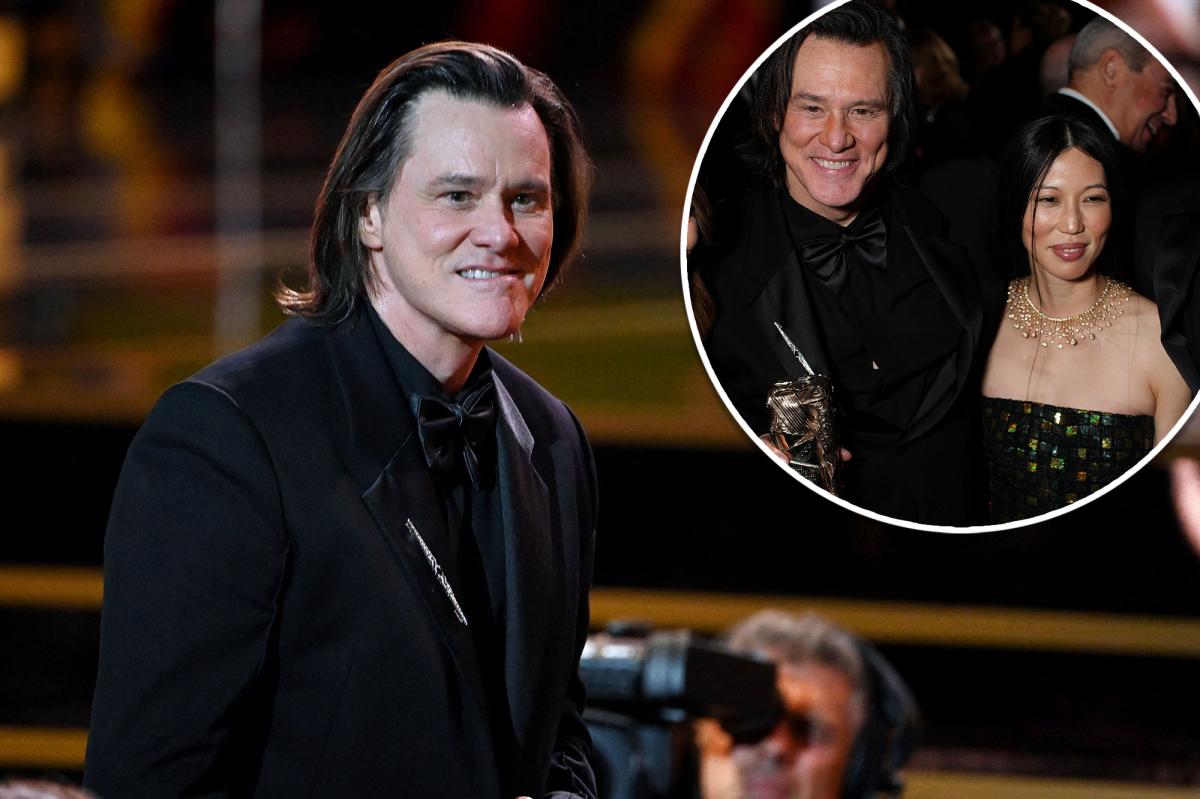
Jim Carrey Just Went From Private Romance to Surprise Marriage in Seven Months
The famously mercurial star quietly married Min Ah in Los Angeles after introducing her to the world at the César Awards — with his daughter and grandson in the front row of the love story.
Jim Carrey has always understood the value of a dramatic entrance. He built a career out of spring-loaded eyebrows, rubber-faced reactions and emotional whiplash delivered at full volume. But when it came to his latest romantic plot twist, the actor chose the opposite approach: no splashy engagement reveal, no glossy magazine spread, no social-media countdown. Just a private Los Angeles ceremony and a marriage announcement that arrived like a very elegant jump scare.
Carrey recently married his longtime girlfriend, Min Ah, in a small private ceremony in Los Angeles, according to TMZ, as reported by Page Six. The wedding comes only seven months after the couple made their public debut at the César Awards in Paris, where Carrey accepted an honorary César for his career.
That is a remarkably efficient celebrity relationship timeline: years of keeping things mostly out of frame, one high-glamour European red carpet, one deeply affectionate acceptance speech, and then — surprise — vows.
The soft launch was anything but casual
Carrey and Min Ah first sparked public interest in February, when she sat beside his daughter, Jane, and grandson, Jackson, at the César Awards. The family seating arrangement had the unmistakable energy of a relationship that had already moved well beyond the “mysterious person standing three feet behind me” stage.
Carrey, 64, accepted his honorary award in French and used the speech to thank his family before turning his attention to Min Ah. “Thank you to my wonderful family, my daughter Jane, and my grandson Jackson. I love you now and forever. Thank you to my sublime companion, Min Ah. I love you, Min Ah,” he said.
“Sublime companion” is not exactly a throwaway phrase. It sounds like something written in a velvet-lined notebook and read aloud beneath a chandelier. For a man whose public image has often been defined by comic excess, the moment was notably tender — and very deliberate. Carrey did not simply thank a date. He gave Min Ah a starring role in one of the biggest public moments of his recent life.
Jane, 38, is Carrey’s daughter with his first wife, Melissa Womer. Her presence alongside Min Ah and Jackson made the Paris appearance feel less like a standard celebrity plus-one situation and more like an introduction to the family ecosystem.
From Largo to Los Angeles vows
The relationship itself appears to have been developing quietly for years. Carrey and Min Ah were first photographed together in February 2022 after leaving a charity comedy show hosted by Judd Apatow at Largo in Los Angeles, according to People.
That sighting now reads differently. At the time, it was the familiar celebrity mystery: two people leaving an intimate industry-adjacent event, possibly together, possibly merely walking in the same direction while photographers did what photographers do. Four years later, the low-key exit has been retroactively upgraded into the opening scene of a marriage.
It is also a reminder that celebrity couples do not have to perform every stage of a relationship in real time. Carrey and Min Ah appear to have skipped the exhausting public itinerary of constant restaurant photos, matching vacation posts and strategically blurry Instagram Stories. Instead, the first major public chapter happened at an awards ceremony in Paris, with family nearby and Carrey speaking about her in language that made the relationship impossible to dismiss as casual.
Then came the wedding, reportedly in Los Angeles and kept private. No elaborate celebrity spectacle is attached to the ceremony in the report, which feels on-brand for a couple that spent years keeping their connection largely away from the spotlight.
Carrey’s romantic history has its own cinematic universe
This is Carrey’s third marriage. He married Womer, a former actress and Comedy Store waitress, in 1987. They divorced in 1995, after welcoming Jane. In 1996, he married his Dumb and Dumber co-star Lauren Holly; that marriage lasted less than a year and ended in 1997.
Carrey later had one of Hollywood’s most visible celebrity relationships with model and actress Jenny McCarthy. They dated from 2005 to 2010, a period that made them a familiar fixture on red carpets and entertainment covers. He was also linked to his Kidding co-star Ginger Gonzaga after the pair made their red-carpet debut at the Showtime Golden Globes Nominees Celebration in January 2019. They split later that year.
Against that backdrop, the Min Ah relationship has been unusually quiet. There has been no long-running tabloid theater, no public breakup cycle and no heavily managed couple-brand campaign. Even the public debut arrived only when the setting — an honorary award in Paris — made it feel natural.
That restraint makes the marriage announcement more surprising, but it also gives it a certain romantic logic. Some celebrity relationships are built for the camera. Others merely happen to be photographed by one.
The internet was already watching Carrey’s latest era
The César Awards appearance generated a separate wave of online chatter when social-media users speculated about changes in Carrey’s appearance and even questioned whether he had undergone plastic surgery. The conversation became strange enough that his representative, Marleah Leslie, pushed back on claims that a “clone” or impersonator had appeared at the ceremony.
“Jim Carrey attended the César Awards, where he accepted his Honorary César Award,” Leslie told Page Six on March 2.
It was an odd bit of internet noise to attach to an otherwise affectionate night: Carrey receiving one of France’s major film honors, thanking his family in French, publicly praising Min Ah — and the internet deciding to investigate his face like it had been assigned a cold case.
But that is the modern celebrity experience in miniature. A private man steps into public view for one meaningful occasion, and the audience immediately starts analyzing the romance, the styling, the family seating chart and the contours of his forehead. Carrey and Min Ah managed to keep a relationship private for years, only to make their debut at an event where every glance was guaranteed to be dissected.
Now they have taken the most consequential step of all, still without turning the relationship into a content franchise. A wedding after a long quiet courtship, a family-centered public debut and a husband who called his partner “sublime”: it is not the loudest love story in Hollywood. It may be the one with the best timing.

Bethenny Frankel’s Ex-Husband Update Is the Least Friendly “We’re Fine” in New York
Years after a two-year marriage became a decade-long legal saga, the RHONY alum says she and Jason Hoppy “both exist on this earth” — which is not exactly a Hallmark card.
Bethenny Frankel has offered the kind of co-parenting update that makes “we’re on good terms” sound like an ambitious fantasy.
Appearing on the September 29 episode of Benny Blanco’s Friends Keep Secrets podcast, the Real Housewives of New York City alum gave a status report on her relationship with ex-husband Jason Hoppy. Her answer was less “we’ve found peace” and more “the ceasefire is holding, technically.”
“Not exactly” friendly, Frankel said when asked where the two stand now. Then came the line destined to live forever in the museum of brutally minimalist celebrity diplomacy: “We do both exist on this earth, so that’s positive.”
It is bleak, funny and extremely Bethenny — a sentence that manages to acknowledge another person’s existence while declining to make any claims about emotional warmth, holiday-card exchanges or spontaneous brunches.
A Two-Year Marriage, a Ten-Year War
Frankel, 55, and Hoppy, 56, married in 2010 and split in 2012. What followed was not a tidy reality-TV breakup where the exes trade a few pointed confessionals, unfollow each other and move on to separate branded margarita empires.
Their divorce became a prolonged and bitter legal battle, including a custody fight over their daughter, Bryn. The pair reached a custody agreement in 2014, but their divorce was not finalized until 2021 — nearly a decade after the marriage itself ended.
Frankel described the experience on the podcast as “torture” and “traumatic,” calling the proceedings anything but a routine split. “Ten years on a two-year marriage,” she said, capturing the strange math of a relationship that ended quickly on paper but continued to occupy an enormous amount of legal and emotional real estate.
That timeline is what gives her latest update its particular charge. This is not an ex-couple still working through the ordinary awkwardness of shared friend groups or one unfortunate vacation photo. This is a former marriage whose afterlife lasted dramatically longer than the marriage, with custody and conflict keeping the connection active long after romance disappeared.
“We Both Exist” Is the New Co-Parenting Chic
Frankel’s language is striking because it refuses the polished celebrity vocabulary usually deployed around exes. There is no “we’re in a great place,” no “we’re better as friends,” no cheerful suggestion that the pain has been transformed into a beautiful blended-family journey.
Instead, there is existence. Earth. Positive, apparently.
It sounds like a joke, but it also reflects the reality of a relationship that has been difficult for years. Not every former couple gets a redemption arc. Sometimes the mature outcome is not friendship; it is distance, boundaries and a shared understanding that the person will remain in your orbit because your child is there.
Frankel said the past year has been “strained” and “challenging,” without offering a glossy explanation or pretending that time has automatically made everything comfortable. That may be the most revealing part of the update. Celebrity culture loves the idea that enough healing, therapy, matching family pajamas and a well-lit podcast appearance can turn any ugly chapter into a lesson. Frankel is offering something messier: a relationship that remains unresolved in feeling while still functioning in reality.
The Custody Battle That Still Defines the Story
Frankel called the custody battle the “horrible, horrendous, worst of my life,” but said it was worth enduring because of her bond with Bryn, now 16. She spoke warmly about the moments when they watch something together, laugh and connect, describing her daughter as her best friend.
Then she added the bittersweet complication: they are now on “different paths” and their relationship can feel “almost like a roommate in a way.”
That is another very un-branded description of motherhood. It is affectionate without being sentimental, intimate without pretending that a teenager and her mother occupy the same emotional zip code. Frankel compared them to “Thelma and Louise,” while acknowledging that they are in “totally different chapters” and respect each other’s chapters.
The juxtaposition matters. Frankel can describe her connection with Bryn as loving and deeply meaningful while also admitting that parenting a 16-year-old is not a permanent sleepover with your favorite person. The dynamic is changing, and she is naming that change instead of forcing it into a tidy “my mini-me” narrative.
A New Romance, an Old Shadow
The timing adds one more layer to the conversation: Frankel recently hard launched a new boyfriend on Instagram. The podcast appearance therefore lands at an interesting moment in her public life, with a new relationship entering the frame while the old one remains emotionally and legally significant.
That does not mean the two events are connected, and Frankel did not present them that way. But celebrity relationships rarely arrive in a vacuum. A new romance can make an old chapter look finished from the outside, even when the practical and emotional threads are still there — especially when a child, a custody history and years of legal conflict remain part of the story.
Frankel’s update is not a reconciliation tease. It is not a secret-friendship reveal or a sudden “we’ve both grown so much” announcement. It is closer to an anti-fairytale: the marriage ended, the divorce eventually ended, the parenting relationship continues, and the exes are still not exactly friendly.
For anyone expecting a grand peace treaty, “we do both exist on this earth” is admittedly a low bar. But after a decade-long divorce saga, low-drama logistics may be the closest thing to luxury. Bethenny Frankel is not selling closure. She is reporting the weather from a very specific emotional climate: cloudy, strained, occasionally survivable, with no chance of a matching Christmas card.

Ashley Tisdale Says Postpartum Depression Made Her Want to Divorce Christopher French
The former High School Musical star opened up about the year her marriage felt impossible—and why French’s calm became a lifeline instead of a plot twist.
Ashley Tisdale is giving the phrase “new-parent fog” a much more honest meaning. On her husband Christopher French’s Recovering podcast, the former High School Musical star revealed that postpartum depression after the birth of their first daughter put such intense pressure on their marriage that she tried to divorce French “so many times.”
It is a startling sentence, especially from a couple who have spent more than a decade presenting a relatively low-drama version of celebrity marriage. Tisdale and French married in 2014, welcomed daughter Jupiter in 2020 and now also share a younger daughter, Emerson. But the story she told on the Sept. 30 episode was not about a relationship collapsing under fame. It was about a mother experiencing a hormonal and psychological crisis she did not yet have language for—and a husband watching the person he loved become unreachable.
“You dealt with a lot of that and we had difficulty during that first year,” Tisdale told French. “I tried to divorce you so many times. But you’re so grounded and calm and knew to just let it blow over.”
The part nobody had properly named
Tisdale said she believed she was prepared for motherhood because she had already worked through anxiety and felt equipped to handle the emotional demands of having a child. Then postpartum depression arrived and made all her carefully collected coping tools feel useless.
“I was so proud of myself for dealing with the anxiety stuff and being like, ‘OK, now I am ready to have a child because I feel like I’m equipped emotionally to be able to do that,’” she said. “But then I got hit with postpartum depression which is really hormonal and all the tools that I learned and knew to use, you can’t use.”
That distinction matters. Anxiety had given Tisdale a familiar set of warning signs and strategies. Postpartum depression, as she described it, changed the entire operating system. She recalled becoming overwhelmed in ordinary situations, including nearly having a panic attack while sitting in traffic. The symptoms were intense, but she said no one diagnosed her at the time.
The diagnosis eventually came from her doctor after the symptoms began to clear around Jupiter’s second birthday. Tisdale remembered the moment with a mix of relief and disbelief: “I remember feeling so much better when the two-year birthday came and she was like, ‘Oh, you had postpartum depression.’ I was like, ‘What? How did you not know to tell me this?’”
There is an especially cruel timing to that realization. By the time she had a name for what had happened, she was already emerging from it. The experience had been real for years, but the explanation arrived late, like a label mailed after the package had already been opened.
French saw the mood shifts up close
French’s account made the story even more intimate. He remembered Tisdale being loving and happy with their newborn one moment, then experiencing what he described as an abrupt, total mood change minutes later.
“Everything had changed,” he recalled. He described watching her lie on the floor and cry in pain, while he felt helpless to fix what was happening. His role became less about solving the problem and more about making the stressful mechanics of life with a newborn slightly easier so Tisdale could get through the crisis.
That is not the glamorous version of a celebrity marriage, and thank God for that. There is no polished anniversary caption here, no carefully arranged couple photo pretending parenthood is just matching pajamas and a well-lit nursery. There is a partner admitting that he could not make the depression disappear, and a woman acknowledging that her own mind had made the marriage feel like an emergency exit.
Tisdale’s comments also make clear that the divorce talk was part of the illness and the strain surrounding it—not a report that the couple is currently separating. French’s calm, in her telling, helped keep those moments from becoming permanent decisions. Neither partner framed the period as easy, but both described it as something they lived through together.
The second time came with a different script
Tisdale said her postpartum experience after welcoming her second child was not as severe. “It’s pretty cool doing it again and not having that experience,” she said, calling the first episode the hardest part of becoming a mother.
That contrast is quietly huge. The arrival of another baby did not simply repeat the first chapter. Tisdale knew more about what she had experienced, had a clearer history to bring to her doctors and family, and was no longer encountering the same symptoms as a nameless personal failure. The second time did not erase what happened after Jupiter, but it gave her a different vantage point on it.
For a public figure whose early career was built on bright, tightly choreographed teen fantasy, Tisdale has become increasingly candid about the unchoreographed parts of adulthood. She has spoken publicly about anxiety before, but this conversation lands differently because it places mental health inside the architecture of a marriage and a family. The headline is the divorce confession. The substance is the delayed diagnosis, the panic, the confusion and the way postpartum depression can make someone feel estranged from the life they thought they wanted.
It also complicates the internet’s favorite relationship shorthand. A marriage can be loving and still be under enormous pressure. A partner can be supportive and still be unable to rescue someone from a medical condition. A mother can adore her child and still feel lost after giving birth. None of those truths cancel the others out.
Tisdale and French’s story is compelling because it refuses the tidy version. There was a baby, a marriage, a mental-health crisis and a long stretch before anyone named it. There were moments when Tisdale wanted out, moments when French could only stay steady, and eventually a clearer understanding of what had been happening.
Celebrity culture usually turns marriage trouble into spectacle: suspicious unfollows, courthouse sightings, a breakup statement with the emotional temperature of a corporate memo. Tisdale offered something messier and more useful. Sometimes the dramatic sentence is not “we’re over.” Sometimes it is “I tried to divorce you because I was sick, and you waited for me to find my way back.”