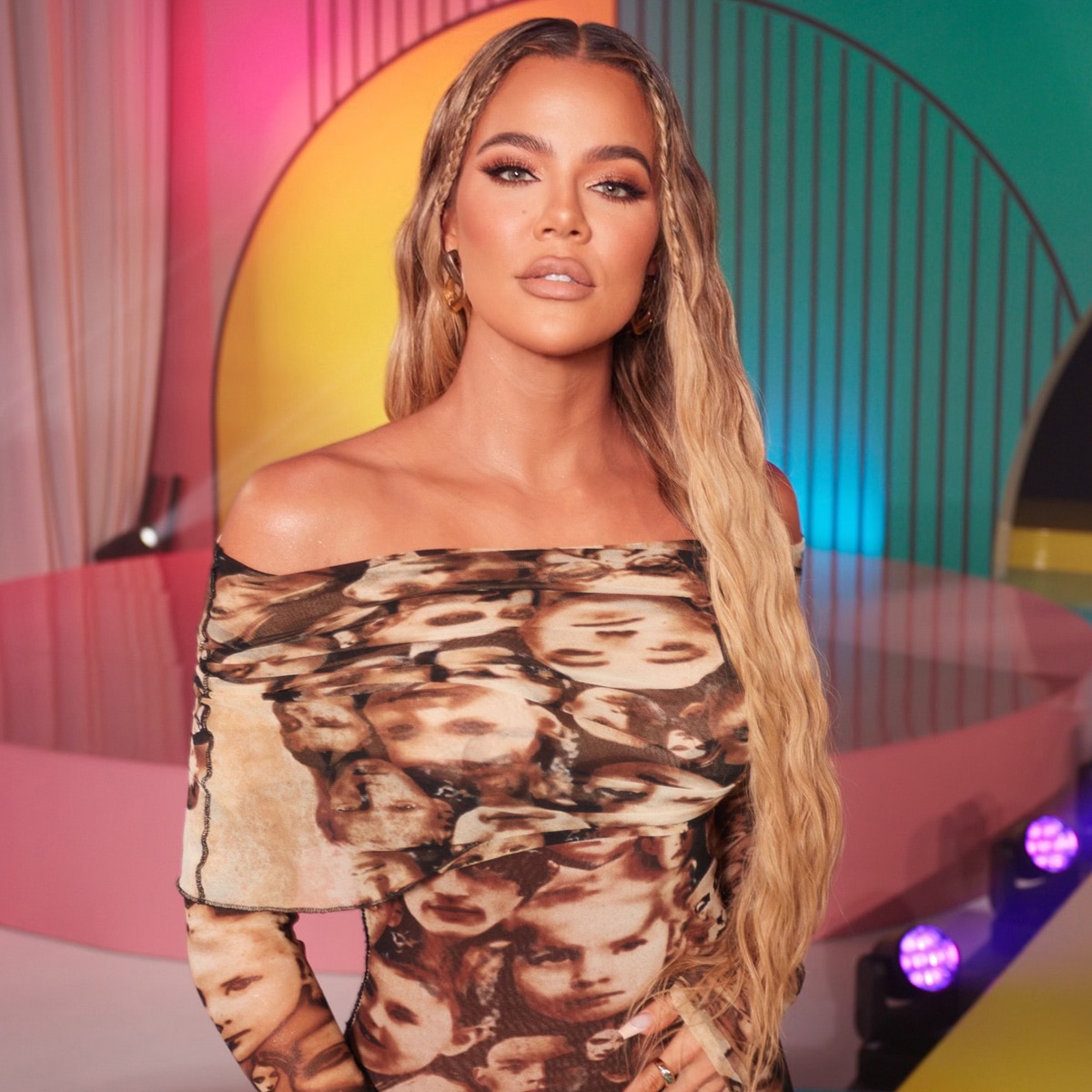
Khloé Kardashian Has a New Dating Label—and It Explains Why She’s Not Looking for Random Chemistry
On her podcast, Khloé Kardashian recognized herself in the definition of demisexuality, then delivered a very Khloé take on romance: she misses being kissed, not being lied to.
Khloé Kardashian may have just found the word for the way she has been moving through romance lately—and, naturally, it arrived during a conversation with a longtime friend, on a podcast, with just enough emotional honesty to make the whole thing feel less like a label and more like a light switching on.
During a Nov. 18 episode of Khloé in Wonder Land, Simon Huck suggested that Kardashian could be demisexual. The term describes someone who experiences romantic or intimate attraction after forming an emotional bond, rather than feeling drawn to someone on the basis of immediate chemistry alone. Huck explained that this can make the classic one-night stand especially unlikely. Kardashian’s response was not a polished declaration or a carefully packaged identity statement. It was more of a delighted double take.
“I don’t think I’ve ever had a one-night stand. I would remember,” she said. “I’m a demi? Wow.”
And there it is: Khloé, 42, discovering a possible explanation for her own romantic wiring in real time. Not because she has suddenly entered a new era of dating, but because she is currently doing almost the opposite. The Good American founder said she is not in the right “headspace” to lean into someone romantically. She has been through enough, she explained, to be wary of repeating the emotional patterns of her past.
She does not miss chaos. She misses the soft stuff.
The most revealing part of the conversation was not the label. It was the distinction Kardashian made between wanting sex and wanting tenderness.
“I just want to be kissed sometimes,” she confessed. “But not necessarily, ‘I just need to have sex.’ Sometimes I just miss a normal nice hug—but from someone you want that hug from.”
That is a very different kind of single-girl statement from the usual celebrity script. There is no performance of being totally unbothered, no insistence that romance is beneath her, no dramatic announcement that she is entering her villain era and deleting every man from her phone. Kardashian is saying something much more recognizable: she can miss intimacy without wanting to invite an entire relationship into her life.
It is the emotional equivalent of wanting dessert without ordering the tasting menu. A kiss, a hug, a person who feels safe enough to soften around—yes. The risk, confusion and potential group project of modern dating? She is still considering the terms.
That hesitation makes sense in the context Kardashian has publicly shared about her love life since her split from Tristan Thompson in 2021. The former couple, who share daughter True and son Tatum, have continued to co-parent, but Kardashian has repeatedly pushed back on the idea that they are romantically reunited. In May 2023, she called the ongoing speculation “tiring.”
She has also said she has been celibate for years following the breakup. In comments to Elle in 2025, Kardashian described feeling embarrassed that celibacy had become her truth, before reframing it as something “special.” That evolution matters. At first, the absence of a romantic life sounded to her like something she needed to explain. Now it sounds more like a boundary she has chosen to protect.
The Kardashian dating philosophy: give her the rules
Then came the part that will likely make every woman who has ever been told a man is “committed” while watching him behave like a freelance agent sit up a little straighter.
Kardashian and Huck discussed open relationships, including whether demisexuality might make one more complicated. She was not sure she would want an open relationship, but she did appreciate the idea of being involved in the decision-making.
“Just give us rules,” she said. “I don’t appreciate that every guy is like, ‘Oh, I’m committed. This is what we’re doing,’ and then they go and cheat. So many girls would be OK with these rules. What I’m not OK with is the lying. Let me decide.”
It is an extremely Kardashian position: romance can be unconventional, complicated and even highly negotiated, but nobody gets to quietly rewrite the agreement while she is standing inside it. The issue is not necessarily the existence of rules. It is the unilateral editing of them.
That line also explains why the demisexual conversation lands differently for Kardashian than it might for someone simply taking a break from dating. She is not describing attraction as something that arrives on command, or a relationship as a prize for being sufficiently healed. She is describing a need for emotional context before intimacy feels meaningful. The bond comes first. The access comes later.
Dating with kids changes the entire casting process
Kardashian has been candid that becoming a mother made the possibility of dating again feel less casual. She told Elle that she had never dated with children before and that bringing a new man into her life was a serious factor. She also said she began therapy to better understand herself, particularly in her romantic life.
That is not exactly a soft launch. It is a full risk assessment.
For Kardashian, the question is no longer only whether she likes someone or whether the chemistry is there. It is whether that person can exist responsibly within the life she has already built. A new relationship would not be a private experiment conducted in an empty apartment. It would touch her children, her family, her schedule and the public ecosystem that has followed her relationships for years.
Which may be why the idea of demisexuality feels like such a useful discovery for her. It gives language to the fact that she is not interested in speed dating her way into a new chapter. She needs time. She needs trust. She needs a person to become emotionally real before physical intimacy becomes the main event.
And while she is not currently “leaning into someone,” she is not pretending she has transcended desire either. Kardashian still wants affection. She still wants the kind of hug that means something because of who is giving it. She just appears to have lost interest in confusing access with connection.
That is the real update from Khloé Kardashian’s romantic life: not a new boyfriend, not a suspicious dinner, not a social-media soft launch. A new piece of vocabulary for an old instinct—and a reminder that being single does not mean being numb. Sometimes it means knowing exactly what kind of closeness you miss, and being unwilling to accept a cheaper version.
Hailey Bieber Just Turned Carolyn Bessette Kennedy’s Most Iconic Outfit Into Boardroom Bait
At the DealBook Summit, the Rhode founder wore a near-perfect echo of CBK’s 1998 Yohji Yamamoto look — and made the case for fashion’s most powerful kind of déjà vu.
Hailey Bieber arrived at the New York Times DealBook Summit dressed like she had a beauty empire to discuss and a Kennedy family photo album to quietly haunt.
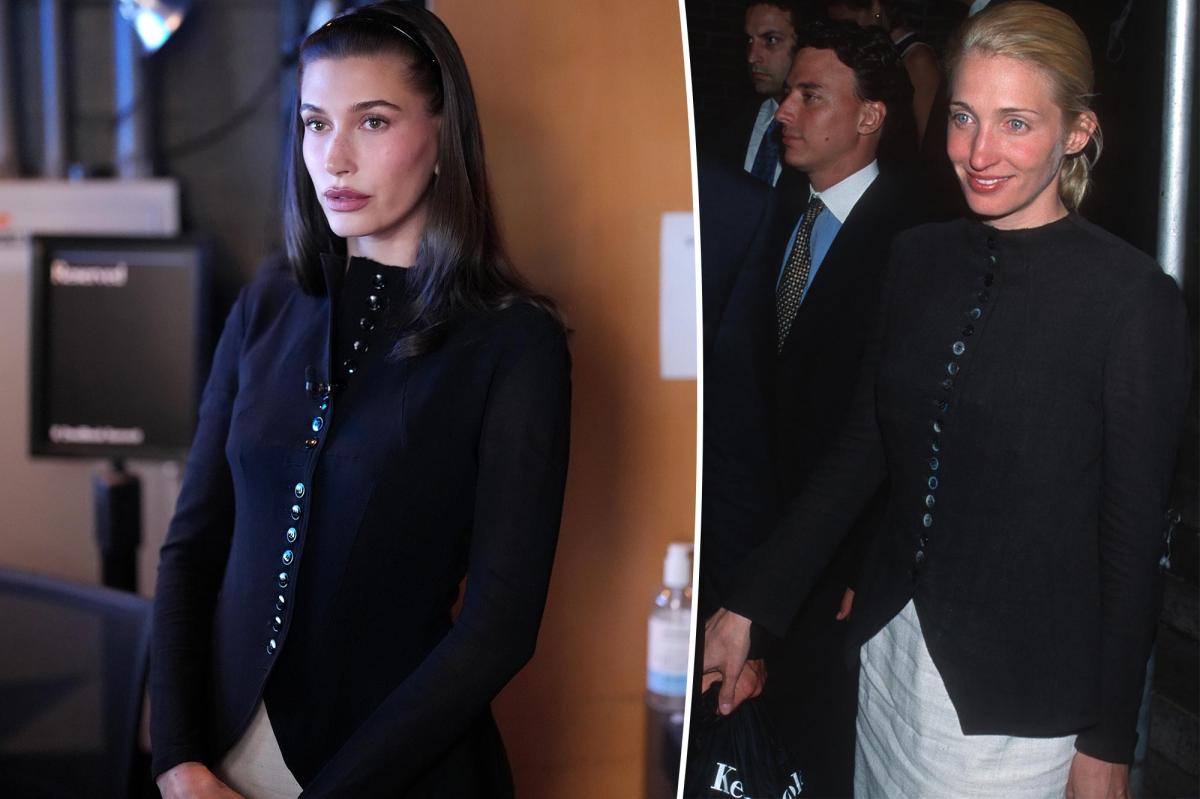
The Rhode founder, 29, appeared onstage Wednesday in a collarless black Yohji Yamamoto button-up jacket, a cream-colored midi skirt, black pumps and a slim headband that gave the whole thing a distinctly Carolyn Bessette Kennedy flavor. It was not a vague “old-money” mood board situation. The look referenced one of Bessette Kennedy’s most memorable outfits almost piece for piece: the same Yohji jacket-and-skirt combination she wore to a Robin Hood Foundation benefit in New York in June 1998.
That is a very specific fashion ancestor to summon at a business conference, but Hailey has been making a habit of it. Her current style era is less “new outfit” and more “what if the most photographed woman in ’90s New York had a skincare line?”
The look was giving CBK, but make it DealBook
Bessette Kennedy wore the original Yohji set with her blond hair pulled into a sleek ponytail and pointed beige pumps. Hailey left her hair down, added the headband and swapped in black shoes, making the silhouette feel less archival museum piece and more polished founder who has three panels, two flights and a product launch before dinner.
It was also a smart fit for the room. Hailey was at DealBook to discuss her billion-dollar beauty company, so the outfit landed somewhere between fashion history and executive uniform. The jacket was severe without being stiff; the skirt softened it just enough; the overall effect said “quiet luxury” before that phrase became a content category with its own affiliate links.
And then there was Justin Bieber, supporting his wife from the audience in a leather jacket, baggy green button-up shirt, loose black pants and red Skylrk sunglasses. His outfit was not exactly a matching John F. Kennedy Jr. tribute, which may have been for the best. Hailey was channeling the controlled elegance of CBK; Justin looked like he had wandered in from a particularly relaxed airport terminal. Together, they offered a very modern celebrity-couple tableau: one person dressed for the boardroom, the other dressed for wherever the boardroom’s after-party might be.
Hailey’s CBK fixation has become a full fashion language
This was not Hailey’s first trip into Bessette Kennedy’s closet, at least spiritually. In September, she wore a dress adapted from the nude illusion gown Bessette Kennedy wore to her 1996 wedding rehearsal dinner. The look was created by Narciso Rodriguez for Cerruti, and Hailey’s appearance immediately joined the growing conversation around her interest in the late style icon’s wardrobe.
Then, on Tuesday night, Hailey accepted the Brand of the Year award at the WWD Beauty Inc. Awards in a black-and-white Calvin Klein Collection look from the brand’s latest runway collection. Given Bessette Kennedy’s decade-long connection to Calvin Klein, that choice felt like another deliberate nod to the same fashion mythology.
Before Calvin Klein became shorthand for minimalist ’90s glamour, Bessette Kennedy worked there from 1988 to 1996. She was a close personal friend of Klein’s, as well as an employee, confidant and muse. That history gives Hailey’s recent outfits a little more texture than simple celebrity vintage hunting. She is not only borrowing the visual language of Bessette Kennedy; she is repeatedly circling the designers and references that built it.
Earlier this year, Hailey also attended the Time100 Gala in a lacy Calvin Klein look based on one worn by Klein’s ex-wife, Kelly, in the ’90s. The pattern is hard to miss: Narciso Rodriguez, Calvin Klein, Yohji Yamamoto, clean lines, restrained color and the kind of styling that looks effortless only after someone has made several extremely specific decisions.
The original jacket had its own celebrity plot twist
There is an especially good subplot to the Yohji set. The original jacket-and-skirt combination was included in an auction of Bessette Kennedy’s most memorable clothing earlier this year. It was estimated to sell for between $2,000 and $3,000, but ultimately went for $12,500.
Hailey’s representative told Vogue that her version did not come from Bessette Kennedy’s closet, which means the magic here is in the reference rather than the provenance. The outfit does not need to have belonged to CBK to activate the association. In 2026, the silhouette itself is practically a celebrity cameo.
The auction also produced its own little fashion-world mystery. Page Six Style reported that a museum, rather than Kim Kardashian as some had speculated, paid $192,000 for Bessette Kennedy’s Prada coat. Even decades after her death, her clothes continue to generate the kind of attention usually reserved for current celebrity breakups, surprise pregnancies and chaotic Instagram unfollows.
That is the unusual power of Bessette Kennedy’s image. She remains one of the rare style figures whose influence is not tied to a single brand, trend or viral moment. Her wardrobe is still being studied because it offered a fantasy of control: simple clothes, exact proportions, no visible effort and absolutely no interest in explaining the outfit.
Hailey’s version is naturally more public-facing. She is building a beauty company, attending industry awards, appearing at a major business summit and moving through a world where every collar, hemline and headband can become part of the conversation. But that is why the CBK reference works. It gives the modern founder uniform a little mystery — or at least the appearance of it.
Hailey Bieber may be selling lip treatments, but lately she has also been selling the dream of a perfectly edited archive. Her message, delivered in Yohji, Narciso Rodriguez and Calvin Klein, is clear: the future of celebrity style may be digital, but the mood board is still very much from 1998.
Taylor Swift Walked Into the CMAs and Turned the Red Carpet Into a Pop-Country Power Move
The 60th annual CMA Awards had country royalty, reality-TV chaos and one extremely loud fashion headline: Taylor Swift.
The country music red carpet has always had its own weather system. There is the rhinestone pressure, the big-hair humidity, the occasional reality-TV storm front and, every so often, a pop megastar who changes the entire forecast simply by showing up.
At the 60th annual CMA Awards, that megastar was Taylor Swift.
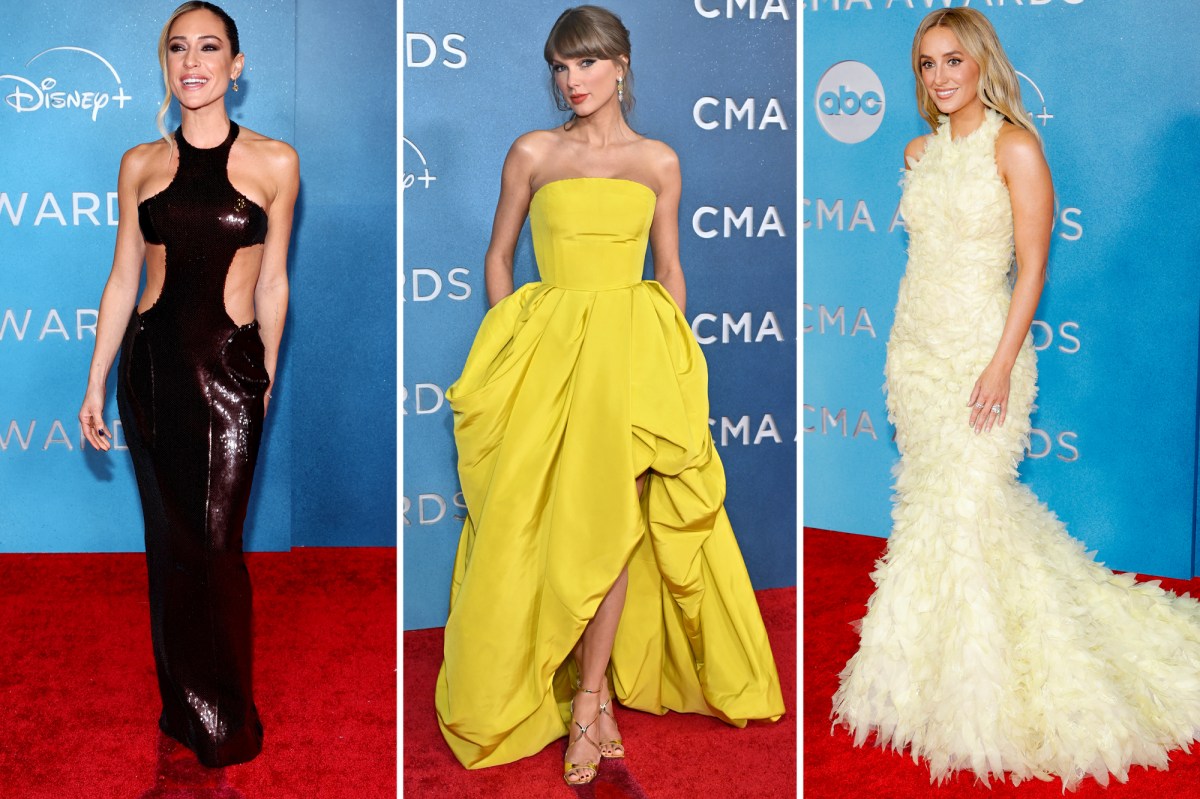
Page Six’s red-carpet gallery puts Swift at the top of the marquee, with four separate images devoted to her before the carousel moves through Lainey Wilson, Tucker Wetmore, The Red Clay Strays and a parade of country stars, television personalities and familiar Nashville faces. No, this is not a subtle placement. The gallery is effectively saying: country music’s biggest night had its own headliner, and then Taylor arrived to make the entrance feel like an event inside the event.
The Taylor effect has officially entered its country era
Swift appearing at the CMAs is the kind of celebrity collision that makes people sit up even when nobody is pretending it came out of nowhere. Her relationship with country music is part of her origin story, not a random genre detour. Before the stadiums, the record-breaking tours and the global pop machinery, there was a teenage Taylor with a guitar and a Nashville dream. Her early career was built in the country ecosystem, even as her sound gradually expanded beyond its borders.
That history gives a CMA appearance a different charge than a standard awards-show walk. Swift is not merely visiting another celebrity’s party. She is returning to a room that helped establish the first version of her public identity — now as one of the most famous people on the planet.
That is the deliciously strange part of celebrity chronology: the same person can be both the hometown girl and the global spectacle. At the CMAs, Swift brings the scale of the latter while carrying the mythology of the former. The red carpet gets a little more electric because everyone knows there is a before and after to her story.
The gallery reflects that imbalance. Lainey Wilson, one of country’s biggest modern stars, is listed alongside Swift, as are Tucker Wetmore and The Red Clay Strays. But Swift receives four entries before the rest of the carpet gets its turn. In celebrity language, that is not just attendance. That is editorial gravity.
Country glam, reality-TV crossover and a very Nashville guest list
The fun of this carpet is that it does not stay neatly inside the country-music family tree. Alongside performers and musicians are Kristin Cavallari, Lisa Barlow, Madison LeCroy and Salley Carson — names that bring reality-TV recognition into an awards-night environment traditionally associated with Nashville polish.
That mix matters because red carpets are no longer just about identifying who is nominated. They are social maps. They show which worlds are touching, which audiences are being invited in and which celebrities understand that a photo opportunity can travel much farther than an awards telecast.
Cavallari arrives with the long-running visibility of a reality-TV veteran who knows how to make an event feel bigger simply by being photographed at it. Barlow brings the Bravo effect, where even a formal carpet can carry the possibility of a confessional, a feud or a group-chat postmortem. LeCroy and Carson add another layer of reality-TV familiarity to a lineup that already has plenty of built-in name recognition.
None of this means the CMA carpet has abandoned country music. Quite the opposite. It means country’s celebrity ecosystem is now broad enough to include the people who orbit the music, the people who amplify it and the people who can turn an outfit gallery into a conversation well beyond Nashville.
That is why the lineup feels more interesting than a simple parade of nominees. Will Bundy and Lauren Watkins appear together in the gallery, while the list also includes MacKenzie Porter, Willow Avalon, Jessi Alexander, Harper Grace, Danielle Parton, Conner Smith and Karley Scott Collins. The carpet is doing what red carpets do best: compressing several different versions of fame into one very glossy hallway.
The real red-carpet headline is the pecking order
There is a temptation to treat awards-show fashion as a sequence of isolated outfits: star arrives, camera flashes, next star arrives. But the more revealing story is often the order of attention. Who gets the opening frame? Who is photographed repeatedly? Who is used to define the mood of the night?
Here, Swift is the unmistakable opening statement. Wilson is the country anchor. The rest of the gallery expands outward from there, moving through rising performers, established names, reality personalities and social-friendly faces. It is a useful snapshot of how modern fame works: prestige, nostalgia, crossover appeal and algorithmic recognizability all sharing the same carpet.
Swift’s four-image presence also captures something specific about her current celebrity language. She does not need a dramatic announcement to make an appearance feel significant. A carpet moment can do the work. The mere fact of being photographed at a particular event becomes its own little chapter, especially when the event connects to a formative part of her career.
That is the part fans will likely linger over: not only what Swift wore, but what the appearance says about the rooms she can still command. She can walk into the CMAs as a former country newcomer, a current pop institution or both at once. Every version is recognizable, and every version makes the photo more loaded than a normal red-carpet snap.
The 2026 CMA carpet, then, is not just a fashion gallery. It is a hierarchy lesson with excellent lighting. Taylor Swift gets the opening burst of attention, Lainey Wilson supplies the country-star authority, and the reality-TV contingent ensures the guest list has enough crossover voltage to keep the night moving outside the broadcast.
That is how a red carpet becomes a social event instead of a queue: one giant pop return to her old neighborhood, a country crowd dressed for its biggest night and just enough Bravo-adjacent energy to make the photo dump feel like it could become a group chat argument by breakfast.