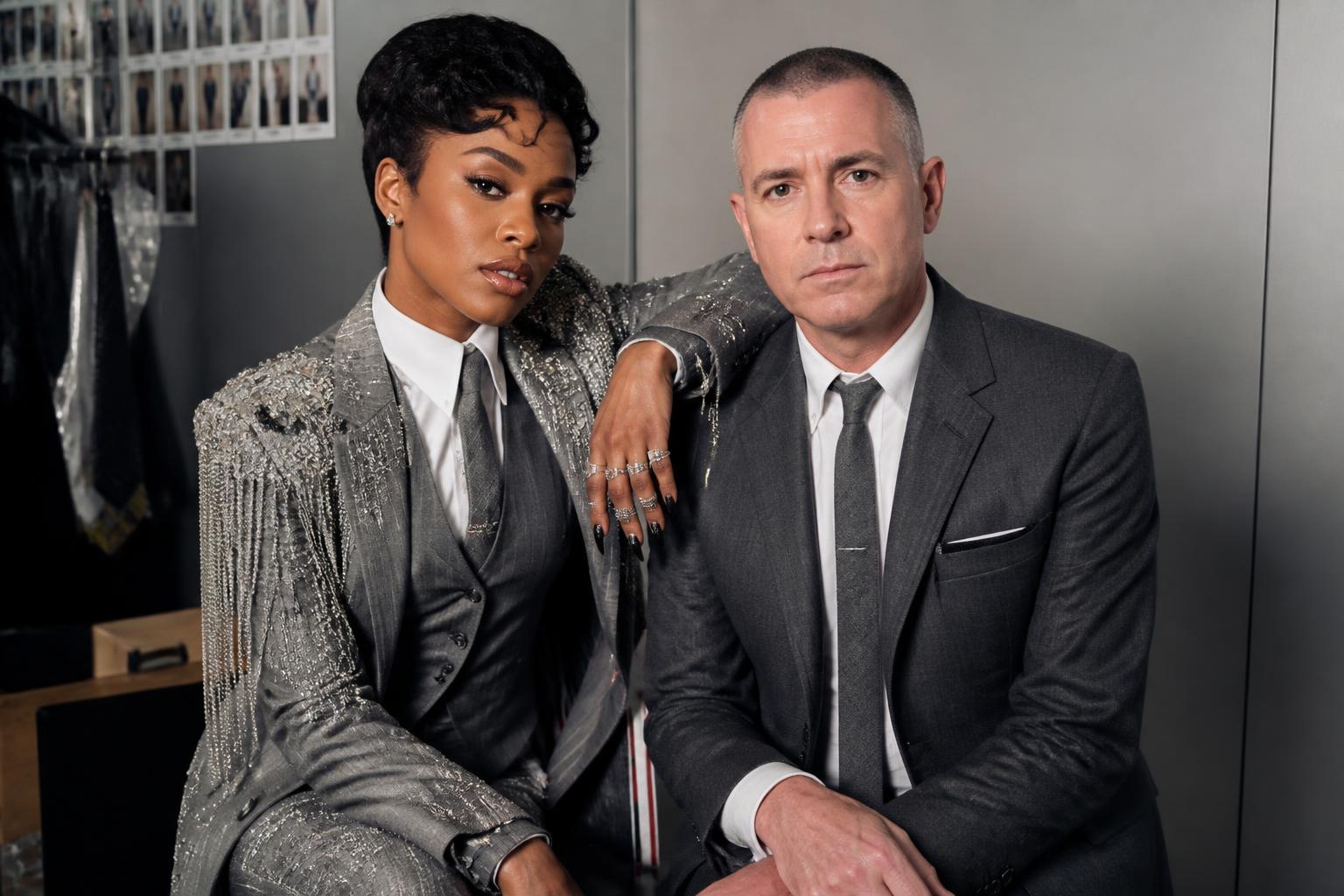
Teyana Taylor and Thom Browne Explain Their Unusual Bond
Teyana Taylor and Thom Browne are not presenting themselves as a standard celebrity-and-designer pairing. In the interview accompanying Taylor’s WWD Weekend September cover, the actress and the New York fashion visionary describe a connection built on shared instincts, even when their public personalities seem miles apart.
Page Six reports that Browne calls the two “weirdly similar,” while Taylor casts herself as his more outgoing counterpart. Her explanation goes beyond clothes: she says she has to value the person and imagination behind the work before she can truly embrace the design. That makes the partnership read less like red-carpet styling and more like genuine creative loyalty.
The cover image gives that bond an appropriately surreal backdrop. Taylor appears in a black-and-white beaded coat dress with sleeves so long they nearly reach the floor, while Browne sits beside her in one of his signature short suits. The visual contrast is pure Browne: disciplined tailoring, theatrical proportions and just enough absurdity to make the whole thing memorable.
This collaboration also has receipts. Taylor has worn Browne’s designs at major appearances including the 2023 Met Gala and this year’s SAG Actor Awards. For the latter, she chose a trompe-l’oeil “naked” dress assembled from 160 pattern pieces, with a sparkling skirt covered in hundreds of thousands of sequins and beads. She has also taken a front-row seat at several of Browne’s shows, including one that reportedly left her in tears.
The interesting part is not a secret romance hiding beneath the couture. It is the unusually personal language surrounding a professional alliance that has lasted for years. Taylor is treating Browne’s clothes as an extension of his personality, while Browne seems to recognize a fellow eccentric who can carry his most theatrical ideas into the spotlight. That is a much stronger fashion story than another celebrity simply naming a favorite label.

Carly Rae Jepsen Explains Her Split From Scooter Braun
Carly Rae Jepsen is no longer working with Scooter Braun, but the split apparently does not come with a side of pop-star warfare. E! News reports that Jepsen addressed the end of their professional relationship, while related coverage from Just Jared presents the parting as notably low-drama.
The available reporting describes Braun as Jepsen’s longtime manager and says the singer does not have bad blood with the music executive. Jepsen also reportedly did not view ending the arrangement as particularly outrageous, which is a decidedly calmer assessment than the usual celebrity-management breakup narrative.
That distinction matters. A management change can be a straightforward business decision rather than evidence of a feud, betrayal or career crisis—and the supplied coverage does not support those more explosive interpretations. It also does not provide a detailed account of the specific reason for the change, so anyone promising a full behind-the-scenes exposé is getting ahead of the facts.
For now, the cleanest read is that Jepsen and Braun have gone their separate professional ways without publicly turning the split into a spectacle. With E! News and Just Jared both carrying the development, the departure itself is well supported; the drama is mostly being supplied by the celebrity-breakup template, not by the details currently available.

Alba Rohrwacher’s New Drama Finds Trouble in Silence
Most movie couples fight on cue. They raise their voices, hurl the line that changes everything and eventually arrive at a finale that feels more contractually required than emotionally earned. A Common Story takes the more uncomfortable route: its central couple cannot quite say what is happening to them, and the silence becomes the real antagonist.
That restraint is the calling card of Anna Foglietta’s first feature behind the camera. The Italian actor-turned-director appears to understand the physical business of a scene—the hesitation, the failed attempt to speak, the look that replaces an explanation—in a way that gives the film its pulse. Variety’s Jay Weissberg praised the movie as a standout from Venice’s Orizzonti sidebar, with the drama built less around verbal combat than the spaces separating one sentence from the next.
Alba Rohrwacher and Guido Caprino play the couple at the center, and the review singles out both performances as exceptional. That matters because this kind of story can become dramatically airless if the actors do not make every pause legible. Here, the appeal is not watching two people deliver increasingly polished arguments; it is watching them fail to translate private feeling into language, even when the relationship appears to depend on it.
The premise also gives A Common Story a useful edge over the standard relationship tear-down. There is no promise of a grand cinematic showdown to tidy up the emotional mess. Instead, Foglietta treats miscommunication as an accumulation of small absences: what goes unsaid, what arrives too late and what each person may assume the other already understands.
That makes the film sound quieter than a conventional breakup drama, but not necessarily gentler. Silence can protect people from cruelty; it can also keep them trapped inside the same misunderstanding. Based on Variety’s review, A Common Story earns its impact by making that trap feel intimate rather than theatrical—a strong launch for Foglietta and a showcase for two actors working at full emotional precision.